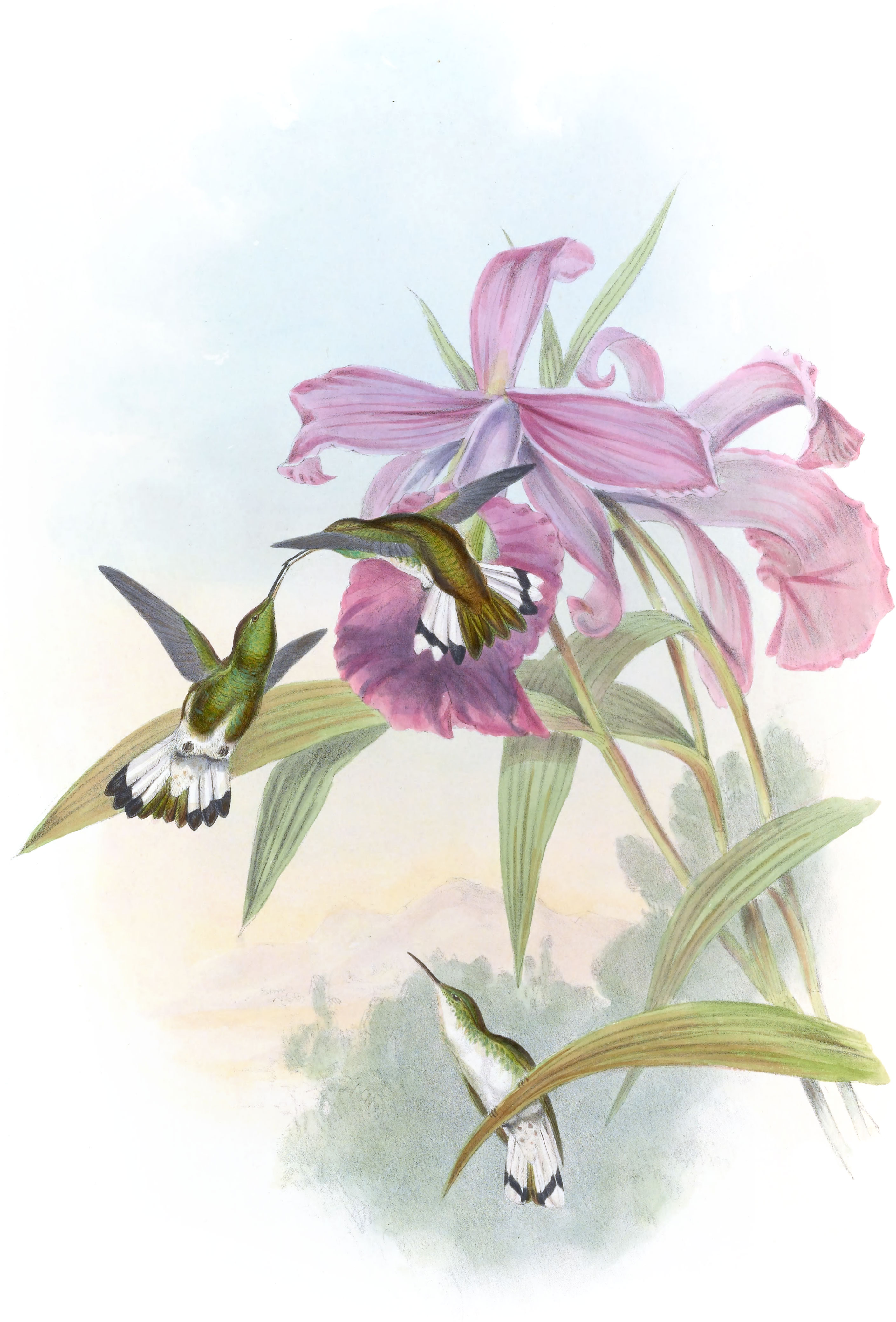
I have before had occasion to remark how different are the species inhabiting Mexico, or the country to the northward of the Isthmus of Panama, from those of the southern portions of the continent of South America, and the present species may be cited as a striking instance in point; for while it is of precisely the same form as its near allies, the well-known Thaumatias albirostris and T. brevirostris of Brazil, in colouring it is very different from both of those birds; in fact it may be said to differ from every other known species of Humming-Bird, from the great amount of white which pervades the under surface and the tail-feathers.
It is a native of the warmer parts of Chiriqui, near David, in the province of Veragua, at an altitude of from two to three thousand feet; and is another of the many interesting discoveries made by M. Warszewiez, who met with it in the locality above named, and from whence he transmitted the specimens figured in the accompanying Plate.
The male has the upper surface very dark grass-green; the central tail-feathers bronzy green; lateral tail-feathers white, largely tipped with black; throat pale shining green; flanks greenish; centre of the abdomen and under tail-coverts white; upper mandible black, base of the lower mandible fleshy white.
The upper surface of the female is the same as in the male, but somewhat paler; the lateral tail-feathers white, crossed by an oblique band, instead of being tipped with black; throat and under surface white.
The Plate represents a male and two females on the Sobralia macrantha, of the natural size.
 Thaumatias candidus
White-breasted Emerald
Thaumatias candidus
White-breasted Emerald
 Thaumatias chionopectus
Snowy-throated Emerald
Thaumatias chionopectus
Snowy-throated Emerald
 Thaumatias leucogaster
White-throated Emerald
Thaumatias leucogaster
White-throated Emerald
 Thaumatias viridiceps
Green-headed Emerald
Thaumatias viridiceps
Green-headed Emerald
 Thaumatias Milleri
Miller’s Emerald
Thaumatias Milleri
Miller’s Emerald
 Thaumatias nitidifrons
Brilliant-fronted Emerald
Thaumatias nitidifrons
Brilliant-fronted Emerald
 Thaumatias brevirostris
Short-billed Emerald
Thaumatias brevirostris
Short-billed Emerald
 Thaumatias affinis
Allied Emerald
Thaumatias affinis
Allied Emerald
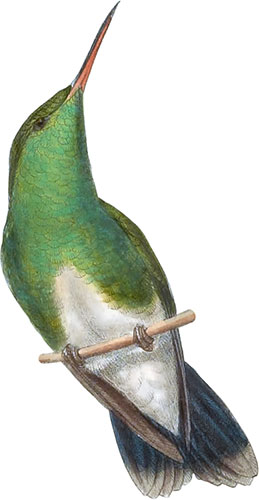 Thaumatias albiventris
White-bellied Emerald
Thaumatias albiventris
White-bellied Emerald
 Thaumatias Linnæi
Linnæus’ Emerald
Thaumatias Linnæi
Linnæus’ Emerald

Featuring all 422 illustrated species from John Gould’s A Monograph of the Trochilidæ, or Family of Humming-Birds arranged by color.