Rich and conspicuous blue is the prevailing tint in the genera Eucephala and Hylocharis, which may be considered as truly Brazilian, since most of the species are natives of that country, almost the only exception being the E. Grayi, which is found in the Andes. There is scarcely any section of the Trochilidæ less understood or more difficult to discriminate than the next six or eight species.
Eucephala Grayi
Habitat: Said to be Popayan in New Granada
 Plate 330
Eucephala Grayi
Blue-headed Sapphire
Plate 330
Eucephala Grayi
Blue-headed Sapphire
This is the largest species of the genus, and a very rare bird.
Eucephala smaragdo-cærulea (Gould)
Habitat: Brazil, from Rio de Janeiro towards the interior
 Plate 331
Eucephala smaragdo-cærulea
Green and Blue Sapphire
Plate 331
Eucephala smaragdo-cærulea
Green and Blue Sapphire
Eucephala chlorocephala
Habitat: The environs of Guaranda in Ecuador, according to M. Bourcier
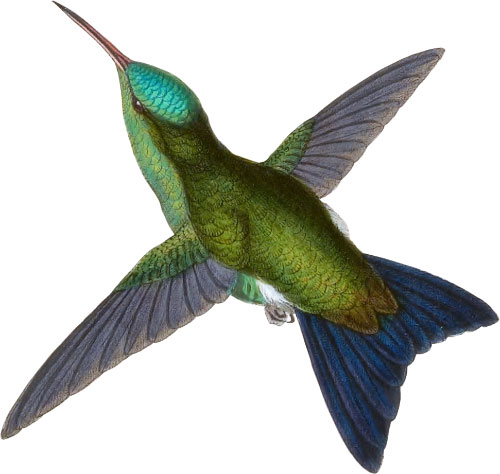 Plate 332
Eucephala chlorocephala
Green-headed Sapphire
Plate 332
Eucephala chlorocephala
Green-headed Sapphire
Eucephala cæruleo-lavata (Gould)
Habitat: South-eastern Brazil
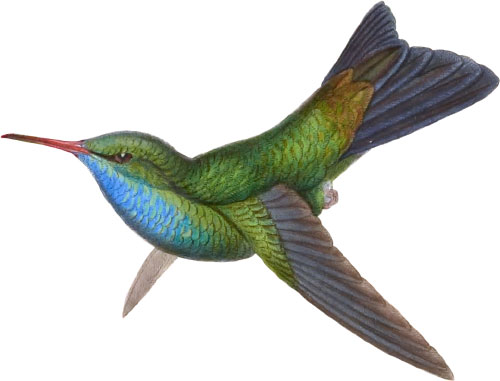 Plate 333
Eucephala cæruleo-lavata
Reeve’s Sapphire
Plate 333
Eucephala cæruleo-lavata
Reeve’s Sapphire
Eucephala scapulata (Gould)
Habitat: Supposed to be Cayenne
No illustrations
Crown of the head, back of the neck, and lower part of the back very deep dull green; throat and chest glittering greenish blue, imperceptibly passing into the dull brownish black of the abdomen; under tail-coverts brown, with a wash of dull blue in the centre of each feather; a mark of blue on each side at the insertion of the wing, forming an indistinct band across the back; upper tail-coverts bronzy green; tail steely black, rather short for the size of the bird, and slightly forked; wings deep purplish brown; tarsi clothed with intermingled greyishwhite and brown feathers; upper mandible black; basal half of the under mandible fleshy, the apical half black.
Total length 3\(\frac{3}{4}\) inches, bill \(\frac{7}{8}\), wing, 2\(\frac{1}{16}\), tail 1\(\frac{3}{8}\).
In the size of its body, it nearly equals the Eucephala cæruleo-lavata, but it differs from that and every other known species of this family of birds.
I have only seen a single example of this species.
Eucephala hypocyanea (Gould)
Habitat: Unknown; probably Brazil
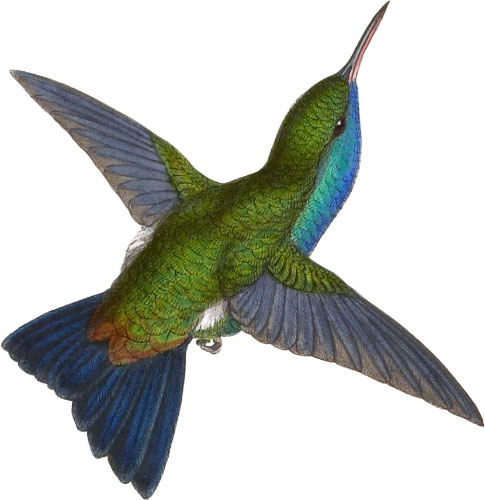 Plate 334
Eucephala hypocyanea
Blue-breasted Sapphire
Plate 334
Eucephala hypocyanea
Blue-breasted Sapphire
Eucephala cærulea
Habitat: Eastern and Northern Brazil (Chamicuros, Hauxwell), the Guianas, Venezuela, Trinidad, and Tobago.
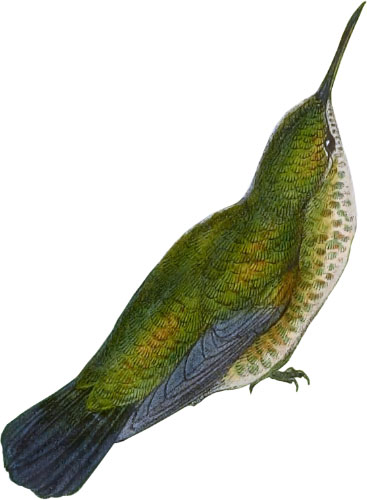 Plate 335
Eucephala cærulea
Blue-chinned Sapphire
Plate 335
Eucephala cærulea
Blue-chinned Sapphire
Specimens from all these localities are so much alike that it is impossible to consider them otherwise than as one and the same species; but I may remark that those from Venezuela have the blue mark on the chin much less apparent than those from Cayenne, Trinidad, and Eastern Brazil. My Chamicuros specimen also has this colour but faintly indicated, and the tail somewhat larger.
Eucephala cyanogenys
Habitat: Brazil
No illustrations
At present the single example of this bird procured by Prince Maximilian of Wied is the only one that has been seen. This type specimen is now before me, and I cannot do otherwise than regard it as a distinct species. It is very closely allied to, but a smaller bird than, E. cærulea.
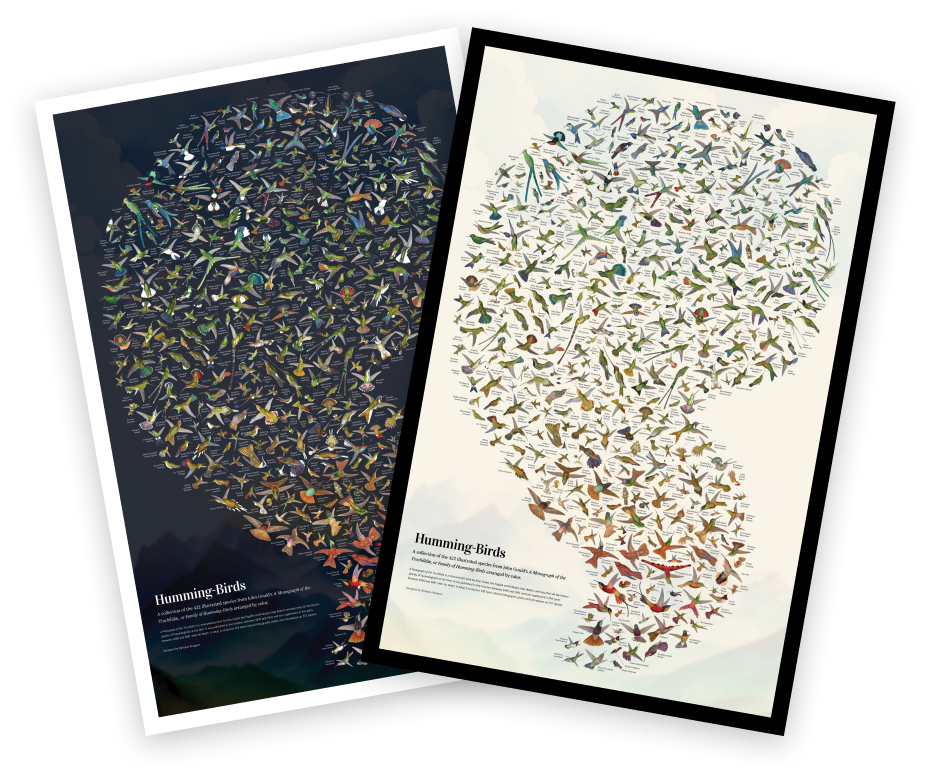
Featuring all 422 illustrated species from John Gould’s A Monograph of the Trochilidæ, or Family of Humming-Birds arranged by color.
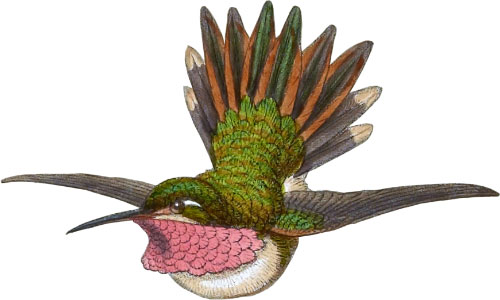 Humming-Birds
