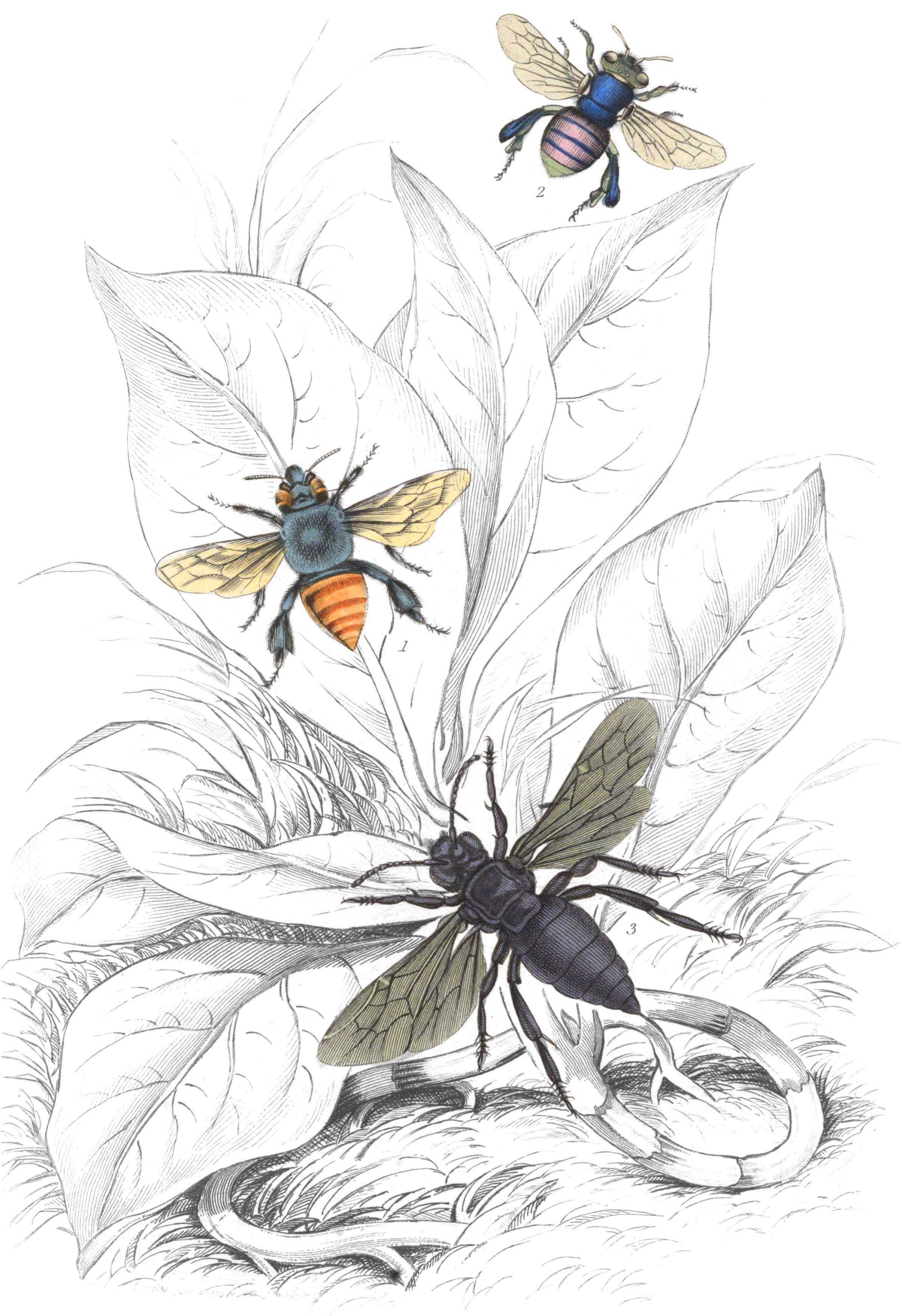
Volume 26, Plate XIX / Entomology (Insects)
Euglossa Surinamensis, E. Analis & Aglaé Caerulea
- Euglossa Surinamensis. Euglossa Surinamensis is a rather small, long-known insect, black and clothed with a short very dense hirsuties, the tongue reaching back to the middle of the abdomen and the eyes brown. The abdomen has a black basal segment with the remainder ochre-yellow, appearing as if gilded, the wings tinged clear brown with black nervures, and the hind tibiae and first tarsal joint broad and flat; it inhabits Surinam, Xalapa in New Spain, and other parts of South America.
- Euglossa Analis. Euglossa Analis is a small, very brilliant bee, not quite half an inch long with wings expanding about three quarters of an inch, here figured for the first time. Its punctured head and thorax are an intense rich blue, the abdomen purple with brilliant golden-green terminal segments and the legs rich shining blue; from the Rev. Hope’s collection, it is a native of Brazil, related to the Cnemidium viride of Perty.
- Aglaé Caerulea. Aglae Caerulea, peculiar to South America, was separated from Euglossa by Lepeletier and Serville, with long filiform antennae and a depressed scutellum prolonged behind into two spiniform projections. Probably parasitical, since it lacks the apparatus for collecting pollen, it is a large glossy insect of violet blue, thinly covered with black hairs, the abdomen’s sides bearing brownish tufts and the wings of that colour with a slight golden reflection; it is a native of Cayenne.
Locations:
Contents:


