Volume 29, Plate VII / Entomology (Insects)
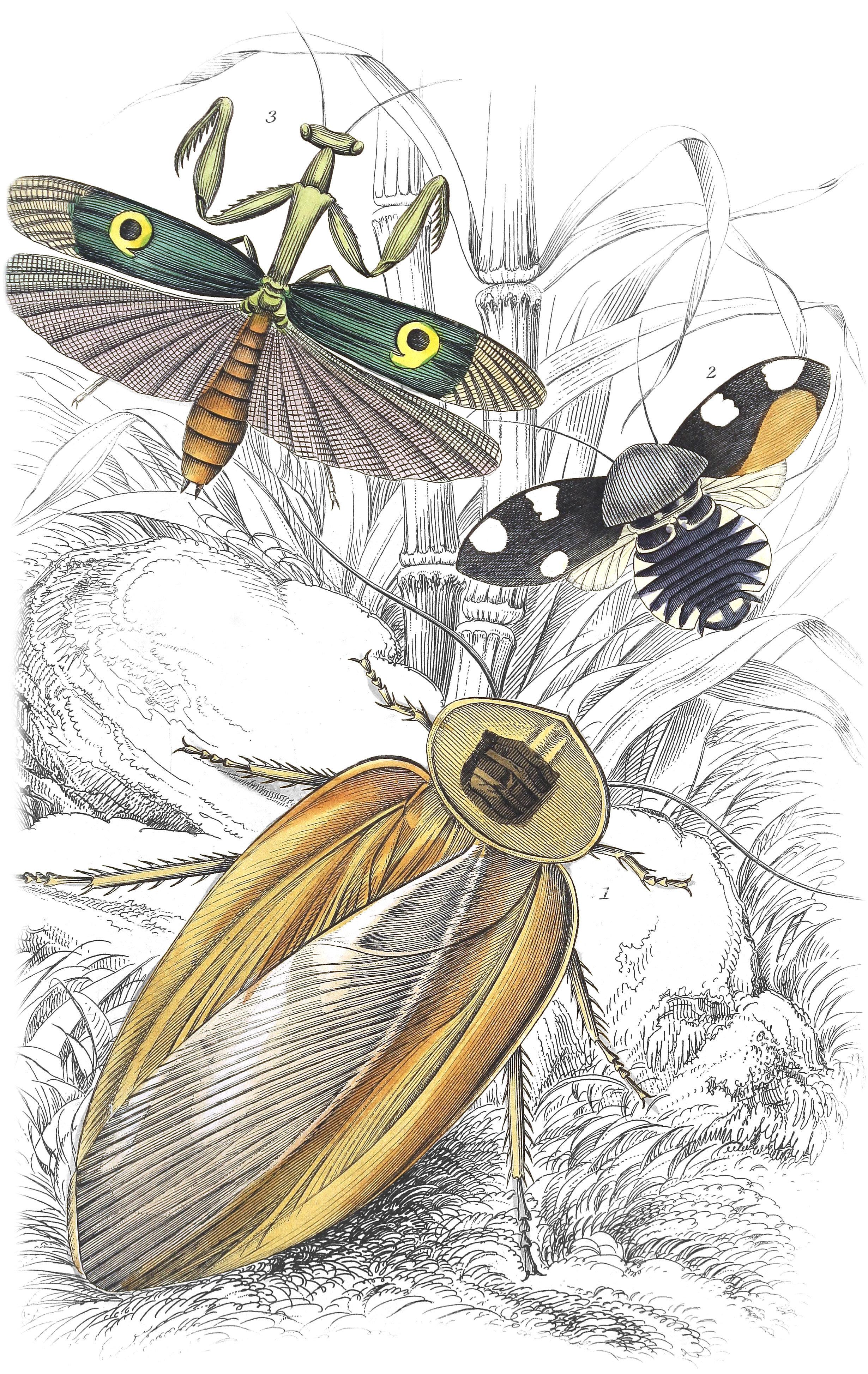
Blatta gigantea, B. Petiveriana & Harpax Ocellaria
- Blatta (Blaberus) Gigantea. The largest of its family, this cockroach has a body about three inches long and wings often spanning half a foot, the general colour a dusky livid with a reddish-brown head, brown antennae half the body’s length, and a small flat transverse-oval thorax bearing a large quadrate brownish-black central spot. The livid striated tegmina each show a narrow brown streak from shoulder along the middle; native to South America and the West Indies, it appears occasionally near harbours.
- Blatta Petiveriana. About ten or eleven lines long and dull black, with antennae half the body’s length, this West Indian cockroach has overlapping tegmina, the upper bearing four yellowish-white spots and the lower three, the inner margin near the centre a fine reddish-yellow. Its wings are very short and scarcely fitted for flight, and the broad black abdomen shows a small triangular fulvous spot at each segment’s side with two little appendages behind; it was first figured by Petiver.
- Mantis (Harpax) Ocellaria. This handsome mantis has a yellowish-brown head and thorax inclining to green, with tegmina transparent at the tips and otherwise green, each marked in the centre by a yellow eye-like spot encircled with black. The wings are transparent with the costa tinged green, the forelegs yellowish brown, and the middle and hinder thighs bear a small expansion at the extremity with two spurs on the tibiae; it inhabits the coasts of Africa.
Locations:
Contents:


