
Volume XX
The Birds of Great Britain & Ireland
Part I, Birds of Prey


Introduction
The wood, the mountain, and the barren waste, the craggy rock, the river, and the lake, are never searched in vain; each have their peculiar inhabitants, that enliven the scene and please the philosophic eye.—Montague.
In full accordance with the sentiments of the author we have quoted above, and to whom the British ornithologist is so greatly indebted, have we often wandered in the recesses of our woods and the passes of far-stretching and craggy mountains, searched around our wild or beautiful lakes and our precipitous sea-coasts, and we have never been disappointed. If we did not always meet with some species new to our collection, we found fresh facts to record of those we already possessed; and we delighted in the landscape enlivened by the airy creatures whose structure we had been examining, and whose habits we could there survey so freely. What would be the landscape without its living inhabitants? The luxuriance of vegetation, varying with beautiful flowers and rich foliage, has charms quiet and seducing, and affording ample subject for contemplation. In the depth of the forest, or on the mountain’s top, ere break of day had awakened their various tenants, and in some of our beautiful mornings of mid-year, we have seen how deeply tinted seemed the green of the foliage, and how chaste and blended were the tints on the nearly barren rock; how lovely the sylvan flowers appeared, shewing their freshest blossoms amidst the soft and matted growth beneath, and how exquisite the structure of the moss or lichen within our reach; how calm, clear, and serene the air, how deep the shadows, but how complete the quiet, how still the silence! There is something in the gradual change from darkness to day-light in places such as these, which, while it is pleasing and agreeable to witness, leaves a deep and impressive feeling not to be dispelled by the richest or most attractive vegetation. Soon, however, the stillness is broken, the various creatures go to their usual occupations—search of food, or the business of procreation. The scene is at once enlivened, and to none are we more indebted for the animated change which ensues than to those forms which will now more particularly claim our attention.
The ornithology of the British Islands may be said to be very extensive, possessing, with a few exceptions, the whole of this portion of the Fauna of northern and temperate Europe, those which are wanting being natives either of the extreme north or south, and just bounding on the forms which occur in the nearest extra-European divisions of the world, Asia or Africa. Many of the species are migratory, a consequence always accompanying insular lands; but the proportion is much less than in islands lying either more to the north or south, where the general climate is less temperate or uniform, and where the species from either extreme annually crowd, to perform the duties of incubation, or to spend the winter far from seasons, the rigor of which even their hardy nature could not withstand. And it is from the middle situation, as it were, of our islands that the birds more peculiarly southern or arctic are met with only as stragglers or occasional visitants, their instinctive wants being satisfied when they reach a climate which holds a middle class, and is subject neither to an arctic cold nor the intense heat of an almost tropical region. Another reason for the large proportion of pieces found in our Fauna, is the very great variation of country within its range. Sea-coasts of the most rugged and precipitous nature, or flat, sandy and stretching into boundless salt-marshes and fens, afford a residence and breeding stations for many sea-fowl and flocks of the Grallatores. Inland, extensive lakes, in still more extended chains, with banks steep and rocky, or flat and marshy, furnish summer resorts to many others of our water-fowl. The Alpine districts of the north, in many parts still clothed with extensive primeval forests, and mixed with ravines and rocks of the wildest and most sequestered character, are solitary and secure retreats to many of the Raptores; while the extensive tracts of moor and moss around, rear a food for them, and are the natural habitation of the Tetraonidæ and the summer-visiting Grallatores. Finally, the cultivated and champagne lands of the mid-lands and south, a mingled expanse of grove, and hill and dale, abound with the Incessorial birds, and with the exception of the shores, are the chosen rendezvous of nearly all our summer and winter visitants. In the whole, we can now number above three hundred species.
In a country of comparatively limited extent, and moreover sinsular, and where within the last hundred years the population and consequent cultivation of the soil has increased so rapidly, a change in the distribution of species, the diminution of the numbers or total extirpation of some, with the introduction of a few others, might be looked for. Every where this march of civilization is most inimical to the retention of the native animals in their proper haunts; they are either hunted and destroyed on account of the injuries real or reputed which they commit on the works of husbandman; or they are chased for the profits yielded by the sale of their skins, and for the food which they may afford to a people perhaps newly settled, and to whom the cultivated productions have not yet been reared in plenty. We have striking instances of this in North America, New Holland, and South Africa. In these lands, wherever colonies have been formed, the larger quadrupeds and birds have been either extirpated from their formerly wild and solitary haunts, or have fled before the settler to districts where they could still enjoy seclusion. We can no longer see the ostrich or emu without performing extensive journeys to the interiors; and the wild turkey, the bird of America, by our latest accounts, is now a rare species except in our “far west.” Similar causes have operated in our own country, and through now extensively, the time of their operation has been gradual and long. So far as number of species is to be regarded, our list will perhaps exceed what it previously did, for so much attention has been given to ornithology of late years, that several rare birds have been added to our Fauna, and some, whose characters had not been very well marked, have been separated from those they resembled; but nevertheless our loss has been great. All the larger Raptorial birds have decreased to a serious extent. The wooded character of Britain in its ancient state, standing, particularly in the northern parts, almost as an uninterrupted primeval forest, has been destroyed, and the favourite haunts of these wild birds have been intruded on. But they chiefly owe their diminution to the large premiums which are offered for their destruction, on account of the havoc they commit among the young of the flocks and to the game. The extensive cultivation, and particularly the drainage, in all parts has materially influenced the numbers of both our stationary and migratory water-fowl. The latter cause has worked most destructively in the fenny districts of Lancashire and Lincoln, and is gradually expelling species which we can never hope to see replaced in other stations. The multitudes of those birds were formerly very great, living and breeding unmolested in parts now under cultivation and furnishing the grains for our markets,
water-foules there is so great store that the report thereof may seem to exceed all credite.
We cannot calculate the proportion of their decrease at less than two-thirds. But our most to be regretted extirpations are among the Rasorial birds, the species of which order, generally easily domesticated and in a great measure gravinorous, afford temptations, from the price that is paid for them, to supply the markets of our large towns as much sought for articles of luxury. The capercalzie has long disappeared from our northern forests; and we fear that a less noble, but more interesting bird, from its restricted locality, is fast following. The Bird of Britain, confined in its range exclusively within the boundaries of our islands, is decreasing fearfully and rapidly. Fifty years hence, another generation may have to travel far before he can see the redgrouse, the moor-fowl of our northern hills, if the indiscriminate slaughter continues as it now prevails. The ptarmigan has also diminished in numbers, but its high and rocky almost inaccessible haunts, will always be, to a certain extent, a safeguard and protection against unlimited destruction. The bustard is another loss which cannot be replaced; the extensive commons, the wastes or plaints of the south, have lost their solitariness, and with it, in the judgment of the ornithologist, their greatest ornament; while among the Grallatorial birds, the crane and stork are now only heard of as stragglers from their wonted courses. But it may be asked, Have no species been introduced, have none become more numerous, so as to balance or replace these blanks in our Fauna? There are a few. The black-grouse has multiplied exceedingly, delighting, as it were, in the protection of the man in the reclaimed lands adjacent to the wilder tracts; the red-legged partridge has been introduced in the south-eastern counties; and the pheasant, the finest of our additions, has been completely naturalized; but these will fall far short to compensate for the cock of the woods, the “wild horse,” the bustard, or the red-grouse, should the latter ultimately fail.
The proportion in which the different orders occur may be interesting. According to one of the latest lists, including all the species discovered up to the end of 1836,1 the whole number of species which have been actually killed or taken in Britain is 323. In this number the Raptores amount to 30, the Incessores to 117, the Rasores to 17, the Grallatores to 66, and the Natatores to 93. In this enumeration of the extent of the orders, the Natatores, or water-fowl, are the most disproportionate, a fact which is easily accounted for by the insular character of the country, and the considerable extent of lakes and marsh which occur in various parts. Of the Raptores none, we believe, have been altogether lost, but the abundance and generality of some of the larger species have been much reduced from the reasons we have already stated. Of the Incessores about forty-nine species are migratory, leaving only sixty-six really indigenous; and this great relative disproportion between the number of truly indigenous birds and the migratory species, occurs from so many of the inhabitants of southern Europe and the nearest coasts of Asia and Africa reaching Great Britain as the extreme of their migration northward; and the opposite course makes the great proportion of our winter migratory birds to occur among the Grallatores and Natatores, which travel southward, making our islands nearly the limit of their range in that direction, while they occupy the colder latitudes during the summer, and perform in these solitudes the process of moulting or the cares of incubation. Of the Rasores two are now extinct, or very nearly so; three have been introduced; two are summer visitants, and one, the passenger pigeon, has only occurred twice, reducing thus our indigenous list by nearly a half.
The progress which British ornithology has been steady and sure, but it has not perhaps been very rapid. It has never been a favourite study with the naturalist, and in Britain, previously to 1800, had a greater portion of care bestowed upon it than upon the other branches of the vertebrata. For our present purpose of giving a very short sketch of its progress, it will not be necessary to trace it to a more distant period than 1678, the date of the work of Francis Willoughby, and whence we would place the commencement of our first era. This is a general work; but it is important to the British student, as giving an early arrangement of our native birds, though mingled with those from other countries. The whole style of this work, and its illustrations, is consonant with the date of the period of its appearance, and when compared with the beautiful publications of the present day, shews the march of improvement, and should teach us to be not too much impressed with the excellence of our own productions, which, a hundred and fifty-nine years hence, may be subjected to even a more severe comparison. The letter-press is written with the quaintness incident to the time, but is expressed with the amiability of feeling which was universally ascribed to the author, and contains some curious facts regarding the abundance of species that are now no ore, or have much decreased in numbers. Ray’s Synopsis Avium et Piscium appeared thirty-five years later, and contained a more finished systematic arrangement. It is known to have been much indebted to the manuscripts of the writer’s former friend and pupil, to which was added the experience gained in the intervening years. This work is necessary to the student who wishes to trace the species from their earlier descriptions. Some years later, (1731–8,) the work of Eleazar Albin appeared, an illustrated work, but too general for the British student, and now very little known. Advancing farther, in 1766 Pennant’s British Zoology was published, bearing more of the character of an illustrated work, for which descriptions were more amply furnished in later editions of a lesser size. This work cleared the discrepancies of many of the synonims, and hinted at the cause of confusion in others which could not then be ascertained by examination or experiment. In 1789, “The Birds of Great Britain,” by William Lewin, was commenced. It is a quarto book, was published in numbers, and professes to give a figure of every species. The plates are etchings, probably done by the author, in many instances shewing good drawing, though in general they are careless; birds are figured, however, which may be useful in assisting to make out what were really described by some of the authors previous or about the same period, under such titles as Lanner, Spotted Falcon, Grey Falcon, Grey Eagle, &c. Figures of many eggs are also given. The descriptive part is written in French and English, but is very short, and enters into none of the doubtful or difficult points of ornithology. Within a few years of the same period, (about 1799,) two works of a more decidedly illustrative character began to be published—Donovan’s and Graves’s British Birds. They appeared in periodical 8vo. parts. The first reach a tenth volume, and contains two hundred and forty plates; the second was discontinued at the third volume, and with the hundred and fourteenth plate. Both are meritorious works, continued under the disadvantages of great outlay and limited circulation.
About the same date, or during the twenty years of the conclusion and commencement of the eighteenth and nineteenth centuries, great progress was making in all branches of zoology, and works upon various plans were pouring from the British and foreign presses; but there were two British works published now, which, though their characters were very different, marked, we think, the commencement of a second era in the advance of British ornithology, and promoted, in different ways, the love and knowledge of the science. In 1797, “Land Birds,” by Thomas Bewick, was published, having no splendid exterior, or delicately coloured plates. This work gained, and has kept is reputation, from the fidelity and character peculiarly its own, which was infused into the wood-cuts, and at the period of its appearance contained the most complete list of our species, generally plainly and concisely described. Its price was moderate, and the vignettes, which filled up blank parts of the pages, rendered it popular from their humor. The later editions have kept pace with the modern advances, and are now esteemed both by the ornithologist and artist. The other work above alluded to will bear a higher patronage has not been nearly so ample. In 1802, Colonel Montague published the first part of his Ornithological Dictionary, a work professing no arrangement, but having the titles of the birds alphabetically arranged, as indicated by the title. A few years afterwards, a supplement was found necessary, and contained nearly as much as the first publication. In these volumes we have a great mass of information relative to the habits and manners of our British birds, a department which had been scarcely yet touched upon; all that was previously known was compiled, while the whole results of the Colonel’s experience are given in addition. The subjects are ably treated; the confusion which had prevailed from the changes of plumage incident to the young and to the old, in breeding season and in winter, were explained; and many ingenious opinions, of which proff had not been established, were then expressed, and of which the results have since shewn with what accuracy the author had observed. Several species were not, for the first time, described and added to our Fauna.
We have yet another work to notice before we complete our brief survey of those devoted more exclusively to this branch of the science. Illustrations of British Ornithology, by P. J. Selby, were commenced in 1826, and concluded in 1833, a folio of two volumes, with octavo descriptive letter-press. The price and magnitude of the plates preclude this work from the libraries of most students; but the descriptive part is indispensible, is moderate in price, and contains ample yet condensed descriptions of all our birds, arranged under the natural system, and placed in the modern genera where such have been considered necessary. The illustrations, amounting to above one hundred, and imbued with the character of the living birds, and without harshness, are executed boldly by the hands of the author himself. None but the professed workman can have any idea of the labour comprised in these two volumes of illustrations; and when it is considered that the drawings and engravings of three hundred and twenty-seven species of our British birds have been made and finished of the size of life, with very few exceptions by one individual, this work will stand alone as a monument of perseverance, while it is equally honourable as a work of science and of art.
In this enumeration of the works devoted to our favourite science, we have only noticed those which were confined to the subject. There are several works not exclusively treating of the department, which may be consulted with profit. The Supplement to Shaw’s General Zoology will be found useful, as giving the characters of the modern genera, in which many of our native species, particularly the Natatores, will range. Fleming’s British Animals gives a synopsis of our species, Turton’s British Fauna contains another, and the British Vertebrata of Jenyngs gives a third, brought down to the commencement of the last year. Many valuable papers have also appeared in our transactions and periodicals, which, however, are generally quoted in the works which we have mentioned above, and in these the names of Edwards, Forster, Walcot, Latham, Montague, Wilson, Fleming, Selby, and Yarrell, may be mentioned as all contributing to our stock of Information.2
We shall now proceed to the more detailed history of our native birds, reserving remarks upon their structure, habits, and geographical distribution, to come into the description of the different families.
Raptores, or Birds of Prey.3
The order Raptores, or Birds of Prey, has hitherto been placed first in our systems, though among quadrupeds, many writers have chosen to place the quadruminous animals, which are analogous to the perching birds, or second order in the arrangement, at the commencement. This, though of little consequence in one respect, shews an irregularity of system which it would be better to avoid; and placing the Raptores first now, is done with the intention, that the Feræ, their representatives among the Mammalia, should stand in a similar situation.
Among most of the ornithological writers previous to 1800, the first order was made to contain three very natural families,—the vultures, falcons, and owls; the shrikes were for a time also admitted, and on the discovery of the African secretary, or snake eater, it was placed among the vultures; but about the period we have just mentioned, a work was published in London, which, though destined from peculiar circumstances to have only a most limited circulation, was, nevertheless, in this country, the commencement of a new era in systematic arrangement. Macleay’s Horæ Entomologicæ, to the few who possessed a copy, and could appreciate its views, gave a new incitement to work; but the principles of the theory of representation being only in this work applied to the class of insects, few other naturalists took the trouble to investigate them, or to try their application to any other branch. Towards the end of 1823, Mr Vigors, well known as a zoologist, in a paper read before the Linnæan Society, and published in its transactions, attempted to arrange the class of birds according to the theory proposed in Macleay’s Horæ; and through we cannot subscribe to all the views which are laid down in this paper, we are fully aware of its great importance to ornithology at the time, and look upon it as most valuable in first pointing out many of the primary groups, and in calling attention to some curious and varied views. We may also remark, that the materials then to be procured in London were scanty, and not all adequate for the proper working out of the subject. Mr Vigors, in his arrangement, maintained the vultures, falcons, and owls, as three of the primary groups, but added to them as the type of a fourth family, gypogeranus, while he left the fifth unfilled up, as either extinct or presently unknown to science. Mr Swainson seems nearly at the same period to have taken up the study of this subject; and soon after the publication of Mr Vigors’ views, many ornithological papers by the former zoologist appeared in the periodical publications, arranging some groups upon different, but upon what he considered to be the correct principles. The same gentleman has, since these writings, given to the public has matured views of this curious and interesting subject, made out from more ample materials and repeated examinations, and he has arranged the raptores as vultures, falcons, owls, adding to them, as typical of a fourth family, the now extinct dodo, (and of whose alliance we think there is little doubt,) but placing gypogeranus (Mr Vigors’ gypogeranidæ) as the grallatorical type of the vultures, and leaving, as before, the fifth family still unaccounted for. This is the latest arrangement up to the present time; but looking at our restricted knowledge of this order of the birds, their comparatively limited numbers, the difficulty of procuring specimens, from their shy dispositions, and the inaccessible and wild nature of their haunts, it is more than probable that several modifications of form yet remain undiscovered, whose appearance would release from difficulty the attempts which are made “to place them all in order.”
In the theory of representation, which we have seen has been lately so much insisted on, the rapacious birds and carnivorous animals are strikingly typified by each other. In the principal forms of each we have the strongest creatures in existence, and both are generally of a large size. Their dispositions are fierce and daring, and we see the whole frame suited for swift pursuit or powerful action. The sight is remarkably acute; in some groups more peculiarly so by night, and in these the sense of hearing is also delicate. The organs of mastication are fitted for tearing, as may be seen in the powerful canines of the Falconidæ. The claws are large, curved, sharp, and retractile. No portion of the world is without Raptorial animals, and according to the all-wise constitution of the laws which regulate animated nature, no other system could long exist, saving that which produced a salutary check upon over production, and a balance of power between all creatures. But, besides this keeping in check of over production, by the preying of one tribe upon a weaker race, another provision has been considered, that of the removal of animal matter where heat renders putridity when life is extinct almost instantaneous, and where there is commonly, from various circumstances, at the same time a great expense of animal life. It is thus that we find in the warmer climates the most abundant distribution of the vultures, which decrease as they reach the north, and in our own country cease, with the rare examples of the species with which our present volume commences. The Falconidæ, again are more universal in their proportional distribution, but we find the stronger or more typical species abounding in the temperate regions; while in those countries possessing a greater degree of heat, and between the tropics, we see the forms more variously distributed, and a greater proportion of those small very weakly formed species, which serve to keep in check the multitudes of small lizards and reptiles, with the countless hosts of insects which are there so extremely destructive; and it is remarkable that a most formidable tribe, the Gryllidæ, to which the locust belongs, is one of the most eagerly hunted after by those smaller falcons. The Strigidæ, or owls, are also universal in their distribution, and prey mostly on the smaller mammalia; a very great proportion of which are also nocturnal in their habits, and being chiefly herbivorous or frugivorous, would, if allowed to overrun, as has been at times experienced, cause almost incalculable loss to the cultivators of the soil, or nearly clear from the ground of those plants which are so bountifully supplied for the necessities of man, and the support of the ruminating animals as well as their own smaller wants.
We shall now notice the families in detail.
Vulturidæ
As the British Fauna can only lay claim to a single species of this family, and that in the character of an extremely rare visitant, we do not propose to enter into many introductory remarks.
The Vulturidæ have universally been looked upon with a kind of disgust. Ungraceful in form, of loose and ill-kept plumage, and except when satisfying the cravings of hunger, or during the season of incubation, of sluggish and inactive manners, they present nothing attractive; while carrion being generally mentioned as their common food, associations have been created of the most loathsome character. They are not, however, without utility, for in the warmer regions of the world they consume the animal remains, which, without the assistance of these birds, the more ignoble carnivorous quadrupeds, and the myriads of carcase-eating insects, would soon spread pestilence around. In many parts of Spain and Southern Europe our British visitant is allowed to roam unmolested; in America the species there traverse the towns, and are kept in the market places to devour and lean up the offal; and in India vultures are observed with superstitious awe, and penalties are inflicted on their disturbers. Our British visitant is typical of the Genus Neophron.

Neophron percnopterus
Genus Neophron.—Savigny,
Now generally adopted by ornithologists, used by Mr Vigors as one of the five forms which compose the family, and considered by that naturalist to connect the Raptores with the Natatores by the nearly similar form and shape of the bill to that of Tachypetes or the Fregate Pelicans, and also by the long and amply developed wings. It is evidently an aberrant form; its members are comparatively weak, and the plumage of the neck runs farther upon the head than in the more typical species. Mr Swainson, in his “Classification,” hints at the probability of the Neophron being the grallatorial genus of the vultures.
- Generic characters.—Bill lengthened, slender, straight, with a distinctly hooked tip; maxilla without any angle; cere extending half the length of the bill; nostriles longitudinal, nearly parallel with the margins of the bill; anterior part of the head and face naked; neck covered with accuminated feathers; wings ample, third quill longest; legs of mean length and strength; tarsi reticulated; toes united at the base; claws strong, slightly hooked and blunt.
- Native country.—Southern Europe, Asia, Africa; chiefly the latter and the European coast adjacent.


The Egyptian Neophron
Neophron percnopterus.—Savigny.
Neophron percnopterus, Savigny, Ois de l’Egypte, pl. 16.—Catharte alimoche, Cathartes percnopterus, Temm. Man. i. p. 8.—Egyptian Neophron, Selby’s Illustrations, pl. A.—Ornithol. Illust. by Sir W. Jardine and P. J. Selby, pl XXXIII. (from the specimen killed in Somersetshire.)—Gould’s Birds of Europe, adult and young.—Eyton’s Rarer British Birds.—Yarrell’s British Birds.
Africa appears to be the stronghold of this Neophron. We have received it from the vicinity of the Cape of Good Hope. It is noted by various travellers to occur on the northern coasts, and on the shores opposed to Europe it is extremely abundant; whence, crossing to Southern Europe, the frequency continues, but gradually decreases as we advance northward, and France and Britain may be accounted the utmost limits to which wanderers occasionally stray. Notwithstanding, however, its great abundance in Spain and the opposite African shores, we have no record of its habits. Its general food appears to be carrion in all its forms, and in some parts it is protected on account of its utility in clearing off the putrid substances;4 at the same time, it is said occasionally to feed on reptiles and the smaller animals. Of its nidification we are equally ignorant. According to Temminck, it breeds in the most inaccessible places, in the holes or the fissures of some perpendicular cliff; but the source of this information is not mentioned, neither the number or colour of the eggs. Mr Bruce again adds to his description,
It lays but two eggs, and builds its nest in the most desert parts of the country.
The single specimen upon which we rank this species as an occasional “British visitant,” was killed on the shores of the British Channel in October, 1825, and came into the possession of the Rev. A. Mathew of Kilve, in Somersetshire.5 When first discovered, it was feeding on the carcase of a dead sheep, and had so engorged itself with the carrion as to be unable or unwilling to fly to any great distance at a time; it was therefore approached without much difficulty and shot. Another bird, apparently of this species, was seen at the same time upon the wing at no great distance, but could never be approached within gunshot. The specimen procured at this time, which its owner kindly introduced to Twizel House for the purpose of being introduced into the “Illustrations of British Ornithology,” we then saw. It was in immature plumage, the dark feathers of the young beautifully mixed with others of a rich cream-yellow. The colour of the naked skin on the head was of a livid flesh-coloured red., that of the legs a pale yellowish grey.
The adult birds have the plumage nearly of a uniform yellowish white or cream colour, excepting the quills, inner webs, and base of the secondaries; the former are blackish, the latter liver brown, which, on the outer webs, gradually shades into the cream colour. The feathers on the hind head and neck, are lanceolate, very pointed and hackled, and appear to be occasionally raised when the bird is either under the impulse of fear or anger. The head, before the ears is bare of feathers, a few straggling hair-like tufts appearing on the chin, and marking superciliary ridges and a circle around the ears. The ski, on these parts, in the adult birds is gamboge yellow; but in the Somersetshire specimen above alluded to, which we saw before it was dried, the colour was livid, this undergoes a change as the bird approaches its mature state. The length of specimens from Southern Africa, is two feet two or three inches. The young of the year, have the head thinly covered with down, and, as observed, have the colouring of the uncovered parts of a less clear appearance than in the adults; the plumage is entirely of a dull blackish brown with yellowish spots on the tips of the feathers. The quills however are black, though not of so clear a tint as in the old birds. In approaching to maturity, the dark parts of the plumage assume a rich purplish brown tint, the feathers appear more glossy, and these dark parts afford a pleasing and strong contrast with the cream yellow of body.

Plate I

We shall now enter upon the second family of the Raptores.
Falconidæ
The Falcconidæ are the typical, consequently the most numerous family of the Raptorial birds. They represent here the more noble Felidæ among the Feræ, as the vultures did the more ignoble carcase devouring dogs, wolves and hyenas of the same family. Their prey is almost always seized by their own energies, either on the wing, or pounced on by surprise in cover, or on the ground; it consists of nearly the whole animal kingdom, quadrupeds, birds, reptiles, fishes, and the larger species of insects. One or two examples, however, do occur among the most aberrant groups in foreign countries, where carrion, or at least animals which the birds have not themselves destroyed, serve as food, and we have observed an occasional instance of it in the common harrier of Europe, (circus cyaneus,) feeding on the fish which remained dead about the stake nets during the reflux of the tide. Confinement immediately so far changes the nature of all,6 that dead food is eagerly seized and eaten, but we have always remarked that, among the more noble,—the Peregrine Falcon, for instance,—the taste, if we may use the expression, was more refined; tainted food was always refused, and so also was some of the strongly scented mammalia; polecats or weasels were never eaten, and even a cat was not esteemed savoury, whereas a hare or rabbit would have been at once devoured. It may be remarked here, that in these two corresponding families of quadrupeds and birds, members of each have been trained to hunt and kill game for the sport or use of man.
In form and structure, these birds are very powerfully made; intended for rapine, they possess corresponding organs of great muscular strength, both to pursue and to tear, and to hold their prey when secured. In the wings of those possessing the most strong and rapid flight, we have lengthened and accuminated form, narrow feathers, but of firm consistency, and when displayed or spread presenting an even surface of resistance to the air. The moving muscles are large and powerful, particularly the pectorals, which are furnished with an expanded insertion into the broad sternum and its deep keel. The clavicles are also strong, and the os furcatorius, which is circular, broad and strong, affords a firm support to the shoulders.7 The bill, having a strong tooth in the species most truly rapacious, is really a tearing instrument, as much so as the powerful canines of the Felidæ. The legs and feet possess immense muscular power, and the claws, remarkably sharp, are also retractile, (though by a different process,) as among their feline representatives. The intestinal canal and digestive organs present gradations between the membranous pouch of the true birds of prey, to the muscular gizzard of other orders, according to the food they particularly select,8 and the former is comparatively short and wide, or narrow and very lengthened; and the latter modification is seen in those which they prey on fish, and thus, to a certain extent, those species agree in proportions with the digestive canal of the Ichthyophagous Feræ.9
In the language of the natural system, the Falconidæ are separated into Typical, Subtypical, and Abarrant groups, all of which are so far represented by the birds in our own country; but they also contain many foreign genera, by which their connection can only be satisfactorily made out.
The Typical Falconine division, the
Falconinæ, Falcons,
is seen in the Jer and Peregrine Falcones, the Merlin, &c. and in these we have the form for rapine developed to the utmost; compact, powerful, muscular; the bill strong, with a lacerating tooth; the wings pointed, the quills of firm texture, the second and third longest; the legs and feet very muscular, the latter with the claws formed for grasping strongly; the manner of flying rapid, decided, not gliding or soaring in watch; the prey almost always struck during flight; breeding places most generally precipitous rocks.
Eggs of Peregrine Falcon and Merlin
The colour of the eggs of birds is nearly constant in the greater divisions, and the family to which any species belongs may be known with tolerable certainty from the form and markings, and general colour of the eggs. In illustration of this we shall introduce into these volumes figures of the eggs of the principal groups of our native birds. Among the true Falcons the egg is always rather round in form, the prevailing colour different shades of reddish brown, with numerous irregular markings of a darker shade; and the resemblance between those of different species is sometimes so close that they can scarcely be with certainty distinguished. Figs. 1 and 2 on plate II. will illustrate the form and colouring of those of the true Falcons.

Plate II
1. Peregrine Falcon. 2. Merlin. 3. Sparrow Hawk.
The true Falcons amount in Britain to six species. Their geographical distribution is various. The Jer Falcon is only a straggler here; Northern Europe in North America, are its strongholds. The Peregrine Falcon is pretty generally distributed over the temperate districts of Europe, where the country is alpine or the sea coast precipitous, and it extends also to the American continent.10 The Merlin is European, perhaps also North American.11 The Hobby is European, and visits us as a migratory bird in summer, keeping, however, to the southern districts. The Kestrel is one of the most abundant species in temperate Europe, but diminishes in numbers as the south is approached, becoming there represented by another species, which, on the African shores, is again represented by a third. This bird was noted by Mr Carruthers as inhabiting the island of Madeira,12 but as a specimen was not procured, we are perhaps not warranted in asserting that it was not one of the very closely allied species of Africa or Spain; at the same time, we have seen it recorded in lists of birds from Africa, on which we could place some dependence. It is recorded by Major James Franklin as occurring on the Ganges between Calcutta and Benares;13 by Dr Horsfield it is said to be Javanese; Mr Selby also mentions having received the Kestrel from continental India, with this distinction only, that the colours of the female birds were paler;14 and by Colonel Sykes it has been noted as inhabiting the Dunkun.15 If these facts can be depended on, and their value must be judged of by our readers, we have for this bird an extensive range, particularly to the south. It does not, however, seem to reach to an equal extent to the northward as the strong and powerful Jer and Peregrine Falcons, but on the American continent is replaced by the beautiful little F. sparverius, which in many respects, partakes of the same manners, though we have in them also a considerable blending of with those of the Merlin.

Beaks: Merlin (left), Jer Falcon (right)
Falco, generic characters.—Bill comparatively short, curved from the base, the mandible furnished with an angular tooth near its point, fitting into a corresponding notch in maxilla; nostrils circular; wings long, accuminated, second quill longest, and the three or four first notched on their inner webs; tarsi short, muscular, reticulated; outer and inner toes unequal in length; claws hooked, short, that of the hind toe longest.
Note.—They are cosmopolite; breed generally on precipitous cliffs; solitary; strike their prey on the wing; are trained occasionally for the chase.

The Jer Falcon
Falco Islandicus, Latham.
Hierofalco Islandicus, Cuv. Reg. Anim. i. 323.—Gryfalco Islandicus, Brisson, (immature plumage.)—Gyrfalcon, Pennant, Brit. Zool.—Faucon Gerfaut, Temminck, Man. i. 17.—Gryfalco candicans, Fleming, Brit. Anim.—The Jerfalcon, Montague, Lowe, Bewick, Selby, Yarrell.
The Baron Cuvier applied to this bird the generic appellation of Hierofalco, placing it at the conclusion of his true falcons; and our countryman Dr Fleming, gives it the same situation, using Brisson’s title of Gryfalco. The absence of the lacerating tooth upon the mandible is the reason assigned for the removal, as all the other parts of the form are acknowledged to be quite typical. In all the specimens we have seen, the tooth has been fully, and in some strongly developed; and we suspect that the want of it is an accidental or occasional circumstance; in the wood-cut, taken from a Scottish specimen, it will be seen strongly marked.
We can only rank this fine species as an occasional straggler among us, and even in the olden time of falconry it does not appear to have been more abundant; they were then sought for abroad, and very high prices were paid for them. The range of the Jer-Falcon seems to be the more northern districts of Europe and America. Iceland was and is one of the most famed strongholds—the capital, so far as the sporting world was concerned—and furnished at a large amount the sorts which were in most esteem in the countries where this ancient sport was pursued.16 It spreads also along the precipitous coasts of Norway and Sweden, Greenland, and all those ranges of ice-bound shores which verge upon the Arctic latitudes. Dr Richardson mentions it as a constant resident in the Hudson Bay territories, and has ascertained it reaching as far south as fifty-two degrees; and Mr Audubon found several pairs breeding on the coast of Labrador. In Britain an occasional specimen is killed, and perhaps finds its way to some public or private collection. Thus in England it is extremely rare,17 and north of the Tweed almost as much so; even in Orkney and Shetland Mr Lowe considers it as a visiter, and we are not aware of any instance of the nest being found. It is equally so in Ireland, the MSS. of the late John Templeton record a single specimen, and a letter addressed to Mr Thompson of Belfast, so late as February, 1837, from J. Stewart, Esq. mentions a specimen killed in a rabbit warren close to Dunfanaghy. It is truly a northern and maritime species—maritime most probably from the abundance of food which is generally found around the rocky shores of its principal range, the breeding resort of numberless sea fowl. The manners, flight, and cry, approach very closely to those of the Peregrine, it is even a more daring bird, and like it delights to have its eyrie on some precipitous cliff overhanging the sea. The nest, according to Mr Audubon, is composed of sticks, sea-weeds, and mosses, but the eggs seem not yet authentically known, though we have some descriptions of them as resembling those of the Ptarmigan.18 When approaching the nest, it becomes very clamorous, descending on the aggressor in sudden swoops. Dr Richardson writes,
A pair of these birds attacked me as I was climbing in the vicinity of their nest, built on a lofty precipice, on the borders of Point Lake. They flew in circles, uttering loud cries and harsh screams, and alternately stooping with such velocity that their motion through the air produced a loud rustling noise. They thrust their claws within an inch or two of my head.19
Their food is both the small animals and sea-fowl in their vicinity, but they also make more extended excursions inland, where the grouse and other game form, a most favourite and much sought after repast, and in the fur countries they follow the partial migrations of the ptarmigan. The stomachs of the birds dissected by Mr Audubon20 contained, among other remains, those of fish, but these may have been derived from the intestines of the sea-fowl on which they had been preying, not from fish taken by their own excursions.
The form of the Jer Falcon is very strong and muscular, the tail is rather longer in proportion than that of the Peregrine, and the tarsi are feathered for an inch and three quarters downwards. The length of an adult seems to be from twenty to twenty-four inches. The mature bird is nearly white, spotted only above. Dr Richardson’s description is,
The head is entirely white, and the neck nearly so, there being only a few central brown marks on the feathers of the nape. On the back clove brown forms a pyriform blotch on each feather, and on the rump it is confined to a narrow streak along the shaft. The spots are smaller on the lesser wing coverts, and on the greater coverts, secondaries and scapularies, the brown is disposed in bars, which do not reach the margins of the feathers. The primaries are white, their shafts and one or two inches of their ends only being blackish brown; they are narrowly edged at the tips with white. The tail feathers and their coverts are entirely white. The whole under surface of the bird is pure white, except the ends of the feathers, which are hair brown. The bill is pale greenish grey, becoming darker at the tip; cere and lores wax yellow; legs yellow.
In an adult bird from Hudson’s Bay now before us, the length is 23 inches. The crown and under parts are pure white, a narrow lengthened streak running along the feathers on the sides of the breasts and flanks. The crown and cheeks have the shafts only black. The tail is also pure white, the shafts of the centre feathers only being dark brown; the outer feathers are about half an inch shorter than those in the centre.
The following is the description of a Scotch specimen in the collection at Twizel House. It was shot by Mr Scobie on his farm of Keoldale, in the northern extremity of Sutherlandshire, during the winter of 1835. The chin and throat are pure white, the feathers of the crown with deep hair brown shafts, those of the nape with the brown a little extended on each side of the shaft. Back and wing coverts, with the central part of each feather, hair, inclining to clove brown, the margin all around being pure white; the greater coverts and secondaries are barred with hair brown. The greater quills have their tips, to the extend of nearly two inches, deep hair brown narrowly margined with white; the exterior circles barred with brown, the interior with imperfect bars, or, as the first and second quills, with a narrow list of brown along the side of the shaft. The tail is white, except the two central feathers, which are barred with brown; the bars on the exterior web, imperfect, or not reaching the edge of the feathers. The outermost tail feather on each side is nearly half an inch shorter than the rest. The breast and abdomen are white, each feather having the shaft and a portion on each side of it hair brown, forming guttiform spots, which decrease in size from the breast downwards. The breast, the thighs, and under tail coverts, are immaculate white. The bills is of a pale bluish gray, the tooth in the upper mandible, and the notch in the lower, both strongly developed. Legs and feet bluish gray. From the manner in which the skin has been taken off and preserved, the correct dimensions cannot be ascertained.21
In the young of the year, the colour22 is mostly of a dull brown, little white being at all visible. As they grow in age, the white increase, the dark parts of the feathers narrowing to a central blotch; and the mature birds white becomes the predominating colour: some birds are nearly white altogether, but, as hinted at by Dr Richardson, this state may be a variation only sometimes occurring, specimens in this plumage being certainly rare. Our next species is

Plate III
The Peregrine Falcon
Falco peregrinus.—Linnæus.
Falco peregrinus, Auctorum.—Faucon pellerin, Temm. i. 22.—Peregrine, or Peregrine Falcon, of Brit. Authors.—Great-footed Hawk, Wilson, N. A. Ornithol. ix. p. 120.—(F. Barbarus, and Tartarian Falcon, of Latham, often placed in the synonimes of this bird, are very questionable.)—Provincially named, Duck Hawk, Blue Hawk, Game Hawk, Cliff Hawk.
The Peregrine is one of the strongest and most beautifully formed birds of its section. It is hardly so long in form as the Jer Falcon, nor does it weigh so heavily; but the male Peregrine, when in high plumage and condition, exhibits a compact muscularity of shape, and an open and bold expression, which approach closely to our idea of the symmetry of a bird, formed in all its proportions for swift pursuit and rapine.
The Peregrine, though not common, nor of very equal distribution over the country, can scarcely be called a rare bird: in several favourable districts it is even frequent. In the rich low lying lands of England, it is only met with as a straggler, but in the mountainous counties, part of Yorkshire, for instance, and in the border counties, and many parts of Wales, its eyries were frequent and are still found. On entering the Scottish frontier, it is still more common, becomes rarer in the lower and richer valley of the Forth or Mid-Lothian; but on crossing this, and entering the Highland ranges, it again prevails. In Ireland, it is also found: Mr Thompson writes,
It may be stated in general terms, that the Peregrine Falcon occurs in suitable localities throughout Ireland. In the four maritime counties of Ulster, it has many eyries, and in Antrim, whose basaltic precipices are favourable for this purpose, seven, at least, might be enumerated: of these only one is inland.23
On the Scottish coasts, almost every precipitous headland is possessed by a pair of “Blue Hawks,” and similar situations elsewhere are the most favourite breeding places of the species, selected, most likely, as by the Jer Falcon, on account of the abundant provender which also nestles around them. Many pairs, however, also breed inland, and the mountain ranges on both sides of the Border abound with eyries; but among a race of birds, which of old were held in so high estimation both in Britain and on the Continent, it was to be expected that some more renowned sites would exist. Thus we have Hambleton in Yorkshire, famed for a breed used to fly at Wild-ducks; in Wales, the rock of Llandidno; and in Scotland, Dumbarton, the Bass, and Isle of Man, all ranked high for the bold and generous dispositions of their Hawks. The birds were preserved with the greatest care, and penalties were attached to their destruction.
It may be here remarked, that several gentlemen now keep hawking establishments, and take the field regularly, sometimes for the sport itself, and also for the purpose of terrifying the game to sit, by causing the falcons to fly over them. We have yet few records of the deeds done in this sport, but in Ireland, John Sinclair, Esq. a friend of our correspondent Mr Thompson, seems devoted to it, and has endeavoured to reclaim not only the noble, but has attempted Eagles and Buzzards, and even the most ignoble of the race, the Harriers, and with a variety of success. This gentleman procures his Hawks from the more northern eyries in Ireland, and uses them chiefly to fly at Woodcocks, and making the best chase; and one peculiarity deserves to be mentioned, that the Falcon stops, as it were, instinctively, so soon as the prey arrives at cover.24
The nest of the Peregrine is generally placed on the face of some precipitous cliff, resting on a shelve of the rock, on a tuft of vegetation, or in a horizontal cleft. It is generally inaccessible to climbing without some assistance, though, in a few instances, I have seen the shepherds take the eggs or young without aid. The nest is composed of a considerable bulk of sticks, coarse stems of grasses or fern carried by the birds; but in one eyrie, which I have known for many years, placed in a horizontal cleft, the eggs are laid on the bare surface among the refuse of the roots of vegetation, a little scooping or working with the breast rendering the spot slightly hollow. The female, when sitting, is easily approached, though warning is always given by the make of any stranger’s approach. At this time he appears high in the air, flying rapidly round, and uttering his piercing and shrill call of alarm. If the young are hatched, the scene is different: both parents generally meet the aggressor, and plainly tell that their boundaries have been invaded. When the site of the nest is approached, both fly rapidly across the face of the cliff, passing and repassing the nest, eyeing at one time the stranger, at another, the objects of their care, and uttering meanwhile cries, which may now be likened to shrieks of anger or despair. Their patience apparently exhausted, a sailing flight is made to some neighbouring pinnacles, where more plaintive cries are from time to time uttered, or the male will, far out of gun-shot above, survey the scene. The least movement or noise of the intruding party, will again bring both parents to the spot, with, if possible, a more rapid passing flight and louder cries. In such situations I have never found it difficult to procure at least one bird, and sometimes both, and in either case have always, in the following season, found the cliff again tenanted, and the nest commonly placed on the same spot. A figure of the egg is given plate II. fig. 1.
The Peregrine is a bird of wide distribution, though a constant native only of the wildest and most mountainous districts; thus, though it has been found in America, it is of more rare occurrence than the Hawks, which delight in wooded tracts, and is scarce, therefore, in the wooded parts of the fur countries.25 It is migratory in Louisiana, and seldom occurs in the middle and southern States, while, in some parts of the United States, Audubon thinks they may breed; and the Falls of Niagara, mentioned as one station, would be quite in accordance with the habits of the bird.26 In the New World, it is upon the northern coast where it is most abundant; Melville Peninsula, the shores of Hudson’s Bay, and the Arctic Sea, are among its most numerous resorts in summer.27 Captain King, it has been said, met with it in the Straits of Magellan, and the specimen of hawk from New Holland, in the Museum of the Linnæan Society, is referred to this species. The latter, however, is considerably smaller in size. It is also mentioned, though with a doubt, as a South African bird by Dr Smith, in his catalogue of the “South African Museum.” If these localities are correct,28 we shall have the bird nearly universal in distribution where situation is favourable; and we think it much more than probable that it may also occur in the Alpine regions of India.
The variation of plumage which takes place in the different ages of the birds of prey, has rendered this species the subject of much confusion and of most varied nomenclature, which has been much increased by the provincial and sporting names which have been applied to the different sexes, states of plumage, and age of the trained birds. The language of falconry was introduced into that of science, and the combination was difficult to unravel. F. communis, hornotinus, and gibbosus, are now ascertained to belong to some states of this bird; and in sporting terms, we have Falcon for the female, and Tercel for the male. We are not so sure, however, of the “Barbary Falcon,” as there are one or two African birds which come near, and whose young states may be very similar; and, except that above noted, we have no modern instance of the Peregrine being received from Africa. The difference in the proportions, and in the notching or emargination of the feathers, is often very marked; and it would be well that a very rigid examination of every part of the specimens which were considered identical, was always made before they are recorded, for we are convinced that many birds have not nearly the extent of distribution which has been assigned to them, and that the representing or analogous species have been taken for them.
The food of the Peregrine residing inland, is principally game of all kinds; on the coast, the various sea-fowl, of which ducks and the curlews are most esteemed. We have seen that the American birds have certain propensities for fish, but few instances have been recorded of small animals being destroyed. The flight, when in the act of seizing or rushing on its feathered prey, is swift beyond description. Ordinarily, it is performed by rapidly repeated strokes of the wings, in which manner it either sweeps over the country surveying for its quarry, or when the latter has been raised, ascends above, following the course until the moment favourable for descent has arrived, when the pinions are folded close to the body, the course directed by the tail, and a diagonal rush upon the victim follows, which, if light, is seized and borne off in a rising curve, or, if of a heavier description, is felled to the ground.29 It is an idea with many that the large Falcons strike their prey with the breast, but the violence of the contact would be felt as severely by the one as the other; and the blow which would stun a pigeon, or a full-grown wild-duck of equal weight, would surely be fatal to both. The weaker or lighter birds are always clutched up; and on the others torn wounds are inflicted, which could only be done by the claws. The bill is not used. It has been mentioned, that the Peregrine often strikes several birds of a covey or flock before returning to his first prey; and Mr Thompson mentions that one of Mr Sinclair’s Hawks, which had taken up her abode in a rookery, when flown at rocks, always struck down several before commencing to prey on one. The same gentleman relates another anecdote to the same point:
Mr Sinclair, when exercising his dogs, towards the end of July, preparatory to grouse shooting, saw them point; and when coming up he started a male Peregrine Falcon off a Grouse just killed by him, and very near the same place he came upon the female bird also on a Grouse. Although my friend lifted both the dead birds, the Hawks continued flying about, and on the remainder of the flock being sprung by the dogs, either three or four more Grouse were struck down by them, and thus two or three brace of Grace were obtained.30
Various Attempts have been made to ascertain the velocity of this Falcon’s flight, but accurate data can scarcely be procured, and our results, in most instances, must be drawn by deduction. It has been rated from fifty to one hundred and fifty miles an hour; at the greatest velocity of its rushes we have little doubt that it is beyond this speed, but in ordinary flight and migration, it may have been perhaps overrated.
The following is a description of the adults of both sexes, procured on the Moffat range of hills during the breeding season, and of the young in its first plumage from the same locality:—
- Male.—Head, back of the neck, and broad streak beneath the auriculars, greyish black, shading into a deep bluish grey on the back and shoulders, rump and tail coverts; the centre of each feather on the back darker, but on the scapulars having the shaft only conspicuous, and a slight irregular clouding towards the tip of the feather; on the rump and tail coverts the grey is paler, and the feathers are indistinctly formed with greyish black; the quills are greyish black, with pale edges, slightly tinged with grey on the outer webs, the three first are darkest; on the lower side they are obscurely spotted on the inner web with reddish white; the second is the longest in the wing, and the first only is notched, (see wood cut;) they reach within half an inch of the tip of the tail; the tail is nearly square, bluish white, with a tint of yellowish grey, pale at the end, and narrowly bound with greyish black; the chin is white; the throat and breast are cream-yellow; the shafts of the feathers on the latter dark, and shewing a very narrow streak: from the breast downwards the lower parts are of a pearl-grey, tinted with rufous, the shafts of the feathers appearing very unmarked, and having those feathers on the lower part of the breast with a deep transverse spot, which gradually changes into bars, more indistinctly marked on the thighs and lower tail coverts; bill is bluish black, yellowish white toward the base of the mandible; cere and legs saffron-yellow; iris deep umber-brown; length nearly sixteen inches that of the wing from shoulder to tip of second quill twelve inches and a quarter.
- Female.—With the distribution of the colours similar, the upper parts generally of a deeper tint, the clouded marking on the back and the bars on the rump and tail more distinct and better marked; underneath, the lower part of the breast, the belly, and thighs, have a more rufous tinge, and less grey intermixed; a longitudinal spotting runs higher up on upon the breast, and the transverse spotting and barring on the other parts is broader, of a deeper hue, and more boldly marked; length about nineteen inches; from shoulder to tip of second quill fourteen inches.
Both the birds now described were shot from the nest.
Young of the first plumage, male.—Upper parts very deep blackish brown tinted with grey, the feathers tipped with rufous, and on the hind head broadly edged with a pale tint of the same colour; quills black, tipped with rufous; tail brownish-black, greyer towards the base, tipped and obscurely barred with reddish white; chin yellowish white, remaining under parts pale and dull reddish orange, tinted with ochraceous, darkest in the centre of the belly, and broadly streaked with umber brown on the centre of each feather; legs lemon yellow, with a tint of green.
A variety in a state of change has the upper parts of a tint intermediate between yellowish brown and clove-brown. The tail, instead of being barred, has an irregular spot on each web of ochraceous, where the pale bands should be, and the longitudinal streaking of the lower parts is wood-brown, instead of the deep ruddy umber-brown seen generally in the young.31

Plate IV
Of the next species we regret that our knowledge is more imperfect, and that we must have recourse to the works of others to glean the information which has been recorded.
The Hobby
Falco subbuteo.—Ray.
Falco subbuteo, Ray, Linnæus, Latham, &c.—Faucon Hobereau, Temm.—The Hobby of Brit. authors.
The Hobby is also a finely formed falcon, and possesses great power of the wings, which are proportionally longer than the Peregrine. This bird is a summer visitant to England, but only a rare one, and is most northern recorded range is noted by Dr Heysham in his catalogue of the Cumberland Animals, prefixed to Hutchinson’s History of Cumberland. He says,
Whether it migrates or not, I have seen it in the beginning of November.
A specimen is also mentioned by Mr Selby as having been killed at Streatham Castle, Durham.32 In Scotland I am aware of no instance of its being captured, and in Ireland it seems equally rare, or rather somewhat doubtful whether it has ever occurred at all.33 It also appears to be only migratory on the Continent, retiring after incubation to spend the winter in some warmer country,—Asia most probably, for specimens have been received from continental India perfectly identical. In this country it arrives in April, leaving again in October. It occurs chiefly in the richer and more enclosed districts, being evidently a bird delighting in woods, where it can sally forth to prey in an open tract. It breeds on trees, sometimes among the forsaken nests of the crow or magpie; and the eggs are described as of bluish-white with olive-green or yellowish blotches.34 This is a colouring of the eggs at variance with all those of all our other British Falcons, and is more akin to what we see in Astur and Circus, the Goshawks and Harriers. Mr Yarrell, however, says they are similar in form and colour to those of the other Falcons.35 The most favourite pursuit of this Hawk seems to be the lark; both Montague and Mr Selby mention having witnessed the chase, and of its very marked predilection for this prey. It is extremely active, and was formerly trained to “hawk,” and Quails and Larks were the principal game, though Partridges were sometimes attempted. It was not, however, held in great respect for this sport.

Plate V
The Merlin
Falco æsalon.—Willoughby.
Falco æsalon, Willoughby, Ray, &c.—Merlin of most Brit. authors.—Stone Falcon of Latham.—Montague, App. to Supp. Orn. Dict. the male.
This beautiful little Falcon has considerable resemblance to the Peregrine, except in stature; but though less, its proportions are all most symmetrical, and the colours of the plumage, though somewhat similarly distributed, are more brilliant and better marked; upon the whole, it may be considered as one of our handsomest Raptorial birds. In the change of plumage it is also allied, and a variety of synoims have in consequence been applied. Formerly it was trained to the chase, and used to hawk for quails, snipes, and larks, and the flight in pursuit of the two latter generally afforded the best sport in the estimation of the falconer. In pursuit of prey, the Merlin does not often mount above it and rush down, as we have generally seen in the Peregrine, but at once gives chase, closely following the victim through all its turns and windings to escape, and unless cover is at hand, is generally successful. It is a bird of great activity, its small size allowing it to turn with ease; and when passing from one part of an enclosed country to another, it flies with the rapidity of an arrow; darting with a gradual glide and closed wings through some vale, it again rises with rapid strokes, and again glides off, but the passage is almost instantaneous, and the spectator can only catch a glance of the active traveller; or it skims along the enclosures, alternately rising as the ground varies, or some quarry is perceived.
The Merlin is generally considered a migratory bird; and in the southern counties of England, or in all those of a rich and cultivated character, it is probable that it may be only a winter visitant, from the want of a place suitable for its nidification, which are districts of a very wild description. In Scotland it resides permanently, migrating, however, partially from the low to the apline districts during the season of incubation, and returning to the former when these duties are ended and the winter approaches. I have little doubt that the same takes place in the northern English counties, and in those where there is a portion of mountainous country. It is perhaps nowhere a very common bird, but in some parts is more abundant than in others. According to Mr Thompson’s observations, it is found in both the north and south of Ireland, and breeds in the mountains of Londonderry, Mourne, and some similar localities. On the approach of winter, both adults and young descend to the low grounds and coast, preferring thus the partial migration as in Scotland. The Merlin is trained by Mr Sinclaire to hunt larks and snipes.36
The mountain ranges on the Scottish Border contain in the season many breeding places, which are as regularly returned to as those of the Peregrine. The site is generally selected on the side of some ravine, far into these wild tracts of the subalpine moorland; the nest is placed on a projecting rock, bank, or tuft of heath, not remarkable for its precipitous situation, and commonly very easily accessible; it is composed of a few sticks or stalks of heather loosely and coarsely laid together without any lining. The eggs are from three to five in number, of a dark reddish brown, with darker spots and blotches, the colour, form, and markings, with the variation of the different specimens, resembling those of the Peregrine, (see pl. II fig. 2.) The female is easily approached at first; but if disturbed more than once, or fired at, becomes extremely shy. The male is generally near at hand, perched on some rising ground or rocky pinnacle, and on the approach of an intruder, gives notice by his very shrill cries and rapid flight around; he is wary, and is unless when the young are hatched, does not come within range. I have never seen the nest in any other situation than that above described; never on threes, as mentioned by some writers, Temminck, &c. and who acknowledge their information to be derived from others. It is, however, probable, that in a country much wooded, a change of situation may be chosen. I have frequently found from one to three eyries in a forenoon’s walk over a country which they frequented. They keep healthy in confinement with ordinary care to their food and cleanliness; became tame, but not familiar; and form a beautiful addition to a collection.
The adult plumage of the male is very rich. The head, back, shoulders, secondaries, rump, and base of the tail, are a fine blackish grey, very deep on the crown, and having there, and on the back or rump, the feathers marked along their shafts with a streak of black; the back of the neck or rump, the feathers marked along their shafts with a streak of black; the back of the neck is reddish orange, having the centres of the feathers greyish black; the auricular feathers are yellowish white, tinted with rufous, marked with greyish black along the shafts, and their posterior tips are nearly of that colour entirely; a pale streak passes over each eye, stretches over the auriculars, and sometimes joins the rufous part on the back of the neck; the centre of the feathers are here also dark; the quills are black, first with a pale edge, the inside webs marked thickly with irregular pale bars; third quill largest, first and second much notched, the tail has the tip white, then a broad black band which runs through the white along the shafts; above this, in the specimen before us, there are two indistinct bars of black upon the uniform grey of the base of the tail; the last of these is hardly perceptible, and the first is most indistinct on the centre of feathers; the chin and throat are nearly white, delicately marked along the shafts of the feathers; the remaining under parts have a general colouring of reddish orange, palest on the centre of the belly, and on the breast approaching to ochraceous; the centre of each feather is marked longitudinally with deep umber brown along the shafts, which on the sides and flanks assumes a triangular form; the under tail coverts are ochraceous, tinted with grey, and having the shafts black; bill bluish black, yellowish white at the base of the maxilla; legs gamboge yellow. Length about eleven inches; that of wing, from shoulder to third quill, eight inches.
A male in the plumage of the first year has the head of a clear rufous, broadly streaked with blackish grey; the upper parts are brown, tinged with grey; each feather dark along the shaft, and rufous on the edges; the quills are deep clove brown, tipped with whitish, and barred on the inner webs with pale reddish orange; the secondaries are tipped with white, and the greater coverts have pale tips and irregular bars of pale rufous interruptedly crossing them; the tail is pale at the tip, and afterwards alternately barred with clove-brown and rufous, the latter tint becoming ochraceous towards the base; the chin is white, and the remaining lower parts pale ochraceous yellow, broadly marked along the shafts of each feather with umber brown, the thighs and under tail coverts only having the streaking linear. Length about ten inches and three quarters.
The female has the upper parts clove brown, tinted with grey, particularly on the rump, the general colour darkest on the head, the shaft and centre of each feather darkest, and each edged with rufous, which is the predominant colour on the back of the neck; the quills have the reddish marking we see in the young males on the inner webs, and the tail pale at the tip, is distinctly barred with umber brown and pale rufous, which towards the base becomes ochraceous; the chin is white; the remaining under parts ochraceous white, tinted with rufous on the breast, and thickly marked with umber brown, disposed in broad longitudinal streaks, the shaft of the feathers shewing darkly in each. Length about thirteen and a quarter inches. The plumage of the first year in this sex does not vary much; a greater share of rufous on the upper parts, and the margins of the feathers more broadly marked, are the most prominent distinctions.
The geographical range of the Merlin has generally been considered to extend to North America, but we have never received or seen a specimen of the true bird from that country. The specimens which have been sent to us as such we consider to be the adult state of the Falco columbarius, and they also agree with the bird figured and described by Mr Audubon under the title of “Le petit Caporal.” Now we have no description of the adult male F. columbarius under that name. Mr Audubon’s account of the male has all the indications of being taken from an immature bird; and we think it more than probable that this may have been confounded for the Merlin, and from hence its extended range has been supposed, while, in reality, the European bird does not exist at all the New World.
The figure in the Northern Zoology may have been taken from a female F. columbarius.

Plate VI
The Orange Legged Falcon
Falco rufipes.—Bechstein.
Falco vespertinus, Linn.—Falco rufipes, Bechst. and Modern Ornith.—Faucon a pieds, rouge ou Hober, Temm. Man.—Orange legged Hobby, Lath. Selby, Yarrell.—Ingrian falcon, Lath.
The strictness with which the indigenous Fauna of our islands has been lately examined, has led to the discovery of straggling specimens of this Falcon, finding their way to the British shores. Farther than having seen specimens of the species, we know nothing, and can merely now give a summary of what has been lately ascertained and written of its habits and occurrence. Mr Yarrell appears to have been the first who called the attention of our ornithologists to its occasional appearance in England, and records it in the fourth volume of Loudon’s Magazine of Natural History.
Three examples of this small falcon were observed together at Horning in Norfolk, in the month of May, 1830, and fortunately all three were obtained. On examination, they proved to be an adult male and female, and a young male in immature plumage. A fourth specimen, a female, was also shot in Holkham park.
A notice has been since read to the Linnæan Society, by Mr Foljambe,37 of the capture of a male in Yorkshire,
and an immature specimen was shot in the county of Wicklow, in the summer of 1832, and forms part of the collection of T. W. Warren, Esq. of Dublin;38
and these are all, we believe, that have been hitherto been recorded.39 On those parts of the European continent, that lie adjacent to Britain, the Red-legged Falcon is also rare. It appears to be a bird delighting in a wild mountainous but wooded region; France and Holland are therefore nearly as unsuited to its liking as Britain. In the first, it is accounted rare, and it has not been found at all in the latter; in the Tyrol and Switzerland it begins to appear, ranges through Poland and Austria, and is common in Russia; of its distribution, farther, we have no record. Though agreeing with the Falcons in general form, it must be reckoned as diverging towards the aberrant species; there are some modifications in the form of the wings, and reticulation of the tarsi, and its food seems to be almost entirely insectivorous. Reptiles may also form a part, for we have generally seen the two kinds of sustenance preyed on, while small birds or animals were less hunted.
Mr Gould’s figure of an adult male, from a specimen in the collection of Mr Yarrell, is represented of a uniform blackish grey, without streak or spot; the thighs and vent reddish brown, or chestnut; the legs and feet of a clear reddish orange, and this also agrees with the most of our descriptions. The adult female, according to specimens examined by the same author, has the head and nape of a dark reddish brown, without streaks, changing, on the back and wing coverts, to bluish black, edged with paler blue; underneath the plumage is nearly white, tinted with chestnut on the belly, flanks and tail coverts, and on the breast and sides, dashed along the quills, with a narrow line of brown; the insides of the wings somewhat resemble those of the Merlin of the first year, and the feathers of the tail are crossed on their inner webs, with from six to eight bars of blackish brown on a pale ground. Young birds somewhat resemble the female, but we still want a detailed description of the different changes of plumage. We have not seen correct dimensions given of this bird: it is a longer shaped bird, but is not much larger than the Merlin.

Plate VII
The Kestrel
Falco tinnunculus.—Linnæus.
Falco tinnunculus of authors.—Kestrel of British ornithologists.—Provincially Windhover, Stonegal.
The Kestrel is by far the most abundant of our Falcons, we may add all of the British Raptores; it is also the most universally distributed, and inhabits the most varied localities. Ruined buildings are a favourite resting place, and the spires or towers of churches,40 where it roosts and incubates even in the more populous towns, free from alarm at the noise or bustle beneath. Well wooded lands, in the midst of cultivation, and extensive forests, are also its breeding places, where the old nest of a carrion crow or magpie, is at once adopted as its own. We again find it equally abundant in the wilder parts and more mountainous districts of England and Scotland, delighting in those deep ravines or gullies, clothed with natural brush and wood, and having parts varied by some precipitous rock, formed into shelves, whereon grow the wild grasses, heath, or blaeberry,41 or a drapery of ivy or honeysuckle; under the overhanging brow of some of these a hole is scraped, and the eggs are laid without any protection from the rock or ground. This we conceive to be the most favourite site, almost always selected where many such retreats occur in the county; and we know several glens, where, within a quarter of a mile, there may, in April or May be found from ten to twelve eyries, and in one situation, eight or nine can be perceived at once. Mr Thompson writes us, that in Ireland it is equally common, frequenting the inland and marine cliffs.
Throughout the whole range of noble basaltic precipices, in the north-east of Ireland I have remarked its presence.
In form, the Kestrel is interesting, by some being thought sufficiently varied to form a sub-genus. It is aberrant in many parts of structure and habits, and the similitude which runs through a small group of five or six species, would seem to warrant its sectional division; we, however, at present prefer retaining it as a part of Falco, and a comparison between what are called the Kestrels, (F. tinnunculus, tinunculoides, rupicola, &c.) the Merlin, and the little American F. sparverius, will, we believe, lead to a similar conclusion. The bill is perfectly typical, and the wings, though proportionably shorter, are, in the comparative length of the quills, more so than in the Merlin; the second quill is the longest, in the Merlin it is the third; but it is in the feet and tarsi we find the greatest variation. The legs are clothed with small rough scales, three large plates only covering the joint of the tarsus with the toes; the feet are altogether shorter proportionally, particularly the outer toes, a form of which we observe in the species of Raptores which feed more exclusively on the reptiles or insects; and this we have borne out by the habits of the birds we are describing. The Kestrels feed much less on birds than any of our small European Falcons. The chief food of the common bird is the small mammalia comprised in the genera, mus, sorex and arvicola, and for this purpose, we see a peculiar manner of hunting, and of motionless suspended flight, which has gained for it the common, but expressive appellation, of “Windhover;” they hang, as it were, in the air, balancing themselves by the expanded tail, and an occasional rapid quivering of the wings, and survey the thick bushy or grassy cover beneath, descending gradually as their prey is seen, and at last pouncing on it. Small birds may be occasionally taken in the same manner, when squatted in cover,42 but we never recollect of seeing the Kestrel openly pursue or give chase to any prey of this description. During the breeding season, in muirland localities, the sustenance is almost completely changed; the small common lizard (Lacerta agilis) forms the greater part of it, and being extremely abundant, serves the parents, and is also carried to the nests. The larger beetles are also fed on, and we have most frequently observed in their stomachs the remains of the larger Carabi, and Geotrupes,—a fact corroborated by the interesting anecdote recorded by Mr Selby, and which shews still more strongly the alliance to some of the Elani, and more decidedly insectivorous species.
In summer, the cock-chafter supplies to this species an object of pursuit and food, and the following curious account is given from an eye-witness of the fact:—
I had the pleasure this summer, in seeing the Kestral engaged in an occupation entirely new to me,—hawking after cock-chafers late in the evening. I watched him through a glass, and saw him dart through a swarm of insects, seize one of them in each claw, and eat them while flying. He returned to the charge again and again. I ascertained it beyond a doubt, as I afterwards shot him.
We may add also, that there is, in the habits of these small Falcons, a very great analogy to the manners of the Shrikes.
In works on falconry, the Kestrel was said to be “easily reclaimed,” and was trained to fly at small birds, snipes, and quails. Mr Sinclaire of Belfast, however, does not seem to hold them in very high estimation for this purpose; he has trained them so far as, when allowed their liberty, they will attend and soar above him like the Peregrine, and fly at small birds let off from the hand.43 In confinement, it is by far the most familiar Falcon we have ever tamed, by a little attention and kindness losing all shyness, coming at once when called on, perching on the hand and shoulder, and uttering its expressive cry of fondness, which can be so easily distinguished in its eyries, when the parents are returning with food to the young, or when the male approaches his partner upon the nest. A remarkable anecdote is mentioned by Mr Thompson of a Kestrel belonging to his friend Mr Sinclaire. One of these birds, which was kept by that gentleman in the town of Belfast, had its freedom, and flew every evening to roost in an extensive plantation in the country, about a mile distant, in flying to and from which it was at first recognized by the sound of the bells attached to its legs. This bird returned regularly to its town domicile at an early hour in the morning.44 We should not have considered this bird the favourite with the ancient falconer, which it appears to have been—boldness of temper, and striking game in open chase, being contrary to its habits in an unreclaimed state.
In this species there is not so marked a difference in the size of the sexes as in some of the birds we have been describing. The male varies in length from fourteen to fifteen inches, the female from about fourteen and a half to fifteen and a half inches. In the adult male, the forehead is yellowish, shading into bluish grey on the crown, and which is continued upon the back and sides of the neck on the cheeks; on the latter the tint is darker, and from the corners of the gape assumes the shape of the dark streak which is so conspicuous in most of the real falcons. On the head and back of neck each feather is narrowly streaked on the centre with blackish grey, and a purplish tint purvades the whole. The back, greater and lesser coverts, and shoulders, are hyacinth red, with a tint of pink or pale reddish purple, which perhaps will be more generally understood by “vinaceous,” each feather having a triangular mark of brownish black at the tip. The quills and secondaries are brownish black, the inner webs with dull white oval spots; tail and upper coverts bluish-grey, the former tipped with white, which is followed by a broad black bar incompleted on the outer web of the exterior feathers; shafts of the centre feathers also black; the under parts are pale buff-orange, more rufous on the belly and thighs; feathers on the throat and neck of a paler tint and spotless,—on the breast and belly with a dark streak in the centre,—on the flanks and lower part of the belly with a triangular spot at the tip, and with a second oval spot on the centre of the feathers; under parts of the wings pure white, with a few oval dark spots at the tips of the feathers.
The female differs in having the whole upper parts hyacinth red, but of a paler and more yellow tint; the head and back of the neck broadly streaked, an each feather of the back, shoulders, and coverts, barred and broadly tipped with blackish-brown; the tail of the same tint, but slightly paler than the upper parts, is narrowly barred for its whole length, and is furnished with the broad terminal band and the white tip; the breast and lower parts are more ochraceous than in the male, and the spotting and streaking of the same form, is broader, and thus appears closer; the underparts of the wings are also tinted with ochraceous.
In the young males, the head and tail have a slight greyish tinge, and the bars are more indistinct or clouded on the latter; the under parts of the wings are also of a purer white than those parts in the females.
In all our British Falcons, the iris is brown, and undergoes no change in the adult birds.

Plate VIII
Male and Female.
Our next division, or the sub-typical, is seen in the sub-family,
Accipitrinæ—Hawks
The sub-typical, or accipitrine section, known popularly as “Hawks,” and of which the Gos and Sparrow-hawks are examples, have the form more slender, the bill with the tooth assuming the form of a projecting lobe or festoon; the wings more rounded and shorter, and when assisted by the ample tail are better adapted for a gliding or flitting progress, than for the rushing flight of the Falcons; the feet and legs are longer and less muscular. The habits of the birds constituting this group are more decidedly sylvan, wooded countries and extensive forests being their principal haunts. Their breeding places are selected on trees, generally of a large size, and are not often placed on bare and precipitous rocks.
The eggs in this group are generally of a white or pale ground colour, the markings very decided blotches of deep or rich brown. See pl. II. fig. 3, for a representation of the egg of the Sparrow Hawk.
In Britain, and, indeed, in Europe, the varieties of this form are very limited, Accipiter and Astur being hitherto the only genera admitted. Those seem to be most numerously distributed in America, Africa, and New Holland; Asia and Europe possessing the least number of species, while the distribution of our British birds is not very widely extended. The Gos-hawk is known only as European; the species of America, though nearly allied, being distinct, while we have no authenticated instance of our own bird occurring there. The Sparrow-hawk is European, and we have the authority of Temminck for specimens occurring in Japan, and we believe that it also occurs in alpine India.
The Gos and Sparrow-hawks were formerly united together under the generic title either Astur or Accipiter, as it pleased their describers. They have been separated by modern systematists, and the distinctive characters rest chiefly on a difference of size, and in the tarsi of Accipiter being very slender, with the scales smooth, and united at the joinings. The distribution of the colours of the plumage, and the habits of both genera, however, agree remarkably, and we are not quite sure that they will ultimately bear separation. We shall place Accitpiter first, as representing the section.

Sparrow-Hawk Beak
Accipiter, generic character.—Bill curved from the base, compressed; mandible with a distinct obtuse lobe or festoon; nostriles oval; wings short, rounded, fourth and fifth feathers longest; first, with the inner web notched; next four, with both webs emarginated; tarsi and feet slender, lengthened, scutelated in front with thin and smooth scales, closely united to each other; toes, with the middle longer than the outer by one joint, than the inner by two; hallux and inner toes equal; claws rather slender, but sharp and hooked; those of the hind and inner toes longest and strong.
Note.—Cosmopolite, habits sylvan, strike their prey on the ground, occasionally on the wing, breed chiefly on trees, were trained occasionally for the chase.

Sparrow-Hawk Feathers
The Sparrow-Hawk
Accipiter fringillarius.—Willoughby.
Accipiter fringillarius, Willoughby and Ray.—Falco nisus, Linnæus.—Sparrow Hawk of Brit. authors.
The Sparrow-hawk, next to the Kestrel, is the most abundant of the British birds of prey, inhabiting all the woodland and more cultivated parts of our islands; while it is also, though more sparingly, met with in the wilder districts, and extends its range to the Hebrides, in which it varies its usual habits, and breeds on the rocky precipices on the coast. Common in the enclosed and wooded parts of Ireland, and known to breed on trees only.45 Woods of considerable extent are its most favourite retreats, where it can make excusions, and return either to the nest or its roosting place. Its form allows it to glide with rapidity among the trunks of the trees, and in the thicket, and the ample tail may be seen constantly employed in guiding its direction. In the open country the progress is a flitting or gliding flight, skimming at a short distance from the ground, along the back of hedges or the skirts of some cover; any obstruction on the way, or fence, is passed as it were by a bound, calculated with exactness, the action performed with apparently no exertion, and the former level course on the other side is again pursued; the prey is seized in the same rapid and easy manner, and the stoop to the ground is made, and the object seized almost without the spectator being able to distinguish it. During the course, some stone, stake, or eminence is often selected for a temporary rest; the station is taken up with the utmost lightness, the wings closed with a peculiar quiver of the tail, and the attitude assumed very nearly perpendicular, when it often remains a few minutes motionless; the flight is again resumed with as little preparatory movement as it was suspended. The prey of the male Sparrow-hawk is smaller birds, his weight not permitting him to carry off a heavy quarry; but the female is a very powerful bird, and we have here (and in the group generally) a very marked example of disparity between the size and weight of the sexes. The female can easily kill a partridge or pigeon, and we have seen her carry the latter for the distance of one hundred and fifty yards; Mr Selby mentions a lapwing being among the provender for the young. We know the locality of the nest, and this prey, which must have been brought from a considerable distance, will tell strongly in favour of her strength. The breeding site is always, except in peculiar districts, chosen in a wood; it is placed about middle height in the trees, and is rather a loose and careless fabric, composed of sticks and twigs built on a straggling base. The eggs are from three to five, bluish-white, with large brown blotches.46 Previous too, and when the nest is building, the birds may be seen in the vicinity soaring at a moderate height in circles, diving and sporting in the air. When incubation commences, the female is shy; but as time runs, she becomes welded to her task, and will allow a near approach. The male does not watch, and an intruder does not call forth those vehement screams and dashes of despair or anger which we see in the true Falcons. Here, the disposition is more phlegmatic, and it is only when the young can exert their voice, that any approach to the nest is marked, and even then great caution is displayed. In rocky situations the nest is placed on some ledge or shelve, or in a screen of ivy; it is built in the same manner, and is tenanted by birds of like dispositions. Mr Thompson, however, states that an ornithological friend of his,
on climbing a tree to one of their nests, and when within a very few yards of it, was attacked by the female bird, and his cap, at one stroke, sent to the ground.
The male has the upper plumate of an uniform pale blackish grey; tip of the tail and nuchal collar white; quills clove brown, darkest at the tips, with clouded bars on their inner webs. Tail with a dark bar after the white sip, shading upwards, and three bars afterwards indistinct above, decidedly marked beneath. Auriculars, buff orange, darker along the shafts. Throat and chin pale ochraceous, with dark shafts; breast, belly, vent, and thighs, ochraceous; shafts dark, and thickly marked with reddish buff orange; in the centre of the belly tinted with brown; under tail coverts white. Length about twelve inches; from shoulders to tip of fifth quill, eight and a quarter.
The female, with the upper parts clove brown, darkest on the crown, and sometimes tinted with rufous; on the tips of the auriculars, above the eyes, and on the hind head, the tips of the feathers only are dark, and the light bases appearing produce a pale line above the eyes, and a variegation with white on the hind head; the quills and tail are barred with narrow darker bands, conspicuous on the under surface of both. The under parts are of a delicate yellowish white; on the throat and neck streaked with clove brown, sometimes tinted with rufous, and on the other parts, except the lower tail coverts, barred with the same colour, which also runs to a point on the apical bands, and sometimes along the shafts; at times, these bars are much darker than at others, and shew beautifully and distinctly on the pure white breast; feet and legs gamboge yellow, irides rich saffron yellow. Length from fourteen to fifteen inches; one shot this morning (Nov. 1836) fourteen inches three quarters; expense of wings, twenty-four or twenty-five inches. In a young female before us, the upper parts are nearly yellowish brown, tinted with grey, and have the edge of each feather ochraceous; on the head and back of the neck darker, and edged with rufous. The lower parts yellowish white; on the breast, a yellowish brown streak along the shaft of the feather, which, on the lower part of the breast, or on the belly, stretched out at the base to a bar, and produced an appearance at once both barred and streaked. On the thighs and vent, the distribution is in bars of a brownish tint. In the young Goshawk, the breast marking is all longitudinal bars, here it assumes somewhat that of the adult bird; in both the colouring of the markings in the young is brown, the adults a rich black.
Astur, generic characters.—Bill compressed, edge of the mandible with an obsolete lobe, nostrils oval; wings short, fourth quill longest, the first five notched about their centre; tail very ample, rather lengthened; tarsi proportionably shorter than in Accipiter, of the middle strength, the scaling in front more strongly marked; middle toe long, the outer toes and the hallux nearly equal; claw of the hind and inside toes strong and nearly equal.
Note.—European, habits chiefly sylvan, sometimes strike the prey on the wing, breed on trees, occasionally trained to the chase.

Plate IX
Male and Female.
The Goshawk
Astur palumbarius.—Bechstein.
Falco palumbarius of authors.—Astur Briss.—L’Autor of the French.—Goshawk of British ornithologists.
A detailed account of the habits of the Goshawk, written from observation, is yet a desideratum in the history of British birds. None of our modern writers have seen the bird in its native haunts, and there is little more detail in the works of the more ancient naturalists, when it was supposed to be more abundant. The districts of the Dee and of the Spey are always mentioned as the parts where this bird is most abundantly found, but it is undoubtedly rare even in these wild wooded regions. Lowe again mentions it as occurring in the Orkneys. In England it is still more uncommon, and it seems curious, that when not unfrequently met with in France, it should pass over as it were, the south of Britain, and appear again at the extreme north.
We never saw the bird upon the wing, and have therefore to regret our inability to add any thing important to its history. A young male, shot we believe near Dalkeith, is the only Scotch specimen we ever saw in a fresh state. This was brought to the late Mr Wilson, janitor to the Edinburgh University, and was probably sold at the dispersion of his collection. In 1820 we saw two nearly killed females brought to a bird preserver in Paris. One of them was purchased, and serves for our present description; both had been trapped, and at that period they were not very uncommon in the collections of the dealers. There seems to be no well authenticated instance of this bird having occurred in Ireland.
From all that we can gather, the Goshawk is a sylvan species, living and hunting much like the Sparrowhawk. The nest is described as built on trees, placed near the trunk, and composed of sticks loosely put together. It lays from two to four eggs, according to the second edition of Temminck, blueish white, marked with streaks and spots of brown; but in the supplement, published in 1835, greenish white, without markings. In distribution, we consider this species as confined to Europe. We have never met with an extra European species, and those which we have examined from America, under the title of Goshawk, were undoubtedly distinct, and the F. atricapillus of Wilson. One of Mr Audubon’s figures approaches closer to this bird than any American specimen we have seen, and we consider it as by no means unlikely to be discovered in the New World, and also in temperate India.47
In form, the female Goshawk is extremely powerful; the feet and legs are comparatively stronger and more muscular than in the Sparrowhawk, and it can with ease carry off the larger game. In our works on Falconry it stands very high, both on account of its strength, boldness, and capability of early training; but in modern days, whether from its scarcity, or less sporting-like appearance, it is seldom asked for, or trained by those gentlemen who are endeavouring to re-introduce the sport.
The colours of the plumage of the adult Goshawk is hair brown, of different shades, generally darker on the crown, and with the base of the feathers on the back of the neck having so much white, as to be seen in almost any position, and to render this part of a spotted appearance; the quills are darker towards the tips, and are barred on the inner webs with a still deeper shade; the tail is barred with liver brown, and is tipped with white; the terminal band is broadest, the others decreasing gradually in their intensity of shade upwards; the base of the inner webs is nearly white, clouded with hair brown; a streak over the eye, cheeks, and lower parts, white; on the eye streak, cheeks, throat, and sides of the neck, streaked along the centre of the feathers with clove brown; on the throat, belly, and flanks, broadly barred with the same colour, the shafts of each feather being of the same tint; the plumes of the vent and thighs have the barrs narrower and of a paler tint; the under tail coverts are pure white; the tarsi and toes are yellow; the claws black, sharp, and polished.
The young of the year have the markings of the lower surface of the body disposed longitudinally instead of across. A young female, now before us, has the back, wings, and tail, hair brown, but of a browner or ruddier tint than in the adult; the feathers tipped with yellowish white, and with the base pale, clouded with the general brown colour; the intervals between the bars of the tail are paler and more clouded, and a pale line generally separates the dark bar from the lighter space between; the head and back of the neck is buff orange, having the centre of each feather broadly marked with umber brown; the under parts are rich cream yellow, palest on the throat and neck, and having the centre of each feather reddish umber brown, the shaft darker, forming a series of broad, well marked, longitudinal streaks; on the thighs, the shafts only are dark, broadening gently toward the tips and on the insides the feathers are spotless; on the under tail coverts the shaft or marking is only conspicuous at the tip, where it is of a spatulate form.

Gos-Hawk Beak

Plate X

Having now noticed the whole limited number of birds representing the sub-typical family of the Falconidæ in Britain, we are about to enter the aberrant group, which exhibits more variation of the structure; but the species of this country which enter into the three sections composing it, are also so few, that it is impossible to detail the minute gradations of form, without the introduction of numerous foreign birds, and we shall simply, therefore, state, that it contains birds of varied form and size, generally less active than those of the two preceding divisions; the bill more lengthened and never toothed; the wings of intermediate length, but pointed, and more similar in structure to those of the Falcons, than of the Hawks. The Eagles, Harriers, and Kit like birds have been taken as representing the sub-families.—We commence with the
Aquilinæ, Eagles
These may be said to be marked by a very large size, a heavy form, long wings, very powerful and muscular feet, the tarsi proportionally short, but strong, and more or less plumed. The head is also frequently crested, beautifully so in some foreign birds, and exhibiting an approach to it in the lengthened feathers on the hind head of the Osprey, and in the lanceolate formed plumes of the Golden Eagle. The typical birds, or true eagles, are a well exemplified by the beautiful Falco imperialis, Temm. of Europe and Northern Africa; by the A. fucosa of New Holland, where the tail begins to vary in form, and is cuneated; and by our own noble bird the Golden Eagle. We have only two British birds entering into the first or aquiline sub-family. The extent of their geographical range is, however, greater than that of the last. The Golden eagle stretches over Europe, is mentioned by Dr Richardson as occurring among the Rocky Mountains, and affords the favourite war plumes for the natives. It is also found in the Alpine India, specimens having been received from the Himalayan range. The Sea Eagle extends through Europe to Asia and America. The Osprey is abundant in North America, and we also possess specimens from New Holland, while it has been remitted by Seibold from Japan.
Among the Aquiline group the eggs still retain the comparatively rounded form, but the ground colour is pale, and there is a want of very decided markings.
Eggs of Golden Eagle and Osprey

Plate XI
will illustrate the eggs of two birds belonging to this group. Fig. 1, that of the Golden Eagle, is a variety more than usually blotched with markings of rich purplish brown. It was procured in the county of Southerland. Fig. 2, the Osprey, was taken from a nest in Loch Menteith. The egg of the Sea Eagle is commonly almost pure white, or very slightly blotched.
Aquila, generic characters.—Bill lengthened, straight at the base, but much hooked towards the tip; edges of the mandible with a faint obtuse lobe; nostriles oval, and placed transversely; wings with the fourth and fifth quills longest; tarsi and feet strong, the former feathered for the whole or a portion of their length; toes comparatively short; claws remarkably strong and hooked, grooved beneath, outer and hind claws longest.
Note.—Composite; breed on precipitous cliffs. Generally strike their prey on the ground, being too heavy to pursue it rapidly. Solitary.
Golden Eagle
Aquila chrysaeta.—Brisson.
Falco crysaetos, Linn.—Aquila crysaeta, Brisson, Fleming, Selby.—Aigle Royal, of the French.—Golden Eagle of Brit. Ornithol. Young.—Falco fulvus, Lynn. &c.—Ring-tailed Eagle.

A. Chrysaeta.—Female.
The Golden Eagle has never been associated with majesty or nobility; in ancient mythology, an eagle was alone though worthy to bear the thunder of Jove. By rude and savage nations he is combined with courage and independence. The young Indian warrior glories in his eagle’s plume as the most distinguished ornament with which he can adorn himself. The dress of the Highland chieftain is incomplete without his badge of high degree. And if, by the trammels of system (which, nevertheless, is indispensable, when the number of objects to be arranged exceeds eight thousand,) we are forced to place him in an aberrant or less honourable situation, yet, when met with on his native mountains, free and uncontrolled, we cannot refute the tribute which has been rendered to him by our predecessors.
In England and the south of Scotland the Golden Eagle may be accounted rare, very few districts of the former being adapted to its disposition, or suitable for breeding places. Some parts of Derbyshire are recorded as having possessed eyries; in the mountainous parts of Wales there are others, and the precipices of Cumberland and Westmoreland also boasted of them. Upon the wild ranges of the Scottish Border, one or two pairs used to breed, but their nest has not been known for twenty years, though a straggler in winter is sometimes yet seen amidst their defiles. It is not until we really enter the Highlands of Scotland by one of the grand and romantic passes, that this noble bird can be said occasionally to occur, and it is not until we reach the very centre of their “wilderness,” that he can be frequently seen. But the species must be gradually, though surely decreasing, for such is the depredation committed among the flocks during the season of lambing, and which is the time when a large supply of food is required by the parent birds for their young, that every device is employed, and expense incurred by rewards, for their destruction. From March, 1831, to March, 1834, in the county of Sutherland alone, one hundred and seventy-one old birds, with fifty-three young and eggs, were destroyed.48 which, while it shews that the bird is not of that extreme rarity which is sometimes supposed, it, at the same time, tells us that if the war of extermination be continued, we shall ere long look in vain for this appropriate ornament of our northern landscape. In Ireland it is generally distributed where the situations are favourable, but at the same time is much more uncommon than the Sea Eagle. The Horn Head, the mountain of Rosheen, near Dunfanaghy, Achill Island, and Crowpatric, are mentioned by Mr Thompson as now or formerly containing eyries on their precipices; from Rosheen they have been now driven off, on account of the destruction done to the flocks. The nest, placed on a ledge perfectly inaccessible, was set on fire by burning a lighted brand, and was consumed with its tenants; the parents have since forsaken a station where they had been attacked in a manner so unusual.
The eyry of the Golden Eagle is placed on the face of some stupendous cliff situated inland; the nest is built on a projecting shelve, or on some stumped tree that grows from the rock, generally in a situation perfectly inaccessible without some artificial means, and often out of the reach of shot either from below or from the top of the precipice. It is composed of dead branches, roots of heather, &c. entangled strongly together, and in considerable quantity, but without any lining in the inside; the eggs are two in number, white, with pale brown or purplish blotches, most numerous and largest at the thicker end. (See Plate XI. fig. 1.) During the season of incubation, the quantity of food that is procured and brought hither is almost incredible; it is composed of nearly all the inhabitants, or their young, of those wild districts called forests, which, though indicating a wooded reason, are often tracts where for miles around a tree is not seen. Hares, lambs, and the young of deer and roebuck, grouse, black game, ptarmigan, curlews, and plovers, all contribute to the feast.
The manner in which the eagles hunt or survey the ground is by soaring above, often to an immense height; the ascent is performed by circles, a beautiful appearance in flight. When the prey is perceived, it is rushed upon by a rapid and instantaneous sweep; and surprised ere it can escape, or paralyzed by terror, the object is generally at once seized. The weight of the birds and the great resistance presented to the air by their large bodies and expansive wings, prevent pursuit being often tried, though we have instances mentioned. Montague relates one where a wounded grouse was seized before the guns could be reloaded, and another, where a black cock was sprung and instantly pursued;
the eagle made several pounces in our view, but without success.49
Mr Thompson has given us the following information of the manner of hunting:—
An eagle was seen by Mr Adams, lately gamekeeper at Glencairn, in pursuit of a hare. The poor animal took refuge under every bush that presented itself, which, as often as she did, the Eagle approached the bush, so near as apparently to beat the top of it with his wings, and thereby forced the hair to leave her place of refuge. In this way she was eventually driven to open ground, which did not long avail, as the Eagle soon came up with and bore her off.
Another anecdote is related on the authority of a sporting friend.
When out hunting among the Belfast mountains, an Eagle appeared above his hounds as they came to fault on the ascent to Devis, the highest of the chain. As they came on the scent again, and were at full cry, the Eagle for a short time kept above them, but at length advanced and carried off the hair, when at the distance from three to four hundred paces before the hounds.50
The distribution of this species extends over the northern parts of Europe; but towards the south the birds become less frequent. It also inhabits North America, but appears to be there generally rare, although in the United States, according to Audubon, it is frequently seen. In the fur countries it again becomes rare;51 and the above mentioned naturalist saw a single specimen only on the coast of Labrador,
sailing at the height of a few yards above the moss-covered surface of the dreary rocks.52
In confinement this bird is easily kept, becomes tame, or accustomed to its keeper, but never very familiar, and, so far as our observations have extended, will never partake of carrion, or food in a state of putrescence.
Mr Thompson has, however, made some observations which would warrant us to allow a greater degree of docility to this bird than we were previously inclined to grant it.
My friend, Richard Langtry, Esq. of Fortwilliam, near Belfast, has at present a bird of this species, which is extremely docile and tractable. It was taken last summer from a nest in Inverness-shire, and came into his possession about the end of September. This bird at once became attached to its owner, who, after having it about a month, ventured to give it liberty,—a privilege which was not abused, as it came to the lure whenever called. It not only permits itself to be handled in any way, but seems to derive pleasure from the application of the hand to the legs and plumage. This Eagle was hooded after the manner of the hunting hawks for some time, but the practice was abandoned; and although it may yet be requisite, if the bird be trained for the chase, hooding is otherwise unnecessary, as it remains quiet and contented for any length of time, and no matter how far carried on its master’s arm. When this Eagle is at large, my friend has only to hold out his arms towards it, which, as soon as perceived even from a distance, it flies to and perches on. It is more partial to alighting on trees than the Sea Eagles, (which are kept also,) and, stationed on their tops, keeps its master in view, following him about the demesne, and where plantations often intervene, flying from one to another in the direction he walks indolently remaining as long as possible where it perches, consistently with keeping him in sight.53
The states of plumage in which the adult and the young birds of this species appear, being so different and decidedly marked, gave rise to the long prevalent opinion that they were distinct. Papers were written advocating both sides of the question; and it was not perhaps until within these twelve or fifteen years, that modern ornithologists were really convinced of the reverse and ventured to united the various names as synonymous. In a wild state, the plumage attains its adult condition nearly by the third year, though the colours of the base of the tail darken considerably after that. In confinement, it often does not take place fully until the fourth or fifth year, and a female which we kept from the nest for six years, had the base of tail feathers in the intervals between the dark bars remarkably pure.
The colours of the adult birds are generally a deep and rich umber brown, glossed with purple on the back and wings; on the hind head and back of the neck, the feathers are of a hackled or lanceolate form, pale orange brown, occasionally edged with a paler tint, and when shone upon by the sun or a strong light, have a brilliant, almost golden appearance. The fronts of the thighs, shoulders, and tarsi, are of the same pale orange brown colour. The quills are blackish brown, nearly black, white towards the base on the inner webs, and clouded with greyish black. The secondaries are clouded with hair brown, brocoli brown, and umber brown. The tail, with the exception of the centre feathers, is nearly square; these are narrowed towards the point, and exceed the others in length, a form which prevails considerably in the true Eagles, and is greatly developed in the New Holland Wedge-tailed Eagle, (Aq. fucosa.) The colour of the tail is grayish brown, palest and almost approaching to white on the base of the inner webs, only the whole appears very dark from the crowded arrangement of the dark markings; these are of very deep umber or blackish brown, disposed in bars across, and irregular clouding in the intervals. In the young birds, the terminal band is always present; but the base of the whole tail is pure white, which is gradually obliterated by the occurrence of additional bars and clouded markings year after year, commencing at first immediately above the terminal bar, and gradually ascending and becoming closer as their age advances. White also predominates on the other parts of the plumage; the quills and secondaries have a much great proportion at the base, and there is a similar distribution in great or less proportions at the roots of the feathers over the whole body, which, as with the tail, is lost and obscured by the gradual occurrence of bars and cloudings. The irides of the young birds are dark, but with age grow paler, and become a clear orange brown. The colours of the cere and legs, from greenish yellow, assume a pure gamboge tint.

Plate XII
The White-Tailed Eagle
Aquila albicilla.—Willoughby.
Vultur albicilla, Linn.—Aquila albicilla, Willoughby.—Falco albicilla, Fauna Sues. and Gmel.—Haliæetus albicilla, Selby.—Sea Eagle, Cinereous Eagle of Brit. Ornithol.—Aquila albicilla, Swain. in Lard. Cyclop.
It is with every deference to the opinions of our distinguished modern ornithologists that we place this bird among the Eagles; but after analyzing the characters of the White-Tailed and White-Headed Eagles, we do not find sufficient distinguishing marks to warrant their separation into distinct genera, and for the present prefer the arrangement which proposes to unite them.
This bird often represents a fine creature in the wild and desolate landscape. Its most favourite haunts in Britain are the northern coasts of Scotland, where the headlands reach a stupendous height, are perpendicular on the face, and where the shelves and ledges selected for a breeding or roosting place can be tenanted secure from the inroads of an aggressor, either from above or beneath.54 Here he resides constantly at once season, or he finds a safe shelter during the night, after his more extended hunting excursions; his screams scarcely sound above the noise of the surge below, or the storm which may range around the rocky pinnacles; but the occasional shriek heard in a moment of quiet, tells forcibly on the imagination while viewing such scenes, and the noble bird himself alone attracts the eye amidst the numerous sea-fowl his companions, his pale grey tinted plumage and pure outspread tail, being marked objects, when opposed to the dark green sea, or the deep and rich shades of many of these splendid precipices. In such situations the eyries are most frequently found, and the nest is there reared, and the young are hatched in safety, notwithstanding the bribes offered for their destruction. The nest is also sometimes placed in more inland sites. The precipitous crags overhanging some alpine loch are often chosen, and such is “Eagles’ Crag,” among the lakes of the English border, and the “Eagle’s nest,” at Killarney. Trees are also selected, though much less frequently. We visited a nest placed on an aged larch, growing on one of the romantic islands in Loch Awe. It was a large fabric of sticks, placed about half way up the tree, (the nest of a Sparrowhawk was a model of it in miniature,) built so close to the stem, very flat, but strongly composed of sticks and roots, and lined in a very miscellaneous manner; wool formed the greatest part, moss also and a child’s bonnet, and part of a bridle were in its structure.55 The eggs are generally two in number, larger than those of the Golden Eagle, round in form, and pure white, or with very pale indistinct blotches. In England the breeding places of the Sea Eagle are now very rare, perhaps not more than one or two. The birds themselves are, however, not unfrequently met with and shot, both in the south and in the border counties of Scotland, which are also beyond their breeding range; but the greater part of the birds thus killed are in immature plumage.
From its occurrence in greatest numbers near the sea, or in the vicinity of some extensive piece of water, the commonly used name has been gained for this bird; but though delighting in fish, and often procuring this kind of food, we have no record by an eye-witness how the scaly prey is seized; it is not a true fisher like the Osprey, its structure is very different, and we have no authority for believing that it plunches. Its congener in America, we know, depends entirely on the prowess of another bird for the fish it procures, and is, moreover, very awkward in the attempts which it has been seen to make upon fish in their native element. But though fish is certainly the most favourite food, nothing seems to come far amiss; dead animals are sometimes even eaten, and he can be easily trapped by a bait of raw or newly killed meat. In confinement we have observed no nicety whatever, except in discriminating a fish from any other kind of food; and a female which has been long in our possession, comes much more eagerly to the front of her cage, and appears more alert than usual when a trout is presented to her view.
The general colour of the plumage of the adult Sea Eagle is a chaste hair brown, of a peculiar dull or opaque tint; on the head and upper parts it is palest, the centre of the back and under parts being considerably darker; the head and upper part of the neck are covered with lanceolate shaped feathers, which are raised on excitement or irritation, and the tint here is remarkably clear, appearing at a distance, when shone on by the sun, almost white; the quills are blackish brown, with a purplish tinge, and have the shafts pale; the upper tail coverts and tail are pure white, and in all the attitudes of the bird are conspicuously seen. This mark of perfect plumage is considered to be completed about the third moult, but the female above alluded to had not a perfectly pure tail at the age of five years, the outer feathers retaining a considerable portion of the brown mottling, which is seen in the second year’s plumage. Now at the age of seven years, the tail is unsullied; the bill and cere are straw yellow, the latter of a darker, rather greener tint; the iris is remarkably beautiful, of a pale grayish honey yellow, very brilliant and expressive.
The plumage of the young bird, or Cinereous Eagle of authors, is generally of an umber brown, of a grayer tint beneath, the feathers tipped with a paler shade, and often white at the base; the tail is mottled with pale brownish white and clove brown, and with the successive moults the proportion of pale colour increases, prevailing most at the base and centre of the tail; the colour of the bill is less clear, more mixed with green, and the iris is pale chestnut brown, but of a clear expression. The form of this species is less compact and firm than that of the Golden Eagle, and when at rest it appears more sluggish from the greater coverts being brought forward and kept in a hanging position over the quills, covering the thighs and portion of the side of the bird.56

Plate XIII
Pandion
From these two noble birds we pass to the true Fishing Eagles, the British form of which is seen in the genus Pandion or Osprey, where the adaptation of structure to the habits of the birds is beautifully displayed. They subsist entirely by their own exertions, watching for and pursuing fish, with as much avidity as the true Eagles hunt their game on the land or in the air. Taking the common Osprey as typical, we perceived a form strong and compact, the head small, the wings very long and powerful, and sharp pointed; but the tail is short and square, being only an assistant in balancing the bird when surveying the water beneath, swift evolutions, or rapid turnings, forming no part of its style of hunting. The prey is seized in the water, struck by the feet of the bird, and these members with the tarsi, are short and remarkably powerful. The toes and claws are perfect gasping instruments; the outer toe is versatile, and the lower surface of the whole foot, particularly on the raised pads which are placed under the joints, have the surface studded with hard and sharp pyramidal points, which enables them to hold their prey, however slippery, whether pierced by the claws or not; the claws are very strong, curved so as to form a part of a circle, and remarkably sharp, while they exhibit another peculiarity in being perfectly rounded,—a structure which will allow either an easy piercing, or a quick retraction or loosening of the hold, if the prey should prove too weighty.

Pandion.—Generic character.—Bill strong, rather straight at the base, the edges of the mandible, with an abortive lobe, or slight angular projection near the centre; nostrils oblong-ovate, placed obliquely, and extending nearly the whole breadth of the cere; wings long, (exceeding the tail,) second and third quill longest, and with the first much cut in on the inner web; tail short and square; legs muscular and strong, covered with round, hard, and jagged scales; feet with the toes free, and nearly of equal length, the outer toe versatile; the under surface covered with sharp pyramidal points; claws much curved, very long and sharp, the under surface rounded; femoral plumes short.
Note.—Cosmopolite; habits aquatic; inhabit Europe, India, North America, South Africa, and New Holland; breed on rocks, aged trees, or ruined buildings; solitary.

The Osprey
Pandion haliæetus.—Savigny.
Falco haliæetus, Linn. &c.—Aigle balbusard, Temm.—Balbusardus haliæetus, Fleming.—Osprey of British ornithologists.—Fish Hawk, Wilson.
The wilder character of the northern parts of our island, thickly studded with lochs and rivers abounding with fish, is much more consonant with the habits of the Osprey than the cultivated margins of the southern streams: consequently we find it a rare bird south of the Forth, individuals which are seen or captured there being stragglers or occasional visitants at a distance from their native haunts.
They are recorded as being occasionally seen in Devonshire, and other parts of the south of England, by Colonel Montague and other writers. Tracing them northwards, we have little indication of their appearance about the “English lakes;” and the bird is not mentioned in Dr Heysham’s catalogue of the animals of Cumberland. Upon the Tweed, they seem to appear periodically, and several specimens have been procured from thence. Two were shot on the property of Lord Home, while frequenting some extensive sheets of water, the resort of immense quantities of water-fowl; and another was killed on the river in 1835. Crossing the Forth, we shall find a pair at least, frequenting each of the larger lochs; and in Ross and Sutherland they are even more abundant. In some districts, four or five may be seen during the day; and at the mouth of the Laxford, in the latter county, we daily saw from two to four fishing at the retreat of the tide; three were frequently seen fishing at a time.
It is north of the Forth, also, that the Osprey breeds, for we have no recorded instance of the duties of incubation being performed in the south. The numerous lochs of the Highlands are thickly studded with islands, wild and rocky, rich and picturesque. On many of them, are the remains of buildings, towers or castles, created in the cause of religion or of war, but now crumbling fast with the advance of time. The chimney of these, or, if it be wanting, the highest pinnacle of the ruin, is selected for the site of the eyry, and on this is built the nest of large and unwieldy structure, composed of sticks and branches. On some islands where no ruin stands, the highest rock is chosen; and on Loch Menteith, the old chestnut trees, we think, serve for a support. The eyries we have seen and examined were, however, always placed on the summit of the ruin, though trees, aged, high, and stumped, were frequent in the vicinity. These nests are returned to year after year, and though one of the partners is often shot, the summer has not half run before another has been obtained. The eggs are of a more lengthened form than what we generally see among the Falconidæ, and are yellowish white, thickly spotted, or blotched with yellowish brown. (See Plate XI. fig. 2.)
When fishing, it flies, with a slow and rather heavy and laborious flight, along the stream or lake, until its attention is arrested, when it balances itself by a rapid motion of the wings, and with the tail expanded. Before striking, a descent is generally made nearer the water, and a renewed inspection is continued, after which the dash or plunge is made with closed wings, and the body is sometimes immersed, and generally quite obscured by the spray of the plunge. If unsuccessful, the bird rises, shakes the water from its plumage in the air, and after a circle around, returns to resume its survey. If, however, the prey has been struck, we have always seen it fly directly to some distant hill or rock, where it is devoured. It is never carried to the shore and immediately eaten; but from the accounts we have received from persons living in the vicinity of their haunts, we have occasion to think that it sometimes feeds in the air, or, at least, soars to a considerable height, and sports with its victim before coming to its resting-place. Water-fowl or game, or the small animals, seem very seldom attacked. It is a true fishing Eagle, and with a well-appointed apparatus; there are instances on record where other prey is resorted to, but we believe such to be caused by necessity, and where the want of unusual subsisence could not be overcome.
The Osprey seems to be frequent in some other countries of Europe, particularly Norway, and is otherwise widely distributed. It is very common in North America, and is known under the name of “Fish Hawk.”57 We possess specimens from New Holland, and Temminck records it from Japan and the Cape of Good Hope.58
The intensity in the colouring of the plumage of the Osprey varies in two specimens before us. The upper parts in the one are very light, and a great proportion of white is seen in the head. In some, again, we have seen the pectoral band complete; in others, it was scarcely marked, except by a few spots or streaks. The former state Mr Selby considers as marking the younger birds.
A specimen, which appears adult, is in length about twenty-three inches. Bill bluish black, much hooked, and presenting the form of the lower outline in our wood-cut.59 The feathers on the hind head, we should almost say the nape, are long and lanceolate, and when raised, shew the commencement of an occipital crest. Head and nape white, streaked irregularly with deep umber brown, a distribution caused by the tips, or half the tips, being of that colour. The posterior part of the auriculars, wings, and back, are dark umber brown. The tips of the feathers on the back and scapulars paler. The quills are very dark, and exceed the tail in length by nearly an inch, white at the base on the insides, and clouded with dark bars; the under wing coverts white, barred with umber brown. The tail is short and square; the feathers composing it ample; the colour umber brown, barred with a paler tint, which is nearly white in the outer plumes; the shafts white; the under parts pure white; the pectoral band indicated by lanceolate streaks of umber brown.

Plate XIV
Cymindinæ, or True Kites
If we remove Milvus (the common Kite of British authors) from that section with which is has hitherto been placed, receiving it as the Fissirostral form among the Harriers and Buzzards, then the title of “Milvinæ” would be very inappropriate for our present sub-family, and the British members of it will be reduced to only one species. We do think that it has been erroneously placed here, and we have, for the present, adopted Mr Swainson’s name of Cymindinæ, leaving it, however, for future observation to determine whether or not the birds which presently compose the genus Cymindis are typical of this sub-family.
One species, the Swallow-tailed Hawk of Wilson, occurring very rarely within the British boundaries, is the only bird which gives our Fauna any claim to boast of this graceful form. There is some confusion in the generic name which should be applied to this bird, and we are not sure that we can now clear it up. Savigny appears to have given “Elanus” to the E. melanopterus as a distinct form, but not including in it that of our British representative, which widely differs; while the title of Nauclerus was given by Mr Vigors to this bird and to the N. Riocourii, when he made out his valuable observations on the “affinities of birds.” They appear to use to differ considerably, and we are now inclined to adopt for the long and fork-tailed species the generic title of the latter ornithologist.
Nauclerus.—Generic character.—Bill short, weak, compressed; nostrils oval, oblique, covered with bristles at the base; wings long, the second or third quill longest; tail long, very much forked, feed short, weak, tarsi reticulated, the acrostarsia below the knees plumed to the middle, claws nearly round; body slender. (Vigor’s Zool. Jour.)
Swallow-Tailed Nauclerus
Nauclerus furcatus.—Vigors.
Falco furcatus, Linn.—Elanus furcatus, Savigny.—Nauclerus furcatus, Vigors.—Swallow-tailed Hawk, Wilson.—Swallow-tailed Elanus, Selby.
We can only notice, what has been repeatedly done before,—the capture of the two specimens which have given this bird a partial claim to a place in our Fauna. The one was killed near Ballachulish in Argyllshire; the other, in 1805, was taken alive in Yorkshire; but since this, notwithstanding the strict attention which has been given to our native ornithology, no other species has been discovered.
The argyllshire bird is recorded by the late Dr Walker, and the Yorkshire specimen was taken by Mr Gothergill, of Carr-End, near Arkrigg. A notice of this fact was communicated to the Linnæan Society, and printed in their Transactions. Mr Fothergill states, that,
apparently to avoid the violence of a tremendous thunder-storm, and the clamorous persecution of a flock of rooks which attacked it at the same instant, it took shelter in a thicket, where it was seized before it could extricate itself. The person who caught it kept it a month; but a door being accidentally left open, it made its escape. It first alighted on a tree at no great distance, from which it soon ascended in a spiral flight to a great elevation, and then went steadily off in a southerly direction as far as the eye could trace it.
The best accounts of the habits of this bird are to be found in the works of Wilson and Audubon. It is a native of the Southern States of North America, extending into Mexico, performing migrations southward from colder districts, and, according to Audubon, never seen farther to the eastward than Pennsylvania. The most remarkable peculiarity in its history, is its great power of flight and the manner of feeding, which, when considered along with the slender form and elongated forked tail, are very strong evidences of its being the representative here of the incessorial Fissirostres. The flight is described by all as remarkably easy, graceful, and buoyant, and great use is made of the tail in direction the turns and windings. The food is snakes, lizards, and small reptiles, caterpillars, grasshoppers, and large insects. Audubon says, that in pursuit of these they never alight, but clutch them up with an easy stoop, and without any apparent exertion, and, having seized the prey, devour it in the air.
At other times they dash along the trunks of trees, and snap off the pupæ of the locust, or that insect itself;
or,
in calm and warm weather, they soar to an immense height, pursuing the large insects called mosquito hawks, performing the most singular evolutions that can be conceived, and using their tail with an elegance of motion peculiar to themselves.60
The same author we have just now quoted, records the breeding places of this bird to be on trees, the nest resembling that of a crow, being composed of dried sticks, and lined with grass and a few feathers. The eggs are of a greenish white colour, with a few irregular blotches of dark brown at the larger end.
Not possessing a specimen, we abstain from giving a minute description of the plumage. Our figure will, however, give a tolerable idea of the rich contrast which the prevailing tints of pure white and deep glossy blackish green afford. The young birds are said to be at first covered with buff coloured down, and, in their first plumage, to want the changing tints of the adults. The length appears to be from twenty-three to twenty-six inches.

Plate XV

We now proceed to the third aberrant form,—the
Circinæ, Harriers
We agree with Mr Swainson in thinking, that the Harriers (Circus) are the typical or representing form in this sub-family; and it would have been better, perhaps, for that ornithologist at once to have changed the name to Circinæ, than to continue what seemed incorrect. We agree also with his views in placing the kite and its allies in this circle, and withdrawing it as the typical form of the preceding. In the system which he has published, one section is not filled up. The Tenuirostral form; while the analogies of Pernis, or the Honey Buzzards, are left almost without notice. The opinion, however, “that extreme shortness of foot”61 would indicate the Tenuirostral form in the four sub-families, where it yet remained to be discovered, receives strength from the structure of this member in these birds. The foot is not in proportion much shorter, but it exhibits an imperfection of form in relation to a raptorial bird, which is very marked, and which, taken in connection with the weak bill, may naturally lead us to suppose that Pernis would represent the Tenuirostral form in the Circinæ, and as such we shall now consider it.
The range of the distribution of our British species are, in some instances, extended, in others the reverse; the Rough-legged Buzzard is North American and European; the Common Buzzard, on the authority of Dr Richardson, occurs in north America, and we have a beautiful specimen, procured in Madeira by Mr Carruthers of Dormont, while Temminck mentions it as Japanese; the Kite seems to be European only, and even in its range is extremely local; here it is found in several districts in England, and is abundant in many parts of the West Highlands, but it is again not to be seen in other parts apparently equally favourable. We know the Honey Buzzard is an extra European bird, on the authority of Mr Gould. The Harriers again as a genus, are distributed over the world, are very closely allied in form, colour, and also in habits; but it is not yet quite authenticated over how many quarters of the globe the species of Britain range; we possess specimens from North America which we consider identical, though the bird is described with a ? by the learned authors of the Northern Zoology: We have also Circi from India, Africa, and New Holland, nearly allied, but they are all distinct and well marked species.
The eggs in this sub-family are characterized by a pale ground, with cloudings of different shades of brown; but in the typical form, which leads us immediately to the Owls, the colour is often uniform, and when clouded, the markings are very distinct. The general colour in the Harriers is uniform greenish white, the clouded specimens may be termed the variety, and does not occur once in twelve or fifteen nests (See Plate XXV. figs. 1. and 2.) The colouring of what may be termed the Buzzards, will be seen on the annexed Plate.
Eggs of Common Buzzard, Honey Buzzard, and Kite

Plate XVI
1. Common Buzzard. 2. Honey Buzzard. 3. Kite.
Those of the Harriers will be represented with the Owls, to shew their close similarity. The eggs of the Buzzard, represented fig. 1, is a common variety; it is often more closely blotched, and the colour is darker; we have also seen them nearly pure white. That of the Kit (Fig. 3.) is rather more distinctly marked than usual; and for that of the Honey Buzzard (fig. 2.) we are indebted to the kindness of Mr Hewitson, who has allowed us to copy his figure taken from a specimen in the possession of Mr Doubleday.
The Circine group may be said generally to be more sluggish and inactive in their habits than any of the families we have yet examined; their manners are as it were more slow and deliberate, and in hunting their prey, rapid pursuit or quick movements are not employed, but habits of watchfulness by soaring may be perceived, or a slow but persevering flight. Their form, with the exception of Circus, as may be surmised from these remarks, is heavy, rather inelegant; the expansion of the wings ample, but of that rounded and hollow construction which is favourable for great activity. The True Buzzards seem to lead to the Eagles on the one hand, and to Astur in the Accipitrine circle on the other; the connection of the Kites to Nauclerus is at once perceived, while the peculiarity of the facial disk in the Harriers at once brings us to the Owls.
Buteo
Buteo. Generic characters.—Bill weak, slightly bending from the base, compressed, edge of the mandible very slightly lobed, cere large, nostrils pyreform, with the narrow point placed upwards and forwards, situate obliquely; wings long, ample, first quill shortest, equaling the seventh; fourth longest, the four first with the webs deeply notched, decreasing in depth with the fifth, and afterwards becoming limited; legs and feet short but strong; claws short, not much hooked.
Note.—Runs into Aquila by the common form of the genus; into Astur by means of the B. borealis, which in the structure of the tarsi and wings, is nearly as much allied to the one genus as the other; inhabits Europe, Africa, and North America; habits chiefly sylvan; breed on trees or rocks.

The Rough-Legged Buzzard
Buteo lagopus.—Fleming.
Falo lagopus, Gmel. and Lath.—Bueto lagopus, Fleming.—Buse pattue, Temm.—Rough-legged Falcon, Pennant, Montague, Wilson, Northern Zool. &c.—Rough-legged Buzzard, Selby.
The Rough-legged Buzzard is a much more uncommon species than the next we shall describe, even in the countries more peculiarly its own. Here it is only an occasional visitant, appearing pretty frequently and with regularity in the south of England; but in the north and in Scotland visiting the shores only at uncertain periods, sometimes a scattered few only being seen, at others they arrive in some profusion. Thus, in 1815, Mr Selby mentions,
that Northumberland was visited by some of these birds, and several opportunities were afforded me of some inspecting both living and dead specimens.62
In 1823 several specimens were shot in East-Lothian, five or six were brought into Edinburgh newly killed, and two were procured for our own collection. Its most regular appearance seems to be on the Suffolk and Norfolk downs, where, in the country adjacent to the coast, it is said to commit much depredation in the rabbit warrens. One or two straggling specimens have also been killed in Ireland.63
We have little knowledge of its habits, except what we can gather from others, but the accounts of the authors who describe it correspond so nearly, that shall consider them correct. In Europe, it seems sparingly distributed over the northern parts, appearing occasionally in Britain, and in Holland, and at this time principally in winter or spring. On the American continent it ranges over the northern division, migrating from one district to another, and extending northward to the fur countries, where it was found breeding by the naturalists who accompanied the overland expedition. Their breeding places seem to be lofty trees, the nest formed of sticks, with a slight lining, the eggs white, spotted with reddish brown;64 in disposition they are more shy and wary than the Common Buzzard; Richardson, speaking of the bird in the fur countries, says,
Being very shy, only one specimen was procured,
and even having discovered the eyrie, he was
fain to relinquish the chase, after spending much time in vain.65
They delight in low situations for their hunting districts, and prey on the various water-fowl, small mammalia, frogs, and toads; they pounce on their prey, and do not pursue it, though Audubon remarks,
It now and then pursues a wounded one;66
their flight is smooth and slow, and from the structure of the feathers, noiseless and buoyant, soaring in the breeding season like the Common Buzzard.
Audubon, when describing this bird, has advanced an opinion which it may be proper shortly to notice. He considers the Rough-legged Buzzard as the young of the Black Hawk, F. niger, of Wilson. We have had no opportunity of comparing the birds, but we feel inclined to consider the opinion erroneous. We find the frequent records of the bird breeding in the supposed immature plumage. We do not know F. niger as a European bird;—and we suspect that the young state of F. (Buteo) niger will very closely resemble our European bird, and that it has thus, in some instances, been confounded with it, which an inspection of the figures of Wilson (pl. 53, fig. 2) tends to confirm. The subject is nevertheless worthy of investigation.
The form of the Rough-legged Buzzard is more slender than that of the common bird, but the wings, tail, and plumage, are more ample. The head is in proportion small, and the bill weak. One of our East-Lothian species agrees very closely with that described of Mr Selby. The head, neck, throat, and breast are yellowish white, with broad triangular spots, and lengthened streaks of brown on the latter; the head and neck narrowly streaked with markings of the same colour. The belly in front of the thighs is deep umber brown, forming a band across; upper parts umber brown; the feathers edged with yellowish white, tinted with reddish; the quills darker in shade, and fading towards the base to fine yellowish white, marked with a few dark incomplete bars; the upper tail coverts and base of the tail white, the remainder of the latter umber brown, banded towards the tip with a deeper shade, and having the whole tinted with reddish. The white colour of the base of the tail seems a constant character in all the specimens we have examined nearly without variation; the feathers of the thighs are yellowish, streaked with umber brown, those clothing the tarsi short and thick, of a paler tint, and narrowly streaked with brown.
In another specimen, the colour of the upper part is deeper and more solid, the streaking of the breast and throat broader, and the tips of the tail coverts barred with umber brown, on a pure white ground. Among others we have seen, there is a slight difference in the intensity of the brown and the broadness of the markings, and one or two had the head nearly spotless, but there is not the same variation which is so conspicuous in our common species.

Plate XVII
The Common Buzzard
Buteo vulgaris.—Bechstein.
Falco buteo, Linn.—Buteo vulgaris, Bechstein, Fleming.—Common Buzzard of Brit. Ornithologists.
The Common Buzzard is not an uncommon species in Britain, frequenting the more cultivated plains and woodlands of England, as well as the very wildest parts of Scotland. In the former, it is a bird of decidedly sylvan habits, delighting in the more extensive chases and parks where there is abundance of aged timber, or in the tracts which still bear the name of the forests; in the latter frequenting the Alpine districts, and breeding on the edges of the ravines with which they are so abundantly intersected. In either case, the nest is built of large sticks, which a scanty lining of wool or hair; the site, an aged tree or some ledge of rock; the eggs, three or four in number, of a rounded form, bluish or greenish white, with pale brown blotches and spots or streaks most crowded at the thicker end. (See Plate XVI. fig. 1.) In its habits it is sluggish and inactive, or rather it appears to be so; the flight is heavy but buoyant, and when hunting it is performed in low sweeps, during which it surveys the ground, and pounces on any thing living which may catch attention; it never attempts to secure a prey on the wing by pursuit. The food consists of almost every thing,—the smaller mammalia, such as mice or moles, the young of game or moorland birds, frogs, toads, &c. It is often described as watching from an eminence or decayed tree, thence sweeping down on the prey when discovered, and for this purpose remaining for hours in one situation; we have never seen it so employed, and have always considered its long stationary perches as the result of repletion, and as a resting place after the exertion of hunting and feeding, and we have known the same station taken up day after day, and hours spent in a motionless dose. When roused from this perch, or during the season of incubation, the flight is slow and majestic; the birds rise in easy and graceful gyrations, often to an immense height, uttering occasionally from their shrill and melancholy whistle. At this time, to a spectator underneath, and in particular lights, they appear of immense size; the motions of the tail when directing the circles may be plainly perceived, as well as the beautiful markings on it and on the wings, sometimes rendered very plain an distinct by the body being thrown upwards and the light falling on the clear and silvery tints of the base of the feathers. The Buzzard is a fine accompaniment to the landscape, whether sylvan or wild and rocky.
In confinement, the Buzzard becomes very familiar, is easily tamed, and as easily kept. Some interesting anecdotes are related by Mr Thompson in his “Irish Raptores.” A male Buzzard, which had been brought up from the nest,
when let off in the morning, his favourite perch was upon some stacks, where he remained patiently watching for mice, which he has been seen to catch, but he was not always successful, sometimes dashing his talons into the straw and bringing them out empty. He preferred mice to rats, though very expert at killing both. He was quite a pet bird; one of his favourite tricks was to fly on his master’s feet and untie his shoe strings. But he was likewise very bold, and taking a dislike to a certain individual, flew at him whenever he appeared, and endeavoured to strike him about the head. This bird occasionally astonished strangers, by smartly striking them on the hat, so as to send it over their ears.67
In geographical range, the Buzzard is pretty general over Europe, except in the low an marshy districts, or the flat and sandy steppes. In North America it seems more sparingly distributed, and chiefly in the northern parts; it was met with by Dr Richardson so high as the fifty-seventh degree.68 We possess a specimen from Madeira, for which we are indebted to the attention of W. T. Carruthers of Dormont, but we have been unable to trace its range to any part of the African continent, of which the Madeiras may be considered as partly the suburbs, and where, in this direction, we commence to see a mixture of African and European forms.
The Common Buzzard varies considerably in the colouring of the plumage, scarcely two specimens being similar. The differences consist chiefly in the intensity of the tint of the upper parts, and in the presence of a greater or lesser degree of marking below. The general colour above is some shade of umber brown, varying to hair brown, and brocoli brown; the feathers darker in the centre, often edged with a paler tint, or with reddish yellow, and generally glossed with a rich and shining purple, which is most prevalent in dark coloured specimens. Wings at the tips are deep umber brown, shading into pure white at the base, where the feather becomes soft and downy; they are crossed with irregular clouded dark bars, which decrease in breadth and intensity towards the roots. The under parts are sometimes pale yellowish white, streaked on the throat and breast with shades of brown in different intensity, and on the belly and vent crossed by broad irregular bars; sometimes they are of a uniform tint nearly as dark as the upper surface of the body and very little interrupted, and sometimes a very dark and deep band tinted with purple occupies the whole belly, while the other parts are streaked and marked with a moderate proportion of brown; the plumes of the thighs are generally dark, crossed with reddish; the tail is slightly rounded, the ground colour whitish, of a chaste grey tinted with ochraceous, or of a reddish yellow; it is crossed by a broad bar of umber brown near the tip, and by seven or eight narrow ones of the same colour. In many of its variations it is extremely beautiful. The length of a male specimen before us is twenty inches, that of a female nearly twenty-three.

Plate XVIII
Pernis
Pernis.—Generic characters.—Bill slender, weak, bending gradually from the base to the tip; edge of the mandible without a tooth, and very slightly sinuated outwards beneath the cere; cere occupying nearly half the length of the bill; nostrils long, narrow, very obliquely placed in the cere, and opening forwards; lores and eyelids thickly clothed with small scale-like imbricated feathers; wings ample, first quill shortest, third and fourth longest, the notching of the four first not so marked as in Buteo; tail ample, rather long, the two outer feathers slightly shorter than the others; tarsi short, comparatively weak, feathered for half their length, reticulated; toes slender, the outer nearly equal to the inner, the anterior joints of all scutulated, claws weak, slightly hooked, with the inner edge of the middle one slightly dilated.
Note.—Inhabits Europe, India; breeds on trees; food chiefly hymenopterous insects and their larvæ.

The Honey Buzzard
Pernis apivorus.—Cuvier.
Falco apivorus, Linn.—Pernis apivorus, Cuvier, Reg. Anim.—Buse Bondree, Temm.—Honey Buzzard, of Brit. Ornithol.
This very interesting bird is one of the rarest British Falconidæ, and is in much request by collectors. We have only seen one newly taken specimen, which was killed in some part of the Lothians, but we are aware that seven or eight birds of this species have been killed within the last five years in the counties of Northumberland and Durham; three of which we saw soon after they were skinned; the whole were procured during the autumnal months, or between August and November, and were probably individually driven out of the line of the equatorial migration from northern parts of continental Europe.69 A specimen was also lately killed near Drumlanrig, which came into the possession of J. Bushman, Esq. to whom we are indebted for notice of it. In other parts of England it seems also very rare, in the north of Scotland it has not occurred at all, and its range in Britain may be limited to the south of the Forth. A single specimen only is recorded to have been killed in Ireland in the vicinity of Belfast.70 On the Continent, it occurs frequently in France and towards the south, but we do not trace it out of Europe, on the confines of Asia. Its flight is light and buoyant, and it is said to frequent watery places in search of the Libellulidæ, but some original description of its habits is yet a much wanted desideratum. Most authors record its preying on birds, small animals, reptiles, &c. During the greater part of the year we should doubt if much food of this kind was looked after, and we would rather conclude that it was only during the dead of winter that the want of the Hymenoptera and the nests of Bees and Wasps would drive it to seek a stronger and less easily captured prey. As an important addition to its habits, we transcribe entire an account given by Mr Selby of the destruction of a wasp’s nest near Twizell by this bird, which was read before the Berwickshire Naturalist’s Club, in 1836:—
This individual was caught in a steel spring-trap on the 28th of August last, under circumstances which, as illustrative of the peculiar habits of the species, I think it may not be altogether uninteresting to detail. On the afternoon of he 27th August, a large bird, apparently of the hawk species, was observed by Mr B. Atherton in the grounds at Twizell, to rise from the ground beneath the decumbent branches of a Platanus. Upon going to the spot, he observed a number of flying wasps (Vespa vulgaris) flying around, and part of a nest and broken comb scratched out of a large hole at the root of the tree, in which it had been built. The fact was mentioned on his return to the house, and from the circumstances detailed, i conjectured it might possibly be the work of a Honey Buzzard; an inspection of the place an hour or two afterwards strengthened this supposition, as it was evident the aggressor had again been there, having nearly torn the whole of the comb to pieces, and cleared it of the wasps, grubs, and immature young with which it had been filled. At the suggestion of Mrs Selby, two steel-traps were set in the evening, close to the side of the destroyed wasp-hive, and baited with two large pieces of comb taken from another nest, destroyed a few evenings previously. Upon looking at them early the following morning, they appeared undisturbed, but during the course of the forenoon, the bird was again observed upon a tree within view of the traps, and apparently reconnoitering the places, and it then allowed of a near approach. It would appear, that whatever suspicions it might have entertained, it had not long been able to resist the cravings of its appetite, as it was found in the evening secured by its leg in one of the traps. From its size, I conjectured it to be a male, and such it proved upon dissection, and an adult bird, from the difference of colour, as contrasted with two birds of the year in my possession, as well as from the pure yellow of its cere and legs, those parts in the young being of greenish grey. It measured twenty-one inches in extreme length, and three feet seven inches in extent of wing; the cere was of a fine lemon yellow, the top of the bill bluish black, the iris dark bluish grey; the tarsi about one and three-fourths inch in length, feathered in part about half way down, the naked part and feet yellow. The claws very little arched, but sharp; the tail long, fan-like, and extending beyond the closed wings about two inches and a half. The exterior plumage is of an uniform dark or umber brown, including the close-set feathers around the eyes, which, from their tilted disposition and firmness, appear well adapted to protect the face of the bird from the stings of hymenopterous insects. The bottom or lower part of the plumage is white, and thick clothing of down closely invests the whole of the body. The tail hair brown, with bars of a deeper colour. The skin I found to be tough and thick. Upon opening the body, the craw and stomach were found filled with wasps, as well full grown as in the nymph and grub state; no remains or feathers of birds, or bones and fur of mammalia, were to be seen, so that, at this season at least, its food would appear to consist entirely of insects, and particularly the Hymenoptera and their larvæ. The neck and gently curved bill, as well as the straight claws of this bird, shew its departure from the typical Falconidæ, and its decreased predatorial habits. It was in tolerable condition, though not in the fat state of the individual killed at Thrunton, and described by the honourable Mr Liddell in the Transactions of the Northumberland Natural History Society. While alive, it shewed no irascibility of disposition, and did not attempt to strike with its talons, and made no outcry. It was infested with that unpleasant looking paraside, Hippomya viridis, several specimens of which were secured.
In the species before alluded to as being killed near Belfast,
The bill and forehead were covered with cow dung in such a manner as to lead them to suppose the bird had in that substance been scratching for insects. On examination of the stomach, which was quite full, it was found to contain a few of the larvæ, and some fragments of coleopterous insects; several whitish coloured hairy caterpillars; the pupa of a butterfly, an dalso of the six-spot burnet moth, Zygæna filipendulæ, together with some pieces of grass which, it is presumed, were taken in with this last named insect, it being on the stalks of grass that the pupæ of this species of Zygæna are chiefly found.71
All authors agree in making the Honey Buzzard breed on trees; the number of eggs three or four, small in proportion, and of a yellowish white, blotched and spotted with brown. Mr Gould says, “several instances of its breeding in this country have come to our knowledge,” and again, it constructs a nest of twigs lined with and other soft materials. The nest mentioned by White was built on a tall slender beech; it was large and shallow, composed of twigs, and lined with dead beechen leaves. Willoughy says, speaking of its nest,
We saw one that made use of an old Kite’s nest to breed in, and that it fed its young with the nympha of wasps, for, in the nest, we found the combs of wasps’ nests, and in the stomachs of the young, the limbs and fragments of wasp maggots. In the nest there were only two young ones, covered with a white down, spotted with black. Their crops were large, in which were lizards, frogs, &c.72
The same ornithologist also mentions that he found
a huge number of green caterpillars, of that sort called Geometra, in the stomach and guts of one which he dissected.
Mr White states that the
craw of the female shot in Selborne-hanger, contained the limbs of frogs, and many grey snails without shells.73
The form of this bird is rather graceful; the head small and the bill weak, are evidently not intended for tearing a strong prey. Its structure, however, seems finely adapted for its peculiar mode of attack; and the scaly formed feathers covering the eyelids, and every exposed part of the face, protect them from the stings of the colonies it preys upon. From the account given us by Mr Selby, the feet also appear to be capable of being well employed in scraping, while Willhoughby remarks that “this bird runs very swiftly like a hen.”
A specimen procured in France is in length about twenty inches. The crown, head, and cheeks, clothed with imbricated feathers, smaller and more loosely arranged on the face. These are of an ash grey, gradually shading into the pale umber brown, which prevails over all the upper parts. Quills, with an inch and a half at the tip, very deep umber brown; towards the base they become nearly white on the insides, and are crossed with irregular dark bars or blotches; the third quill is longest, the next nearly equal, and the sinuation of the inner webs of the four first hardly so deep as in Buteo. Secondaries, also with the tips dark umber brown, which forms a bar across the wing, a peculiarity of marking also seen in the other known species of Pernis. The tail is rather long, of a paler tint than the back; there is one broad dark band at the tip, a second more than half way up, and a third crossing at the tips of the upper coverts; the intervening space is clouded with narrow indistinctly clouded bars. The throat is pure white, the shafts of the feathers of the chin only dark; rest of the under parts pure white, having the tips of the feathers marked with a triangular bars of umber brown, darkest along the shafts; insides of the thighs pure white; tarsi feathered nearly half way down.
An adult male killed at Twizell in September, 1835, is in length twenty-one inches and a half. Bill bluish black; cere lemon yellow; tarsi and feet of a deeper tint of the same colour; plumage entirely very deep clove brown; scaly feathers of lore tinted with grey, and with purplish reflections on the wings and back, the feathers white at the base; tail with three indistinct paler bars, and tipped with yellowish white; the basal half of the inner webs of the quills white, clouded with pale clove brown in the form of bars. In the collection of P. J. Selby.
Two other specimens, killed previously, have the head, neck, and under parts white, dashed with pale clove brown; the back, wings, and tail pale clove brown, upon the shoulders having the feathers tipped with yellowish white; the cere and legs greenish yellow. In the collection of P. J. Selby.74
In this genus, and some allied ones, the young are generally clothed in a paler plumage. This is confirmed in the two specimens just mentioned, by the greenish yellow of the cere and legs, which do not seem to attain their brilliancy until after maturity; and in one foreign species we have repeatedly seen the same distribution of colour.

Plate XIX
Milvus
Milvus.—Generic characters.—Bill of moderate strength, cutting margin of the mandible with a slight obtuse lobe, cere short, nostrils placed rather obliquely, elliptical; wings long, fourth quill longest, the first five notched in the inner webs; tail long, more or less forked; tarsi short, plumed in front below the joint; toes rather short, claws long, strong and curved, inner edge of the middle one dilated.
Note.—Habits arboreal.

The Kite
Milvus regalis.—Brisson.
Falco milvus, Linn.—Milvus regalis, Briss.—Milvus ictinus, Savigny.—Milvus vulgaris, Flem.—Le milan royal, Buff. Temm.—Kite of British ornithologists.—provincially, Glead, forktailed, fishtailed glead.
This very graceful bird is distributed locally from one end of our island to the other. In the New Forest, and many of the woodland districts of England, it is plentiful, particularly in the eastern counties; in Yorkshire we have also frequently seen it, but north of this it becomes more rare, except in the country of the lakes, where some pairs breed. In the south of Scotland it is nearly unknown, but in many parts north of the Forth it is extremely common, and no where more so than in the Western Highlands. It is every where a fine accessary to the landscape, “one of the most harmonious appendages of the forest.” We have often admired its graceful flight and sailing gyrations, heightening the effect of some dark and craggy forest scene, and the quiet is broken by its peculiarly shrill whistle or squeel.75 When intruding on the eyrie, both sexes soar in a circling manner, making frequent dashes to the vicinity of the aggressor, uttering their cries with vehemence, shriller and more peculiarly toned. The nest is often placed only about half way up the tree, close to the stem, a slight and flat fabric. The eggs, two or three in number, are less than those of the common buzzard, and are white, speckled with brown. (See Plate XVI. fig. 1.)
The food of the Kite is various; young game, the produce of the farm-yard, and reptiles, particularly the common lizard which is so abundant on the moors in summer, furnish ample food. Where there is a herring fishery near, the refuse, which is daily left on the beach is eaten. We have seen this several years since at Inverary. When the curers retired to their meals, six or seven of these birds would frequently sail down from the neighbouring wood, and uttering their shrill squeel, carry off the cleanings. We are aware of no part where these birds are more abundant than on both sides of Loch Fine; and during the season of the fishery, they may have been attracted to the vicinity of the stations. We have no authenticated instance of the Kite being a native of Ireland, and although, as Mr Thompson remarks, the name of “Kite,” occurs in the statistical surveys, &c. the provincial and more general application of the word to the Buzzard, and some of the larger Raptores, renders it very doubtful that the application was ever correctly made. Rewards were of old offered for the destruction of the “Kite” as a bird of prey, but the doubt here continues the same.76 On the continent of Europe it seems equally but as locally distributed.

Plate XX
Spizætus
We have now to notice another form, which, though it possesses a very dubious claim to a place in our Fauna, it would scarcely be proper to omit so long as the facts of its capture remain uncontradicted, and also as it illustrates that division of the birds of prey which Mr. Swainson considers to be Rasorial. The genus Spizaetus of Vieillot contains birds of a very noble aspect, from their compact, yet somewhat elegant form, and from the conspicuous crest with which the head of most of them is adorned.
Spizætus.—Generic characters.—Bill strong, with a lobe or festoon in the centre of the edge of the mandible; orbits and lores covered with down and hair-like feathers; wings rather short, fifth quill longest, sixth and fourth equal, inner webs of the five or six first notched; tarsi rather long, slender, thickly plumed to the toes; toes rather weak, claws long.

The Crested Spizætus
Spizaetus cristatellus.—Selby.
Spizaete cristatelle, Temminck, pl. col. 282.—Spizaetus cristatellus, Illustrations of Ornith. by Sir. W. Jardine and Mr Selby, pl. 66.
Spizaetus cristatellus was figured in the “Ornithological Illustrations,”77 from a specimen supposed to be captured on the British shores, and we now copy what we then learned regarding it. The specimen in question was sent to Mr Selby, to determine the species, by the honourable H. T. Liddell, of Eslington House, with the following memorandum:—
In the autumn of Mr Wingate, animal preserver at Newcastle-upon-Tyne, who informed him that he received the skin a short time previous, in a fresh state, from Aberdeen, and that the account he got with it stated, that it had been killed upon the coast by the captain of a vessel about to enter that port.
The bird proved to be an adult species of Temminck’s Crested Spizaetus, and the description taken at the time was,—
The bill is black, the cere of yellowish green colour, the naked space between the bill and the eyes greenish black; the forehead, throat, sides of the neck, and whole of the under parts, pure white; the legs are long, and the tarsi thickly clothed with white feathers; the crown of the head and nape, yellowish brown, mixed with amber brown; from the occiput springs six or eight elongated dark brown feathers, forming a pendant crest; the whole of the upper parts of the body are of a dark umber brown, each feather with a paler margin; the ridge of the wings is white, the tail long, of a deep clove brown colour, with seven narrow black bars, the tip white; the feet are yellow, the toes reticulated as far as the last phalange, and are armed with powerful sharp and crooked claws, particularly those of the interior and hind toes; length, about twenty inches; the wings, when closed, appear to each about one-half the length of the tail; the first quill is narrow and short, the fourth and fifth the largest in the wing.
This form, so far as we are aware, is Asiatic and South American. The bird now described is a native of Asia and Ceylon, and seems extremely rare.


Plate XXI
Circus
We now pass to the more common genus Circus, or Harriers. This is the form which, in their own circle, is thought to represent the nocturnal birds of prey. They are of a light and buoyant form, the body and members lengthened, in some species almost weak. The feet and tail bearing considerable resemblance to those parts in the more slender accipitrine birds, and the bill shewing a marked attenuation or weakness towards the tip; but the circumstance of a ruff-like disk surrounding the face, has called the attention of every observer, and with the largely developed ears, at once points to the owls as close allies.
The colours and changes of plumage in all the species are very similar; both sexes are clothed in the same livery until after the second moult, and are so much alike as hardly to be distinguished except in size. In the males, the change is to shades of grey; in the females, to a lighter tint of the reddish or darker browns which appear to be the prevalent colours of the whole. The upper tail coverts are commonly lighter, and shew a very striking bar or band during flight. The eggs of the Harriers are pure white, or greenish white generally unspotted. (See Plate XXV. figs. 1, 2.)
Circus.—Generic characters.—Bill bending from the base, compressed, weak, tip attenuated, edges of the mandible with a slight lobe; nostrils large, nearly oval, and almost concealed by the hairs at the base of the bill; face, with a facial ruff, the feathers of it approaching in structure to those of the owls; ears large; wings long, fourth quill slightly exceeding the third in length, the four first slightly notched; tail lengthened, slightly rounded; tarsi long, the feet slender; claws gently curved, weak, but sharp.
Note.—Cosmopolite; inhabits the vicinity of muir or waste lands, low or marshy.

1. Common Harrier. 2. Marsh Harrier.
The Common Harrier
Circus cyaneus.—Fleming.
Male—Falco cyaneus, Linn.—Circus cyaneus, Flem. Br. Anim. Selby, &c.—Hen Harrier of Brit. Ornithol.—Female—Falco pygargus, Linn.—Ringtail of British Ornithologists.
The identity of the Hen Harrier and Ringtail, as the different sexes of this species, has been long since proved; but although the fact was known to Willoughby, who describes the latter as “the Ringtail, the male whereof is called the Hen Harrier,”78 the ornithologist of the last and beginning of the present century, entered into many discussions regarding it, and some interesting anecdotes of their habits will be found detailed by Montague79 and Dr Heysham.80
The Common Harrier i sone of the most familiar as well as most typical species of this genus, formerly abundant in all the more extensive wastes, commons, or downs of England; frequent in the greater parts of Scotland, hunting the lower lands in the winter, and the subalpine ranges during the season of incubation; and of general distribution in Ireland, where it affects similar localities.
Among our latest ornithological writers, there seems a difference of opinion as to the range of the Common Harrier, and whether the birds procured from the American continent are the same.
The Prince of Musignano considers the birds identical; while Mr Swainson and Dr Richardson describe a species with a query, and under the title of C. Americanus. I have generally observed the American birds to be larger than those of this country, and having the tarsi stronger and proportionally longer; and it is probable that American may possess a bird distinct from the true European Harrier; it may also be remarked that, in the figure of the American bird given in the Northern Zoology, the lower parts and insides of the wings are represented spotted, whereas the birds of Britain on the same parts are pure and immaculate; a similar arrangement of colouring is represented in the figure given by the Prince of Musignano.
In the third volume of our edition of Wilson’s North American Ornithology,81 we gave an account of the manners of this bird, which later observations have confirmed, and we now copy this rather than attempt to rewrite the substance in other words.
The habits of the British Harrier differ considerably according to the district they inhabit. In a country possessing a considerable proportion of plain and mountain, where I have had the best opportunities of observing them, they always retire at the commencement of the breeding season to the wildest hills, and during this time not one individual will be found in the low country. For several days previous to commencing their nest, the male and female are seen soaring about, as if in search of or examining a proper situation, are very noisy, and sport with and each other in the air. When the place is fixed, and the nest completed, the female is left alone, and when hatching, will not suffer the male to visit the nest; but, on his approach, rises, and screaming, drives him to a distance. The nest is made very frequently in the heath bush, by the edge of some ravine, and is composed of sticks, with a very slender lining. It is sometimes also formed in one of those places called scars, or where there has been a rush on the side of a steep hill after a mountain thunder shower; here little or no nest is made, and the eggs are merely laid on the bare earth, which has been scraped hollow. The young are well supplied with food, we believe by both parents; and we have found in and near the nest, the Common Lizard, (L. agilis,) stone chats, and young grouse.
When the young are perfectly grown, they, with the old birds, leave the high country, and return to their old haunts, hunting with regularity the fields of grain, and now committing great havock among the young game. At night they seem to have general roosting places, either among whins or among long heath, and always on some open spot upon the ground. On a moor of considerable extent, I have seen seven in the space of one acre. They began to approach the sleeping ground about sunset, and before going to the roosting place, hunted the whole moor, often three or four in view at a time, crossing each other, and gliding along in the same manner with that of the C. Americanus, described by Dr Richardson. Half an hour may be spent this way. When they approach the roosting place, hey skim three or four times over it, to see that there is no interruption, and then at once drop into the spot. These places are easily found during the day, and the birds may be caught by placing a common rat trap, or they may be shot in the moonlight night. In both ways we have procured many specimens.
When kept in confinement, they generally roosted on the ground in a corner of the cate, three or four huddled together; once or twice. We have found them perching, but even during the day they rested mostly on the ground, and only when alarmed rose to the cross bars. We have never seen them perch in a wild state.
On the English commons or wastes, where these birds also breed, the nest is placed in the situation as near as the locality will admit, to that just described. The cover here is generally furze or whin instead of heath; and thus Montague describes the nest
composed of sticks rudely put together, was nearly flat, and place on some fallen branches of furze, that supported it just above the ground.82
Of the nest of the American bird, Dr Richardson writes,—
The nests, we observed, were built on the ground by the sides of small lakes, of moss, grass, feathers, and hair, and contained from three to five eggs, having a bluish white color, without spots.83
We have never seen more than the above number of eggs; but Dr Heysham records having seen six in one nest, or seven in another.84 Temminck places this species in the list of European birds which he has received from Japan.
The adult male has the upper parts bluish grey, passing into blackish grey on the centre of the back, and to pearl grey on the throat and breast; quills black, with pale tips; tail, pale blackish grey, the inner webs of all the feathers except three in the middle, paler, changing to white on the outermost pair, and clouded with obscure bands of blackish grey, but with no trace of brown or reddish. The upper tail coverts, belly, vent, thighs, inner wing coverts, and axillaries, pure and unspotted white; the shafts of the feathers on the flanks sometimes black, but no spotting or reddish marking as exhibited in the C. Americanus of the Northern Zoology; legs and irides gamboge yellow; length of a specimen before us in full plumage, scarcely exceeds sixteen inches; length of the wing from shoulder to extremity of third quill, about twelve and a half inches.
The female varies more than the male in the tints and markings of her plumage; the ruff is more conspicuously marked; more so, indeed, than in any other our British Harriers. The Auricular feathers are long, of the loose and hairy texture of these forming the disk of the face of the owls. The general tint of the upper parts is umber brown, of a paler or darker shade, glossed with purple, and having the edges of the feathers marked more or less with reddish or ochraceous. The feathers of the ruff are yellowish or reddish white, bending inwards, not so compact in texture as those of the owls, and marked along the shaft with a streak of deep umber brown, varying in breadth. The quills are umber brown, often grey on their outer webs, pale coloured on the lower surface, and distinctly barred with brown. The rump is pure white, conspicuously seen during flight, and giving rise to the well-known name of Ringtail. The tail is ample, pale at the tip, and barred alternately with umber brown, and reddish or yellowish brown, the intensity of the shades lessening on the outer feathers, and on the inside webs. The under parts in one specimen before me are ochraceous, darker and more rufous on the breast, and having the centre of each feather broadly streaked with reddish umber brown, except on the thighs and tail coverts, which are paler and spotless. In another, on a paler ground the dark brown streaks are much broader, occupying all the feather except the margin, while the feathers of the thighs are thickly marked with irregular bars of pale reddish brown, a similar marking spreading also over all the tail coverts. The length of these females is from eighteen to twenty inches.

Plate XXII
The Ash-Coloured Harrier
Circus cineraceus.—Selby.
Ash-coloured Falcon, Falco cineraceus, Mont. Trans. Linn. Soc. ix. p. 188.—Ornith. Dict.—Ash-coloured Harrier, Circus cineraceus, Selby, &c.
We are indebted to the assiduity of the late Colonel Montague for the discovery of this species to the British Fauna. Closely allied to the preceding, it had remained confounded with it, and although the distinctions are strongly marked, unless to an observer such as we have mentioned, they would be very easily overlooked. it is a species of much greater rarity than the Commons Harrier, and, so far as we know, has not yet occurred in Scotland. Neither has it yet been ascertained to be native of Ireland. Mr Selby mentions its occurrence on the Northumbrian muirs, where it breeds, but this is the most northern locality which we have seen noticed. Montague records its being taken and breeding in Devonshire, and we have occasional mention of its occurrence in some other of the English counties, particularly in the south, though its abundance is not nearly to be compared with that of its nearly allied congener; and Mr Gould states that it is common in the fens of Cambridgeshire and Lincolnshire.85 The habits of the two birds, so far as we know, are very similar,—the same gliding buoyant flight, and low manner of hunting along the ground, surveying the cover, and occasionally hovering to examine some likely spot. The nest is also similar. That discovered by Mr Tucker was made on the ground among furze. Temminck remarks, that it breeds in the vicinity of marshes and lakes abounding with reeds; and more lately, in his Supplement, that it is very common in the marshes of Holland, much more so than the Common Harrier. European specimens of the male and female in our possessions may be thus described:—
The upper parts, throat, and breast of the male, dark blackish grey, darkest on the back and shoulders; first six quills nearly black, greyish at the tips, the seventh lighter in tint, and the others following it becoming paler still; secondaries of a pale blackish grey, marked across the centre with a clouded black bar; tail lengthened, pale grey, centre feathers uniform in tint, the others grey on the outer webs, and marked with clouded bars across the inner, nearly black on the first pair, reddish on the second, which colour predominates towards the outside, and on the outer pair the bars are nearly pale yellowish orange; the belly, vent, under tail, and wing coverts are pure white, the grey of the breast being gradually blended into the white of the remaining lower parts; the feathers on the body and thighs of these parts are boldly marked with reddish brown along the shafts, diverging in the centre as an unfinished bar, while the axillary plumes are crossed with broad bars of the same colour; these markings vary in distinctness and intensity, and in some specimens contrast beautifully with their pure white ground colour; the bill is bluish black; the legs yellow, stronger and scarcely so long as in the Common Harrier; length is sixteen and a half inches.
The chief distinctions between this bird and the male Common Harrier are its small size, the much greater length of the wings, which exceed that of the tail, and in the specimen before us, from the shoulder to the extremity of the third quill measures fourteen inches; and in the lower parts being streaked and barred with reddish brown.
The description of the female Harrier, were the dimensions and proportions similar, might server also for this bird. Our specimen is in length about eighteen and a quarter inches; the wing from the shoulder to the extremity of the third quill about fourteen inches and three quarters. The upper parts are the same tint of umber brown seen in the Ringtail, the feathers on the crown edged with reddish, on the nape and scapulars with yellowish white; on the tail, there is greater preponderance of red on the bars of the outer feathers, and the lower parts from the breast downwards; the thighs, insides of the wings and axillaries, are streaked and barred with a reddish brown nearly as clear as that of the male, but appearing more dull in appearance from the less pure tint of the ground colour. The intensity of the colouring in these birds varies,—some are like the one now described, while others have the tint of the upper parts very dark, glossed with purple, and nearly without interruption from pale edges to the feathers. The under parts also vary much, for in the specimen of the female described by Mr Selby, the lower parts are said to be “orange brown, without spot or streak.” This is a character very constant in the African birds known under the name C. ranivorus, where the reddish tint also extends to the generally conspicuous tail coverts.

Plate XXIII
The Marsh Harrier
Circus rufus.—Brisson.
Falco æruginosus, Linn.—Circus rufus, Brisson.—Buzzard harpaye ou de marais, Temm.—Moor Buzzard of British ornithologists.—Marsh Harrier, Selby.
This species, while it maintains the general form and contour of the Harriers, exhibits stronger proportions in every way. It is, at the same time, very similar in its manners, flight, and mode of hunting; delights in low and marshy grounds, preys on aquatic animals and birds, reptiles, water-rats, wild-ducks, and frogs. It glides over the cover or tall reeds, close to their tops, making a dart when any quarry is raised, but never pursues it; occasionally settles either to rest or seize some prey; and we have several times got within shot by approaching cautiously when it had alighted. They frequent the same beat for many days together, crossing it nearly at the same hours, and hunting the same places in their turn. The nest we have never seen, but it is recorded upon good authority to be placed on some tuft of grass, or a slight eminence in the vicinity of the marsh. The eggs are pure white, and larger than those of the preceding birds. (See Plate XXV, fig. 1.)
The Marsh Harrier appears to be common in many parts of England, but is rare generally in Scotland, the western parts being too precipitous for its habits. It would also seem to be partially migratory, for it appears much more numerously in one season than in another; one year we know of seven or eight specimens being killed upon the Border, while, for the last ten years, it has ben comparatively rare. The general character of Ireland is also unfavourable for the abundance of this species. It occurs, however, in various localities, breeds on the mountains of Monaghon, and of Ballynascreen, Londonderry, but is rare in Donegal.86 On the Continent it is found in similar localities, is very rare in Alpine or precipitous districts, and is extremely common in the low-lying countries. In Holland, for instance, it is abundant, five or six being often seen at a time sailing over the reedy margins of the lakes or rivers, and one or two are always appearing as some other creek or bay opens to the view.
There is often a considerable variation in the tints of this species, and of the predominance or want of white on the head and throat. In one specimen before me the whole plumage, with the exception of the forehead, hindhead, throat, and sides of the mount, with the tips of the quills, is very deep umber brown, not distinguished by any lighter shade underneath. The parts excepted are yellowish white. In another specimen the plumage is of a pale reddish umber brown, having the upper tail covert, and base of the outer tail feathers, pale yellowish red; the former shewing a bar like that seen on the Ringtail. The quills are not tipped with white, and the white of the hindhead is very pure, extended above each eye. In the young birds the colours are generally more uniform, and there is no yellowish white about the head; on what has been considered the adult birds, again, the pale colour sometimes extends over the whole head, purist on the occiput, and there is often a patch of the same colour on the scapulars. The most common state of the bird, however, is that first described, umber brown, with the head and throat white, the centre of the crown more or less spotted with brown. Mr Selby mentions a variety which he kept in confinement, having the throat, bastard wing, four quill feathers, and outer tail feathers, pure white. The bill is bluish black; cere, legs, and feet yellow; the claws sharp, but not strong in proportion to the size of the bird, and not much curved, (see fig. 2. of woodcut.) A female measured about twenty-three inches and a half; a male scarcely twenty inches. The usual length of the first is from twenty-two to twenty-four inches, of the latter from nineteen to twenty.
Mr Gould, in his beautiful “Birds of Europe,” has figured a bird as the adult state of the Marsh Harrier, which, if he is correct, shews a curious change of plumage. He is of opinion that all the specimens generally killed in this country are young birds, that the species is very long in attaining maturity, and that it breeds while in the young state of plumage. The bird which he has figure as in perfect livery, has the head, neck, and breast pale, with the white markings to the feathers; the shoulders, secondaries, and tail, of the delicate pale grey common to the male of the Hen Harrier and Ash-coloured Harrier, while the under parts, particularly the lower, are tinted more with rufous. Mr Gould mentions having received it from Himmalaya.

Plate XXIV

Strigidæ, or Owls
We now enter among what are familiarly known as the nocturnal birds of prey, and are often looked upon with superstition, from invading the silence of the night with their grotesque appearance, or their loud and peculiarly melancholy cries or hootings. The Strigidæ, or Owls, as a family, are comparatively little known, and, consequently, the typical forms for an arrangement have been only artificially pointed out. In Great Britain, the members of it are limited in numbers, amounting to six or seven species, and some of these are of extreme rarity, and only partial or periodical visiters. They fill, during the night, the same offices which the bolder hunting Falcons perform in the open day, and serve to keep in check the overrunning of those small mammalia to which Nature has also allotted a “nightly season.” For this purpose their various organs are beautifully suited; their vision is acute, though not adapted for the glare of noon-day; their ears are contrived to catch sound in the broadest way, and possess a delicate perception; while their plumage is of the softest texture, “falling gently on the air.” The wings are constructed for a light, buoyant, and noiseless flight; for, independent of soft and downy feathers, they have the webs with plumules disunited at the tips, and either remarkably pliable, or separated like the teeth of a saw, allowing a free passage to the air, or possessing a pliability to yield to its pressure; yet the proportion of the quills is similar to that belonging to birds endowed with a powerful flight, and we see its use in the easy light skimming or sailing near the surface of the ground or cover, which is capable of being for a long time sustained. But in addition to these provisions for allowing a noiseless approach to their prey, we find another nearly as essential, and where a contrary arrangement would have rendered the others useless. The colours of the plumage exhibit a union of tints best suited for concealment; nothing marked or obtrusive, no bright or gaudy plumes which might quickly catch the eye of an otherwise unwanted prey, but a chaste and harmonious blending of the more sombre hues, mixing as a whole into a neutral tint, but shewing, on close inspection, the most minute and delicate of Nature’s pencillings. The tarsi and feet, though not shewing any great strength, are finely formed for grasping, for the external toe is versatile, as in the Scansores; and the foot can thus be used either in scrambling in the interior of some rent or chimney, or in the hollow of a tree, while it also becomes more complete as an organ of prehension.
In their habits, the Owls may be generally termed arboreal, the dark recesses of the forest or wooded rocks affording cover from the too strong light of day. From these retreats they can make excursions in twilight, either to the outskirts or to the more open glades. A few species are marked by the peculiarity of their selecting the refuge afforded by ruined buildings during the day; and in almost all countries, one at least is known as delighting in such retreats. One British bird, and a few foreign species, do inhabit countries where wood is scarce, or totally wanting; but their day retreats are either among the crevices of rocks, or the burrows of some animals.
The eggs are of a rounded form, and are always nearly pure white, in some assuming a slight greenish tinge as among the Harriers; see
Eggs of Harriers and Owls

Plate XXV
1. Marsh Harrier. 2. Hen Harrier. 3. Tawny Owl. 4. Short eared Owl.
The geographical distribution of the birds which belong to the British Fauna is extensive. The common White Owl reaches the North American continent, perhaps also to that of India, while it seems represented in all the other quarters of the world by some bird nearly allied in size and colouring, but of which the specific distinctions have not yet been properly ascertained or characterized. The Long-eared Owl is the same in Africa;87 also in North America. The Short-eared Owl is by no means uncommon in American, and it is also found in the Indian division of the world, for we have received specimens in every way identical from China. The Tawny Owl, as far as we know, is restricted in its range to Europe, but has its representative, closely allied in habits, in the Barred Owl of North America. The Snowy Owl has the regions of the north for its strongholds, Northern Europe, and America, reaching nearly to the polar latitudes, while it appears also to have been met with, but more sparingly, on the colder frontiers of the Asiatic continent; in Great Britain, it is very rare. The small species of Owls, or Nocturnæ, may also be accounted only as visiters having reached the limit of migration, than as really belonging to the natural fauna of our islands; and so much confusion yet exists in the characters under which they have been described, that it is scarcely possible to correctly assign the boundaries of their range.
The systematic arrangement of the owls is a task of great difficulty, from both the general scarcity of facts which are known relating to the habits of the different species, and from the few collections which contain a large series of specimens; while, in a group of birds which evidently possesses a very cute sense of hearing to assist in securing their sustenance, the ears must shew some peculiarities of formation which, in dried or stuffed skins, can scarcely be examined with satisfaction. In seeking for the typical species, we must examine those parts of their form which are most subservient to their wants as nocturnal preying birds; and it is in the organs of sight and hearing, and their accessaries, where they chiefly vary from their representatives of the day. The eyes in those species which appear to have the senses of hearing and seeing most developed, are large, surrounded by a bony ring capable of expansion and compression, and they are placed in a large concave disk, like a lamp in the centre of a reflector. In the day, the birds remain in a state of repose in some dark retreat, and there take the rest which others enjoy during the night; but, on the approach of twilight, their morning, as it were, commences, and they then display an activity which has not always been reconciled with their apparently, at other times, stupid appearance; and during this time, we have every reason to believe that, from the provisions of their form, their vision is as acute at a short distance, as that of the Falcons, but that it is not very extended, which, indeed, from their close and low manner of hunting, would be unnecessary. The ears have a very large conchal opening, and have an operculum of greater or less size; and the whole can be thrown open at pleasure, and exposes a large concave opening, which, in a time of complete silence, is admirably fitted to catch the slightest vibration of sound.

White, or Barn Owl
The species which Mr Swainson has selected as typical, or exhibiting all the peculiarities of the nocturnal Raptores in their greatest development, is the common White or Barn Owl of Europe.
Head of Barn Owl, natural size

Plate XXVI
In this bird there is a very great perfection in the organs, but, at the same time, there is an apparent deficiency in some of them when compared with the corresponding parts of another form, that of Otus. In the White Owl, the plumage is of the greatest softness and pliability; the feathered ruff and disk, in the centre of which the eyes are placed, are wide and expansive, and the eye externally appears full; but this important organ, when removed from the socket, is neither proportionally larger, nor is it surrounded with a bony ring of much power. The separation of the ruff of feathers surrounding the disk opens very widely to display what may be called the conch of the ear, and the operculum is large and rounded, but the external opening of the ear itself is small. The shape of the bill in this form is lengthened, and the gape is wide. The habits of the White Owl are more familiar than those of any other European species. Though in part arboreal, it prefers rocks and ruined buildings for its retreat, and even the less frequented parts of inhabited houses. It is easily approached by day, and becomes tame in confinement.
In the genus Otus, composed of a portion of those species whose heads are ornamented with lengthened feathers, which can be raised or depressed at pleasure, and which has gained for he birds possessing them the common appellation of “Eared,” we have the plumage equally soft and pliant as in the last, and the colouring is composed of blended shades of brown and yellow. The facial disk is large and expanded, and the eye, when removed, is large, and is surrounded by a ring of bony plates of much strength. The conch is large, but the operculum is not so large or expanded as in Strix, while, on the contrary, the external opening of the ear is large, as if to compensate for the lesser surface white can be thrown open to receive the sounds. The bill is short and hooked, the rictus not so ample. The habits of Otus are more decidedly arboreal. They abide constantly in woods, and breed on trees; and, when once roused from their day retreat, become wary and shy.
The food of the Owls consists chiefly of the smaller mammalia. There are few birds, which our common species could seize, which are nocturnal, and they do not seem to endeavour to seek our their sleeping retreats. The castings of our three commonest birds almost invariably contain the remains of mice and arvicolæ, which, prowling for their smaller wants in the night, also attract attention, at the same time that they are evidently eagerly hunted for. Small birds are, however, occasionally taken, the remains being found in the stomach; at the same time, we mention the mammalia as the more general food. The Short-eared Owl is a bird considerably more diurnal in its habits, and during the breeding season it preys on young of game and the birds which frequent muirland districts. The two large species, also, seem to attack grouse and rabbits, or young hairs, but all of them by coming suddenly on their prey, and not by entering upon any chase or pursuit. Mr Thompson, in his paper on the Irish Raptores, mentions, on the authority of a friend, that the remains of coleoptera have been frequently found mixed up with the casings.88 Temminck mentions this food with his Manual, and it is also confirmed by Mr Waterton, who discovered the shreds of beetles in the castings of the Tawny Owl. Several of the night-flying coleoptera are of large size; and if we judge from the analogy presented by the smaller Falcons, we are entitled to consider that insects are more frequently preyed on than is at present suspected. Some of the small species feed wholly “upon beetles, grasshoppers, and other insects,”89 Fish also form a portion of their food. Mr Waterton has seen the White Owl seize a fish in the water; while we have the authority of the same gentleman, of Mr Bloxom, and of Mr Bree of Allesly, for the same kind of prey being seized by the Tawny Owl.90
We shall notice first the genus Strix, restricting it to the form of the common European Barn or White Owl.

Strix
Strix, generic characters.—Bill lengthened, nearly straight at the base, and bending to a hook to the tip; cere fleshy; nostrils oval, and placed on the anterior ridge of the cere; facial disk large and complete; eyes comparatively small; auditory conch very large, furnished with a broad, rounded operculum; external opening of the ear comparatively small.91 Wings ample; second quill longest, first and third equal; tail short, even; legs clothed with cetaceous feathers; toes thinly covered with hairs; claws long, sharp, slightly curved, grooved beneath.
Note.—Habits arboreal; breeding stations, ruined or unfrequented buildings, holes in rocks; food, principally the smaller mammalia, mus, sorex, arvicola, &c.

White or Barn Owl
Strix flammea.—Linnæus.
Strix flammea, Linn.—Aluco flammeus, Fleming Br. Animals.—Chouette effraie, Temm. Man.—White Owl, Barn Owl, Screech Owl, of British Ornithologists.
In detailing the habits of this common species, we shall state what in general they are, being aware that in some localities they may vary slightly, and that there are occasional exceptions to its usual manner of feeding, and hunting for its prey.
The White or Barn Owl is by far the most common and equally distributed species over the British Islands, very common in England, and abounding in Scotland, and extending to the north, while it is apparently equally common in Ireland. It is this species only which frequents ruined or unfrequented buildings, the spires of churches, the pigeon cot, or the watch tower; in such situations, some hole is selected within which it can repose by day, or place its nest in the season; the chimney is made use of for such purposes, or some ivied crevice in the mouldering walls may be sought for and found fitting. In a district where buildings of this description are not frequent, some thick pine or evergreen, or one of those varieties of the oak which retain their withered leaves thickly during winter, serve as a retreat by day, the bird generally perched quite upright, and often close to the bole or trunk of the tree; and where it is frequent, a walk through the wood or plantations, and a careful inspection of the evergreens, will commonly discover one, the pure white plumage of the breast being conspicuous, and shining even through the thickest foliage. When they are thus found, they are easily approached very close, and we saw an instance where a spruce tree was climbed till within a few feet of the drowsy bird, which was only fairly roused when an attempt was made to gripe at the legs. When discovered in a chimney, they do not attempt to escape upwards, but turn on their backs and snap and hiss, their common manner of defence where escape seems unattainable. Neither where roused from such retreats do they seem so wary as our other species, always permitting an approach within ten or twelve yards. But in such situations, or in woods, we have never seen the nest, though a hollow tree may be occasionally selected, as mentioned by Temminck. From these retreats a sally is made each evening generally between sunset and dusk; the open glades of the woods are hunted, the meadows and grass fields, in a low and sailing flight. Meadows are a favourite resort for the Arvicolæ, and a newly mown field of hay we have seen very carefully examined. The prey is dropt suddenly down upon without any apparent effort; at times a stop in the steady flight is suddenly made, the bird rises slightly in the air, and immediately makes the stroke or pounce. Sometimes a considerable time is spent on the spot where the prey is seized, as if it was immediately torn and fed upon; but it is more generally carried off at once to be consumed at more leisure, and this is always done at the season of incubation for the support of the young. Excursions are often made to a much greater distance, and with considerable regularity; we have frequently met the White Owl a mile from his cover, and the Irish birds seem to stray even farther. Mr Thompson says,
I have the following evidence of its regular flight to some distance from its domicile, just as twilight commences. Near Belfast, there is a considerable extent of low lying meadows, which are flooded by heavy rains, and at such times are resorted to by various species of wind fowl (Anatidæ.) The flood never attaining such a height as to cover the banks surrounding these meadows, they are frequented by persons for the purpose of shooting wind fowl on their evening flight, and to whom the owl, on as “murderous deeds intent,” occasionally falls a victim.92
This species, and its congeners, have gained a bad character from the supposed destruction to young birds and game, &c. but, so far as we have observed, without reason; and the occasional seizure of some young bird, hare, or rabbit, from the preserve, is amply recompensed by checking the multiplication of the mice, shrews, and campanols, which, when numerous, are extremely destructive to many kinds of vegetation. Depredations on the pigeon cot seem equally without foundation; jackdaws often enter the houses for the purpose of breeding, but at the same time feast on the pigeon’s eggs, and for this, or the depredations of rats, which commonly also abound, has the White Owl been blamed. Our valuable correspondent, Mr Thompson, mentions a case where there forbearance was well exemplified: in a dove-cot or near Belfast, a pair of White Owls had their nest,
this contained four young, which were brought up at the same time with many pigeons, the nests containing the latter were on every side, but the Owls never attempted to molest either their parents or their young.93
They are, in fact, rather protectors than depredators, for, if breeding themselves in the vicinity, the rats will be seriously thinned to supply food for the young. In the instance above alluded to,
never less than six, and so many as fifteen mice and young rats have been observed on the shelf beside the nest, and this was the number left after the night’s repast.
All our records tend to shew that these small mammalia are the principal food of this useful bird, and the numbers destroyed nightly is very great.
The nest is constructed at the bottom of the chosen spot of slender sticks, lined with grasses or straws, wool or hair being seldom an ingredient in its composition; the fabric is in general not bulky, and in some instances little more than what covers the surface is made use of. The eggs are rather round in form, and are pure white; the young, soon after being hatched, are covered with a very soft down of snowy whiteness; with increasing age, the yellow feathers of the upper parts gradually appear, and by the completion of the plumage, there is little difference from the perfect state of succeeding years. When intruded on in the nest, they throw themselves back, hissing and snapping at the unwelcome visiter.
When the White Owl has been roused from his resting place in the day, he flies most unsteadily; he is “not awake,” as is often said at the time by ordinary spectators, and it is certain that in a clear day he does not recover or seem at ease in his flight, and, where the ground is tolerably open, may be almost kept up with by running. On such occasions, it is curious to see the crowd of small birds which flock around his flight; the chaffinch is one of the most prominent aggressors, both in keeping close and in clamour. The same scene takes place when Owl happens to be discovered by these birds reposing in some thicket, and they generally have an assistant in the small blue titmouse, which is even bolder in making attack. The bird all the while sits motionless with a drowsy glimmer of the eyes, and I am not sure that he is never fairly turned out of his retreat. The same motive seems here to attract these little birds, as occurs when a cat or fox is discovered strolling through the thicket; the prowler may be at once discovered to any one acquainted with the peculiar cries uttered by the clamorous host of tiny pursuers.
In confinement, the White Owl is easily tamed, and becomes familiar, sitting in some corner, or hole made on purpose, during the day; but if disturbed, occasionally rising and eating its food. Towards evening it becomes active, and will then come playfully to the person accustomed to the near, putting on the attitudes of a raptorial bird, and coming forward with freedom, and without alarm.
The plumage of an adult bird of this species is beautifully clean and pure. An old male procured many years since reposing in an old chimney in company with its mate, is the purist in tint we have seen. The whole face, ruff, sides of the neck, lower parts and thighs, are of the most silky and unsullied white, a slight tinge of reddish brown being seen around and at the inner corners of the eyes. The ruff, which is often marked on the upper part with yellowish or dark tips, is quite uniform in colour and unmarked. Upper parts pale ochraceous yellow, delicately crossed on the crown, back, shoulders, tips of the quills and secondaries, with irregular wavy bars, each feather except the quills having a small white spot surrounded with black at the tips; the quills are paler towards their base, and are crossed with clouded bars of a deeper ochraceous tint, mottled with gray; inner surface of the wings pure white and spotless. Tail is very pale ochraceous, delicately mottled with blackish gray. Tarsi are clothed with thick plumes at the knees, which gradually become thinner and shorter towards the feet, on which the feathering appears as scattered bristly hairs. This bird we consider as a very pale coloured specimen; in the common state of the plumage, the shades of the colour are deeper, the markings bolder and more decided, more reddish brown around the eyes, and a tint of ochraceous around the ruff, and the bars on the wings appear dull black on the lower side. Length to extremity of the tail about thirteen and a-half inches, the wings exceeding it about half an inch.
In the female, the colours are rather duller, the ochraceous colour often extending upon the lower parts, particularly across the breast; and the belly and vent is often marked at the tips of the feathers with greyish black spots.
The eyes of this species are smaller in proportion than in the other British species. (See wood cut.) The irides deep umber brown. The colour of the bill is yellowish pink. In the extra European specimens of birds which are considered to be identical with this, the under parts are always more tinged with ochraceous.

Plate XXVII
Ulula
For our next genus we have adopted the name of Ulula, given by Cuvier to the Tawny Owl, as more appropriate, and possessing otherwise as strong claims as that of Syrnium (Savigny.)
As a generic type, it will appear to possess characters of a very marked description, and varying widely from those of the birds we have commenced with, and which Mr Swainson has used as typical of the whole group. The much stronger and less lengthened bill, the greater development of the organs of sight, the small conchal opening, and the difference in the structure of the wings, are all very important. The ears, though having the conchal opening comparatively small, have an operculum proportionally larger, and more complete than any of the European forms, Strix excepted; in the American Barred Owl, which has been generally ranged with this, both on account of the similarity of structure and manners, the operculum is rounded, nearly similar in form to the true Strix, and capable of entirely closing the conchal opening. The rudiment of a lobe in the upper mandible is also important. The habits of the birds which we know as composing this genus are strictly arboreal, they live in woods, breed on trees, and seldom make excursions to the open country in search for prey. It appears to be an American and European form; the allied birds we have seen from South America differ materially in the form of the ear, though in other proportions of the parts they more nearly agree.

Tawny Owl Head and Ear
Ulula, generic characters.—Bill bending from the base, hooked and strong, mandible with a slight indication of a lobe or tooth; conchal opening not large; operculum ample, oval; wings short, concave, rounded; first quill short; fourth and fifth equal and longest; the four or five first notched on their inner webs, and with a rather deep emargination on the outer webs towards the base. Tail rounded ample, but not long. Tarsi plumed, toes plumed above for a part of their length.

Tawny Owl Feathers
Tawny Owl
Ulula stridula.—Selby.
Strix tridula, Linn.—Chouette houlotte, Temm.—Ulula stridula, Selby.—Tawny Owl, Brown Owl, Ivy Owl of British Ornithologists.
Most of our writings on British Ornithology have recorded this bird as being next to the White Owl, the most common of our natives; Montague calls it “by far the most plentiful Owl in England.” So far as our observations in the North of England and South of Scotland have extended, this is not the case, the Long-eared Owl appearing much more plentiful, and more generally distributed. While in Ireland, although it is mentioned in the statistical surveys, it has never occurred to Mr Thompson, and we are perhaps without any direct authority for its occurrence there. Like the greater part of the family, it is strictly arboreal in its habits, delighting in dark or gloomy woods of pine or evergreen, enjoying there a grateful shade by day, and a secure retreat for its nest and young in the hollows of the more aged, or the deserted nests which have been placed near the summit of the highest trees. It is not so shy as the Long-eared Owl, allowing a very close approach when discovered in its dormitory; when roused, flying onward only for a short distance in a low lazy flight, and in an extensive wood it will continue long to flit on before, apparently unwilling to rise, until urged by the too near approach of the intruder. It appears even more sensitive to the light than the White Owl, and Montague remarks,
and so defective in its sight in bright day, that it is no uncommon thing for boys to hunt them down with sticks and stones.94
During the flight in the day, and when disturbed, it moves in silence, but at night it is this bird which principally utters the peculiarly modulated and toned “hootings,” which are converted into forebodings of evil; this hooting is the more peculiar call of the genus (ulula;) and from its melancholy and sometimes startling noise, has led the superstition in all countries where they are natives. The Barred Owl of America, for instance, seems equally noted with its European congener for this peculiar call.
The Tawny Owl, as noted above, seeks its breeding place in the hollow trees, or the deserted nests of the carrion-crow or magpie, sometimes in the holes of rocks,95 and Montague says sometimes in barns. Little preparation for depositing the eggs is made, a general smoothing of the bottom of place of deposit, with the lining of a few slender sticks, straws, or grass. The eggs are from three to four in number, larger than any of the British Owls of a nearly similar size, nearly round, and pure white. (See Plate XXV. fig. 3.)
The food of this Owl is more indiscriminate than that of our two more common species, the White and Long-eared. It is a powerful bird, and will take young hares and rabbits; we have found the bones of one of them in castings, which, though we cannot affirm certainly, we are inclined to think were cast by this bird; rats and the arvicolæ are very favourite food, and the most common; small bird are also taken, and the specimen from which we made the drawings for the illustration of the characters, contained the remains of a thrush. Fish are proved also to form a part of the prey of this bird. Mr Bloxam and Mr Bree both notice it, the latter writes,
Some years since, several96 young Owls97 were taken from the nest, and place in a yew tree in the Rectory Garden here; in this situation the parent birds repeatedly brought them live fish, bull-heads, (cottus gobio,) Loach, (cobitis barbatula.) Since the above period, I have on more than one occasion found the same fish, either whole or in fragments, lying under the trees on which I have observed the young birds to perch after they had left the nest.
Mr Waterton also confirms the fact; and from the different localities it would appear that this food was pretty generally sought after by the Brown or Tawny Owl. The manner of taking the prey is scarcely so well ascertained, from the account given, the White Owl seized its prey in the water, and we have an anecdote mentioned by Mr Jennings, where the gold and silver fish in the flower garden at Bulstrode were missing and watchmen being appointed saw Owls, which they called the common Brown Owl, alight on the side of the pond, and
there waiting the approach of the fish, captured and devoured them.
Mr Waterton also remarks,
I have found by dissecting the bolus of this species, that it feeds copiously on different sorts of Beetles,
a circumstance not entirely confined to this species.
The plumage of this species varies considerably in its tint and intensity, whence it has been described under more than one title, or composing more than one species; the distributions of the principal workings, however, continue similar, but there is a considerable variation in the form and size of the more subordinate bars or crossings. The tint varies from a deep wood brown colour, to an umber or tawny brown, more or less tinted with ochraceous or reddish; the most common state the plumage is of a yellowish umber brown, the feathers on the crown and nape deep umber brown in the centre, on the back each feather is longitudinally streaked along the shaft with umber brown, and marked across with delicate irregular bars of the same colour. The feathers immediately lying over the wings are pale ochraceous, dark along the centre, and with the outer webs pure white, which forms a conspicuous longitudinal streak when the bird is at rest; the feathers composing the wings have irregular markings of the same tint, and somewhat same distribution with those on the back; the coverts are tipped with a large white spot on their outer webs, secondaries indistinctly barred with wood brown and ochraceous; the quills with deep wood brown and yellowish white on the outer webs, pale reddish brown on the inner. The tail is rounded, indistinctly barred and mottled with wood and pale reddish brown, the light markings palest on the outer feathers.
The ruff is somewhat imperfect from the eyes, but the disk is ample, greyish white, tinted with ochraceous and reddish. The under parts are white, or yellowish white; the feathers longitudinally streaked with deep umber brown, and crossed with occasionally interrupted bars of the same colour, yellowish white and ochraceous. Tarsi and feet thickly feathered as far as the last scales of the toes. The length will run from thirteen and a-half inches and fourteen inches. The form of this species is strong and compact, wings ample, but not long; feet and tarsi muscular; the plumage full, and very soft and downy.

Tawny Owl Claws

Plate XXVIII
Noctua
The genus Noctua of Savigny, which composes the next very intricate group, forms Mr Swainson’s third type of the true Striginæ, and what that gentleman considers will prove the tenuirostral form; he proposes for it the title of Scotophilus, rejecting Noctua altogether as applied to a group of the lepidoptera.
We have taken Strix Tengmalmi of Gmel. Noctua Tengmalmi, Selby, as typical of this, retaining the old title and have derived our generic characters from it; the other British bird, generally referred to the same genus, seems to differ in some points, which we shall notice immediately.

Noctua Eye
Noctua, generic characters.—Bill much curved from the base, cere short, nostrils oval, fascial disk almost complete, slightly imperfect above the eyes; feathers composing it large; conchal opening large, operculum oval, narrow, but running along its whole upper edge. Wings with quills ample, rounded; third and fourth equal and longest; inner webs of the first and second notched; tail ample, nearly square; tarsi and toes completely feathered with soft hairy plumes; claws delicate towards the tip, sharp; general plumage full and soft.
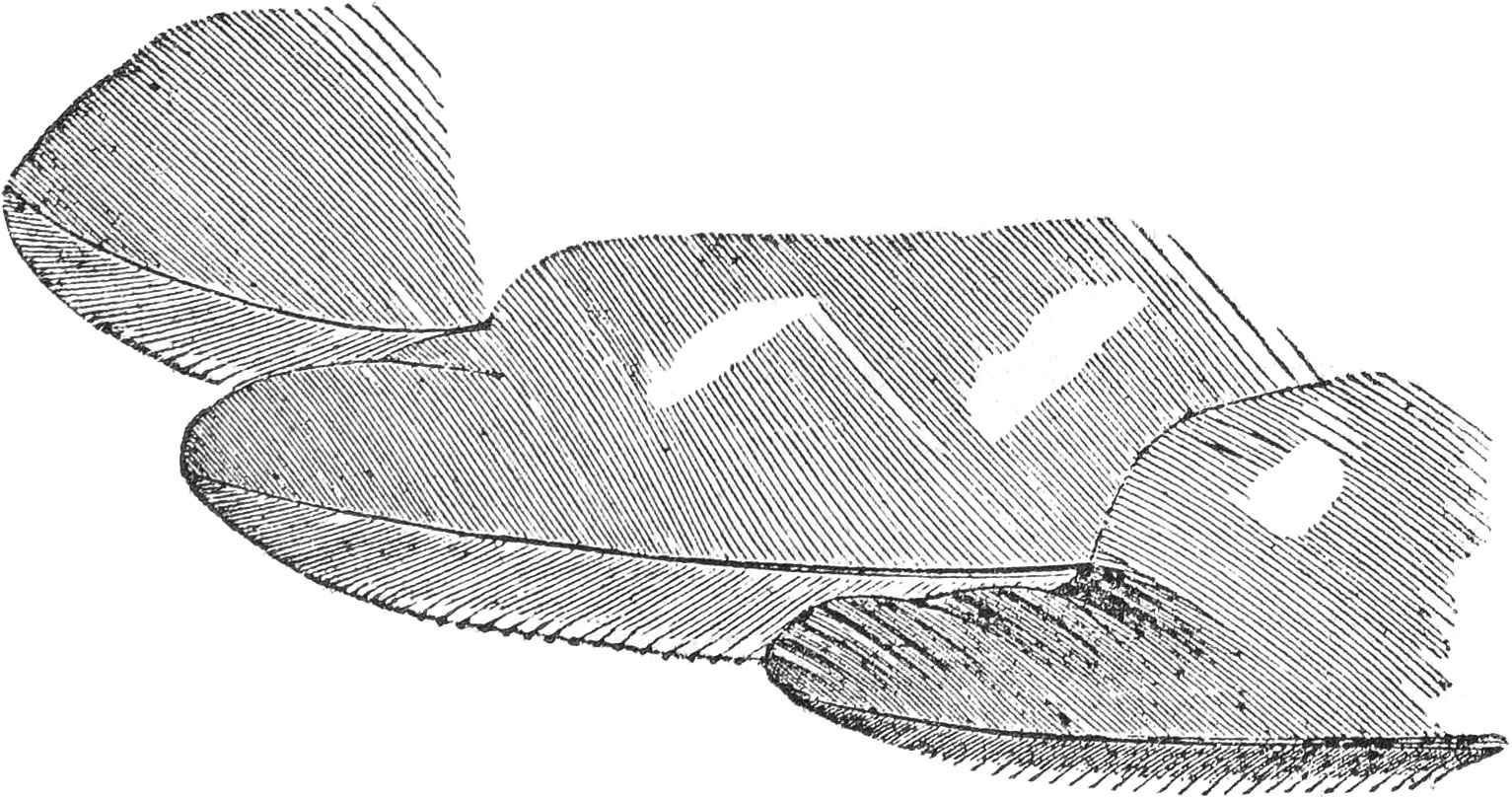
Tengmalm’s Night Owl
Noctua Tengmalmi.—Selby.
We have thought it best to exclude most of the synonyms which are sometimes applied to this species, from the confusion which has been made between it and the next. The last we have quoted with a doubt, but if correct, it will shew how long it is since this little Owl was known; “the ears great,” will not allow it to belong to the next, to which it has been generally attached. The figure of Bewick, and his description, appear also rather to belong to this than the next, except in the drawing of the legs; and it would be worth while for some ornithologist to see the specimen, and ascertain decidedly the species from which his figure was drawn.
This pretty little species is a rare bird in Britain, and can be viewed only as an occasional visitant; “several instances of his capture” are said to have “recently occurred,” but the localities have not been detailed; that in Mr Selby’s collection was killed near Morpeth in Northumberland. It seems pretty common in some parts of the continent, particularly the northern and eastern parts, living in the extensive pine forests, and breeding in the holes of decayed trees. According to Temminck, it is in a great part insectivorous, feeding on phalenæ and coleoptera; the smaller mammalia are also said to be eaten. It is found also in North America, extending to the borders of the Great Slave Lake. The plumage is remarkably loose and soft, at the same time full and ample; the fascial disk is white, shading to yellowish white, and gray towards the outer edges; while around the eyes, and on the feathers which cover the bill, it is of a dull and deep black. The ruff is well marked, and the feathers composing it are broad; opposite the conchal opening it is deep brownish black, beneath it is pale liver brown, the base of the feathers white. The head, upper parts, wings, and tail, have liver brown for their ground colour; on the nape of the base of the feathers is yellowish white, giving the appearance of a pale collar. The colour of the back is nearly uniform. The edges of the shoulders white, and also the scapulars, the latter having a narrow edging of liver brown; the greater coverts, secondaries, and quills, are marked with oval spots or bars on the outer webs. The tail is crossed with three or four narrow interrupted bars of white. The lower parts are white, clouded with liver brown; the tarsi and toes are thinly feathered with soft downy yellowish white plumes; claws rather long, slender, and sharp. Length from top of crown to extremity of the tail, from eight and a-half to nine inches.

Tengmalm Night Owl Claw

Plate XXIX
Scotophilus
Our next little Owl is that which we have just alluded to as confounded in its characters with Noctua Tengmalmi. For this form we have taken the title which Mr Swainson proposed for Noctua—that of Scotophilus. It will be seen to differ materially in the form of the ears and structure of the wings.

Noctua Scotophilus Ear
Scotophilus, generic characters.—Facial disk more imperfect than the last; conchal opening and operculum very small; wings lengthened, the quills narrow, deeply notched on the inner webs, fourth quill rather longest; tarsi thinly clothed with feathers; toes clothed with hairlike feathers, bare at the extremity.

Noctua Scotophilus Feathers
Naked-Footed Night Owl
Scotophilus nudipes.
Strix nudipes, Nilson, Orn. Swe.—Gould’s Birds of Europe.—Noctua passerina, Little Night-Owl, Selby.—Strix and Noctua passerina of modern ornithologists.
There is little doubt that the name passerina, applied by Linnæus to a small Owl, has, I may say, carelessly been given to several diminutive species on account of their size only, and without looking whether it was properly applied or not. The bird of which we have endeavoured to give a representation, is the Strix or Noctua passerina of most modern ornithologists, but it is not the S. passerina of Linnæus, or the bird to which that title was originally applied; neither can it be the Noctura minor of Ray, for that naturalist says,
parvitate sua ut quæ merula minor sit, nec alaudam magnitudine multum excedat.98
We are not satisfied, also, that it is the Little Owl of Willoughby, (Eng. ed. p. 105,) although in some points the description agrees tolerably. He says, “The ears great,”99 which would coincide much better with our last species. There seems to be little doubt, again, that the bird described by Nilson is identical with the passerina of moderns, and on this account we would prefer retaining for this the title “nudipes,” reserving the other for the small European species, which, we believe, has not yet been recorded as killed in Great Britain or Ireland.
On comparing the woodcuts which we have given of the parts of N. Tengmalmi with those illustrating this description, it will be seen that there is a very marked difference, sufficiently so to render the birds generally distinct; and in this case, perhaps the proposed term of Scotophilus, applied by Mr Swainson, might be used to designate either the true Noctuæ, of which we have placed N. Tengmalmi typical, or to be given, as we have now down, to those of similar form with the bird we are describing.
The principal distinction of form in these birds is the imperfect disk and ruff of nupides, and the small conchal opening. The annexed sketch will shew the comparative size in the two species, but being drawn from dried specimens, may not be quite correct in form. The legs and feet of Tengmalmi are covered to the very claws with thick and soft downy feathers, while in nudipes the tarsi are more lengthened, the feathering more depressed and less downy, and it ceases at the junction of the tarsus with the toes, the latter being only clothed with sparse bristly plumes on their upper surface. In the wings, the longitudinal proportion of the quills does not much vary, but in Tengmalmi the feathers are soft and broad, the two first only notched, and the whole wing shewing the provision for noiseless and sustained flight; in nudipes, the quills are narrow and stiff, the four first notched, the fifth slightly so, and shew the structure more adapted for a swift flight.
The plumage of this species, to a certain degree, resembles the last; the disk is grayish white, mottled with liver brown, particularly beneath the eyes, but it wants the dull black feathers covering the base of the bill and surrounding the orbits. The ground tint of the upper parts, as in the last, are liver brown on the head and back of the neck, having the feathers white along the centre, and ending in an oval spot of the same colour; on the back of the neck and scapulars, the feathers are white, margined with liver brown, and at the base of the same tint; on the nape, the white is most predominant, and forms a pale collar; on the scapulars, the white markings are also large, sometimes confined to the outer web; and on the back, the disunited webs of one feather lying over the white portion of the one before it, gives a clouded appearance to these parts, from the light colour shining through. The quills are marked with yellowish white bars on the outer webs; on the inner, with large yellowish or ochraceous white round or oval spots; the secondaries are barred with white, tinted with reddish brown at the margin of the bands. The tail is not so ample as in Tengmalmi, and is crossed with about four ochraceous bands; the under parts yellowish white, streaked or clouded with liver brown, the markings indistinct form the loose webs of one feather lying over another; the tarsi are yellowish white. In this species, the bill seems to be yellow in a fresh state; in the preceding, it is gray or bluish white. Length, from crown to extremity of tail, about eight and a half inches.
This bird can also only be looked on as a straggler, and the localities where specimens have been killed have not been authentically recorded. Mr Gould, however, assures me that several fresh specimens were to be seen in London during last spring. One came into the possession of Mr Leadbetter.100

Naked-Footed Night Owl Claw

Plate XXX
Otus
In the birds composing the genus Otus, Cuvier, we begin to see habits more diurnal, and a less degree of annoyance when exposed to a bright sun; more wary habits when disturbed; the irides coloured, as in the aberrant forms of the Falconidæ. The structure, however, continues all the beautiful peculiarities for nightly hunting, but the habits we have mentioned must weigh strongly in coming to a proper decision what form is entitled to rank as typical of the whole family. The head is adorned with egrets or lengthened feathers,—a modification of a crest.

Otus Beak
Otus, generic characters.—Bill comparatively short, bending from the base, and forming an eliptic curve; margins of the mandible nearly straight; nostrils oval, placed obliquely. Conchal opening large, shutting with a narrow oval operculum; auditory opening large. Facial disk complete; head furnished with egrets. Wings long, second quill longest; tail even; legs and toes feathers to the insertion of the claws; claws moderately curved, long, sharp, rounded beneath, except that of the centre toe.

Otus Ear
Note.—Habits arboreal; breed on trees in extensive woods.
Long-Eared Owl
Otus vulbaris.—Fleming.
Strix otus, Linn.—Le Moyen Duc, Buffon.—Hibou, Moyene Duc, Temminck.—Otus vulgaris, Flem. Brit. Animals.—Long-eared Owl of British ornithologists.
The characters of this form are detailed above, and the difference in the form of the ear and external conchal opening are endeavoued to the represented in the woodcut. This is an Owl of strictly arboreal habits, frequenting only the thickest woods, hunting on their skirts at evening, and breeding on trees. The sombre tints of the plumage, beautifully pencilled when inspected nearly, are more unobtrusive than that of the White Owl, and harmonize better with the seclusion of the forest. In a dull winter evening, he is frequently seen abroad before sunset; and when disturbed during the day, the flight, though sailing and buoyant, is bold and strong. He perches openly, and when approached, you can perceive his beautiful orange coloured eyes dilated, brilliant, and expressive, his long egrets raised and depressed; he is aware of being pursued, and a second flight is taken before a very near approach can be gained. This Owl generally makes use of the deserted nest of the carrion crow for his breeding-place, but we have seen it placed about half way up the tree, close to the trunk, in a situation where it was not likely there would be a previous nest. In this instance, the fabric was quite loose, and almost from the appearance of many nests we have examined, that some assistance or repair is given to the old structure by the addition of some fresh sticks before incubation is again commenced. Dr Richardson says, that the Arctic America
it lays three or four roundish white eggs, sometimes on the ground, at other times in the deserted nests of other birds in low bushes.
Four pure white eggs, of a form considerably oval, are generally laid, sometimes as early as the middle of March. Food is most amply supplied to the young, and consists principally of mice and arvicolæ, occasionally small birds.101
The Long-eared Owl is generally distributed over Britain, wherever there is abundance of wood and cover. In the South of Scotland, it is certainly the most common next to the White Owl; we have not yet, however, ascertained its range northward. In Ireland, Mr Thompson remarks, it is resident; and where a sufficient extent of wood exists, as in Down and Antrim, it is a common species. According to this gentleman’s observations, it also strays considerably from its cover, being known to be shot, in the dusk of the evening, a mile from high water mark, in Belfast Bay, by a person waiting in a barrel (sunk in the ooze) for the flying of widgeon.102 In other parts of the world, the distribution is extensive.
The colouring and distribution of the markings, in this species, is more akin to what we saw prevailed in the Tawny Owl; a chaste blending of ochraceous, white, and gray, reminding one of the shades which prevail among the Caprimulgidæ. The long egrets and brilliant eyes give to it also a peculiar aspect, and altogether it is the most striking among our native species. The ruff is complete; the tips of the feathers being black, shew almost a circle of that colour around the inner angle of the eyes, and folding over the bill; the feathers are white, bordered with the black, immediately next the eye; the outer part of the disk is yellowish brown. The forehead, and the part immediately behind the conchal opening, is finely marked with delicate undulations of gray, white, and ochraceous; the egrets are generally composed of six principal feathers, graduated in length, ochraceous towards the exterior edge, grayish white on the inner, the centre deep black, slightly broken into the edges by each colour. All the upper parts have a ground of grayish white along the shafts of the feathers, streaked with black, and barred and spotted with undulating markings of ochraceous and black; the secondaries become more distinctly barred, and the quills, towards their base, are crossed with uninterrupted bars of dull black and ochraceous or tawny; towards the tips, they became beautifully clouded with gray and blackish brown. The tail is very nearly square, the centre feathers are barred irregularly, those towards the outside decidedly crossed by black and tawny. The under parts are of a rich yellowish white, tinted on the edges of feathers with ochraceous, the centre of each black, breaking off in delicate and interrupted bars of the same tint, particularly on the flanks and lower parts of the belly. The tarsi and toes, to within one or two scalings of the extremity, are thickly clothed with yellowish white downy feathers. Claws are long, not much hooked, or of great strength; the colour wood brown, pinkish at the base during life. The irides are rich and brilliant Dutch or orpiment orange. Length is from thirteen to fourteen inches, and the form is not so robust or muscular as in the Tawny Owl. There is considerable variation in the shades of different individuals of the Long-eared Owl, and also in the closeness of the dark markings; it is, however, a well marked species, and easily distinguished from any of its foreign allies. The nearest in size and colouring is one from Mexico, which has been characterized by the Prince of Musignano.

Plate XXXI

Short-Eared Owl
The only other species of this genus belonging to the British Fauna is the bird commonly known as the “Short-eared Owl,” from the shorter relative length of the egrets or ears.

Short-Eared Owl
This bird, the Strix brachyotos, Linnæus, Otus brachyotos, Cuvier, will stand as one of our migratory or partially migratory species. In England, to the south of Durham, it is a winter visitant; but to the north of this in breeds, extending to the Hebrides, where a few specimens may be also seen during the winter months. In the 8vo. edition of Wilson’s North American Ornithology, we detailed our observations on this species. Since that period, we have had no opportunity of seeing the birds in their breeding haunts, and we therefore now give the substance of what we then wrote.
In England it has received the name of Wood-cock Owl, from appearing nearly about the same time with that bird. They perhaps then do not remain stationary, but are met with in their migration to and from the north, similar to the appearance, for a few days, of the ring-ouzels and dotterels. In spring, they are seen singly or in pairs, and in the fall, in small groups, the amount of their broods when again retiring. They do not appear to be otherwise gregarious, and it is only in this way that we can account for the flock of twenty-eight which Bewick records as seen together in a turnip field, and the instances mentioned by Mr Selby, of five or six of these birds being frequently found roosting together. In the North of England and in Scotland, they will rank as summer, perhaps permanent residents. Hoy, and the other Hebrides, where they were first discovered to breed, were considered the southern limit of their incubation; but it extents much farther, and may be perhaps stated as the extensive muirland ranges of Cumberland, Westmoreland, and Northumberland. Over all the Scottish muirs it occurs in considerable abundance; there are few sportsmen who are unacquainted with it; many being killed during the grouse season, and those individuals which Mr Selby mentions occurring on the upland muirs, most probably bred there. On the extensive muirs at the head of the Dryfe, a small rivulet in Dumfries-shire, I have, for many years past, met with one or two pairs of these birds; and the accidental discovery of their young first turned my attention to the range of their breeding; for, previous to this, I also held the opinion that they had commenced their migration southward. The young was discovered by one of my dogs pointing it; and in the following year, by searching at the proper season, two nests were found, with five eggs each. The nests were formed upon the ground on the heath; the bottom scraped until the fresh earth appeared, on which the eggs were placed, without any lining or other accessary covering. When approaching the nest or young, the old birds fly and hover round, uttering a shrill cry, and snapping with their bills. They will then alight at a short distance, survey the aggressor, and again resume their flight and cries. The young are barely able to fly by the 12th of August, and appear to leave the nest some time before they are able to rise from the ground. I have taken them, on that great day to sportsmen, squatted on the heath like young black game, at no great distance from each other, and always attended by the parent birds.103
We have since occasionally observed this Owl in December and January; by no means common, however, four or five specimens during five or six years;104 and it is most probable that the great proportion of those which breed with us return again during winter, and the bird is certainly much more abundant on the ranges of upland muir during summer than in any locality after the breeding season has been completed. Those we have seen at this season have been disturbed from whin covers or patches of long and tangled grass and bramble, sitting close at first, but afterwards very shy and wary. Mr Thompson remarks,
In Ireland, it is one of our regular winter visitants in the north. October 13th is the earliest date of its occurrence to me; and I have several times shot this Owl in the neighbourhood of Belfast, invariably in wet and boggy places, where snipes might be expected.105
The geographical range is extensive, as we have already noting; and, next to Europe, it seems most abundant on the American continent. In the United States it is a winter visitant, appearing in November and departing in April,106 most probably to some wilder direct to breed; for it is a summer visitant, again, in the fur countries, arriving as soon as the snow disappears, and departing in September. It is found as far north as lat. 67°. Its principal haunts are dense thickets of young pine trees, and dark and entangled willow clumps, where it sits in a low branch watching assiduously for mice. Its nest, formed of withered grass and moss, is placed on a dry spot of ground; and, according to Mr Hutchins, it lays ten or twelve small round white eggs.107
In the markings of this species we have the same prevalence of tawny and black, or deep umber brown, which we have seen in most of the preceding birds, but it is without that blended very undecided and wavy character which we see so beautifully disposed in the Long-eared and Tawny Owls. The head and disk are comparatively small, the latter complete; the egrets in the male are nearly an inch in length, composed of about six feathers, liver brown on the centre and outer edges, buff orange on the inner webs. The disk around the eyes is black, extending outwards to a greater or less degree in different specimens, and in some reaching almost to the margin of the ruff. The external half of the disk, however, is generally yellowish brown, the shaft of the feathers black above the eyes, and where they cover the bill, nearly white tinted with gray; the very edge of the disk is white, and coming in contact with plumes forming the ruff, which are white at the base, causes the appearance of a white circle. The feathers composing the ruff are white at the base, mottled towards their tips with yellowish orange and black, except opposite the conchal opening, where they are wholly of the latter colour. The upper parts are buff orange, having the feathers broadly marked in the centre with liver brown, sometimes having a purplish tinge; on those immediately folding over the wings the marginal edgings of light are broader, often approaching to yellowish white, and here forms the conspicuous stripe which we have seen in most of the Owls; on the shoulders the markings are also larger and of purer tint, and on the secondaries they assume the form of irregular bars. The quills are nearly pure white at the base of the outer webs, shading into pale buff orange; for half their length nearly free from spots or bars, but towards the extremity distinctly marked with three or four bars of liver brown,—after the fifth quill they become more clouded; the inner webs are pale buff orange, clouded with liver brown and gray, which becomes near the tip the prevailing colour. The tail is pale buff orange, the feathers becoming nearly pure white to the outside; they are marked with distinct bars of liver brown; the two centre feathers clouded in the pale intervals with the same colour; the outer web of the last feather is often altogether spotless. The under parts are pale buff orange, shading into pure white on the vent and lower tail-coverts; the throat and breast broadly streaked with liver brown along the centres of the feathers; the streaks narrowing in breadth on the belly and flanks, becoming nearly linear on the vent, and finally disappearing entirely. The interior of the wing nearly pure white, on which the dark bars on the inner webs appear more conspicuous and decided; the tips of the under wing-coverts are liver brown, and form a lengthened spot or bar across. The tarsi and feet, to within the third scale, are covered with close and fine yellowish white downy feathers.
In different specimens, the buff orange is often much deeper in intensity, and of a clearer shade; in the female it prevails more on the lower parts, the marking on the back and wings is more solid or massed together, and the egrets are shorter, often so much so as to be scarcely visible. In a Chinese specimen before us, apparently a female, we have the marking remarkably bold and distinct, the lighter tints very vivid.
The irides bright gamboge yellow. Length generally from fourteen to fifteen inches.
Bubo
Cuvier has employed the title Bubo to distinguish those Owls which have the tarsi feathered and the head adorned with egrets, as in the genus Otus, but having the facial disk more imperfect and the conchal opening small. He assumes for the type the European Eagle Owl; the Large Virginian Horned-Owl is also closely allied, and we believe the form extends to Africa and India. The birds are all of large size; the habits partly sylvan and nocturnal, but they breed in bleak and woodless regions. When distributed during the day, they do not shew that great sensibility to light which the White Owl and its congeners display.
Bubo, generic characters.—Bill short, strong, and bending from the base, edges of the mandible slightly sinuated; nostrils large, oval; facial disk incomplete above the eyes; head furnished with egrets; conchal opening small, no operculum? wings rather short, concave, third and fourth quills longest; legs and toes feathers; claws long, sharp.
The Great-Eared Owl, or Eagle Owl
Bubo maximus.—Sibbald.
Bubo maximus nigri et fusci coloris, Sibbald Sc. Illust. ii. p. 15.—Strix bubo, Linnæus.—Le grand duc, Buffon.—Great-eared or Horned Owl, Eagle Owl of British ornithologists.—Provincially, Orkney, Katogle or Stock Owl.
The description of the habits of the Eagle Owl, by one who has observed it in a wild state, is yet a desideratum in a history of British birds. Northern Europe seems to be the stronghold of this fine species; Norway, Russia, and Germany, are given by ornithologists as the countries where it most abounds, but its rank, as a British species, rests only on a few instances of its capture, and on one or two records of its appearance, which are by no means circumstantially detailed. “In Orcadibus,” is all that Sibbald tells us, and the Orkneys have been handed down as a locality, without the instances of its capture being regularly and authentically recorded. Dr Neill, in addition to the account given by Dr Barry, says,
it may be added that it often attacks rabbits and red grouse, which are abundant in several of the islands,
thus implying that (in 1804) the bird had either been lately seen or heard of. Montague states, that it has been shot in Yorkshire and Sussex, also in Kent;108 and Mr Selby, in a note, states,
I have been lately informed, from good authority, that one of the above species was killed on the upland muirs in the county of Durham some years ago.
In Ireland Mr Thompson has not seen it, but Mr Stewart in his catalogue of the birds of Donegal remarks,
Four of these birds paid us a visit for two days, after a great storm from the north, when the ground was covered with snow; they have not since been found here: as I am informed that a pair of them breed on Tory Island, about nine miles to the north of this coast, it is probable that they came from that island.109
So far as we understand the habit of this bird, it continues in the seclusion of the forests or wooded precipices during the day, hunting in the twilight, perhaps during dull weather at all times. Temminck gives ruined buildings as occasionally selected for its breeding places, also the clefts of rocks; Mr Hewitson mentions its nest as place on the ground in bare and bleak rocky districts; the number of eggs is said to be from two to four, rarely the latter, of considerable size, pure white, like those of all the Owls we are acquainted with, and of a rounded form.
In confinement this bird is easily kept, and becomes to a certain extent acquainted with its keeper, or those immediately near it. One which we kept for some years excited much interest, and we shall again transcribe our note on its manners.
An Eagle Owl in my possession remains quiet during the day, unless he is shewn some prey, when he becomes eager to possess it; and when it is put within his reach, at once clutches it, and retires to a corner to devour at leisure. During the night he is extremely active, and sometimes keeps up an incessant bark; it is so similar to that of a cur or terrier, as to annoy a large Labrator house-dog, who expressed his dissatisfaction by replying to him, and disturbing the inmates nightly. I at first also mistook the cry for that of a dog, and without any recollection of the Owl, sallied forth to silence the disturber of our response, and it was not until tracing the noise to the cage that I became satisfied of the author of our annoyance. I have remarked that he barks more incessantly during a clear night in winter than at any other time; and the thin are at that season makes the cry very distinctly heard to a considerable distance. This, however, is not the only call; when much annoyed either at some stranger, or the appearance of any larger animal, he will utter a loud hoot or “hoo,” snapping at the same time loudly with the bill. This bird shews a great antipathy to dogs, and will perceive one at a considerable distance; nor is it possible to distract his attention so long as the animal remains in sight. When first perceived, the feathers are raised, and the wings lowered as when feeding, and the head moved round, following the object while in sight; if food be thrown, it will be struck with the foot and held, but no farther attention at this time paid to it.110
From the characters we have given at the commencement of this description, it will have been seen that this bird is fully entitled to different generic rank from the “eared birds” we have been last describing; but the colours of the plumage, consisting of black and ochraceous, or buff orange, and their irregular distribution, correspond nearly with the birds composing the genus Otus. This is a bird of great power and strength, and during the night, or when roused during the day, exhibits a fierce and active appearance. The disk and ruff are small and incomplete, grayish black, tinted with ochraceous, and margined round the occipital edges with black. The egrets, which are fully two inches long, are deep black, slightly edged with ochraceous yellow on the inner sides. The whole upper parts, including the wings and tail, have a ground shade of ochraceous yellow, with the centre of the feathers black, which broadens at the tips, and at the sides is shaded off in light wavy mottles of a similar tin. On the greater coverts and secondaries the markings assume the form of indistinct bars from their greater crowding, while along the shaft the dark colour is continuous. The quills on the inner webs are of a brighter tint of ochraceous, and are there crossed with distinct narrow bars of black; on the outer webs, the bars, though distinct, are yellowish brown, clouded with a darker shade, and generally edged next to the ground colour with an irregular darker margin; towards the tips the dark colour predominates, and is there mingled with gray. The ground colour of the tail is paler than that of the quills, and it is crossed with mottled bars of brownish black; the pale spaces towards the tips, and on the centre feathers, being also thinly mottled; on the inner webs the bars are very narrow. When viewed from the lower side it is much paler in colour, the bars appear all narrow, and the mottling on the intermediate spaces scarcely appears. On the under parts of the body the same ochraceous tint prevails; the chin is white; on the throat, breast, and belly, the feathers are broadly streaked with black, which breaks off to the sides in interrupted bars; on the other parts of the belly, vent, flanks, and under tail-coverts, the shaft is black, and the feather is crossed with numerous irregular bars of brownish black, nine or ten sometimes being counted on one feather. The tarsi and toes are clothed as in Otus, and are crossed with indistinct bars of brownish black. The irides are brilliant and bronzed orange. Length of the male about twenty-two inches.

Plate XXXII
Scops
The genus Scops, Savigny, forms a beautiful little group, which seems distributed over Europe, Asia, and parts of Africa; it is composed of individuals distinguished by their small size, their imperfect disk, egrets on the head, very thin lengthened legs, and soft plumage. Habits are arboreal and nocturnal.
Scops, generic characters.—Bill curved from the base, weak; nostrils round; facial disk very incomplete, wanting above the eyes; head with egrets; conchal opening very small; wings long, third quill longest, first and second slightly cut in near the tip of the inner webs; tail short, even, or slightly rounded; legs rather long, feathered with short plumes to the insertion of the toes; toes reticulated, except the extremity of the first joint.
The Scops-Eared Owl
Scops Aldrovandi.—Willoughby.
Scops Aldrovandi, Willoughby.—Strix scops, Linnæus.—Hibou scops, Temminck.—Scops-eared Owl of British ornithologists.
The Scops-eared Owl is a very rare British visitant, being principally found in the southern districts of Europe, and even there it is migratory, appearing only in the summer months, and in France arriving and departing with the swallow. The instances of its capture in Britain are not very well recorded. There is a specimen in the Foljambe collection, which was believed to be shot in Yorkshire; Mr Fothergill of York has another, which was shot in the spring of 1805, near Weatherby, in the same county;111 Mr Selby gives his representation from a specimen said to be killed in the vicinity of London, and mentions in a note having seen a specimen killed near York, in the possession of Mr Bewick,112 and it is stated to breed in “Castle Edendene,” near Stockton-on-Tees.113
Its habits from observation we cannot detail; from all accounts it seems most abundant, and has been most observe din Italy. Spalanzani is among the first who detailed its habits, and gives its favourite residence as lower wooded regions. Mr W. Spence, who has noticed it more lately, and in a notice in Loudon’s Magazine, observes that one established itself in the garden belonging to his house at Florence, where it constantly uttered its cry from night-fall to mid-night, as intervals between each other as regular as the ticking of a pendulum.114
It is possible to convey by words an idea of the beautiful penciling on the plumage of this little species. It is a delicate blending of smoke gray, chestnut, and yellowish brown, streaked, barred, and speckled with black. On the upper parts the dark markings run along the shaft divaricating into ragged bars; on the breast and belly they are broad streaks along the shafts, the feathers otherwise mottled with zigzag bars of the same colour; the egrets are composed of several feathers with dark centres; the ruff is yellowish white at the base, becoming ochraceous and tipped with black; the disk surrounding the eyes, and composing the face, is smoke gray, very delicately penciled with brown. The feathers on the back white immediately lie over the wings, are rich yellowish white, with dark edges and tips, and from a conspicuous mark as in the Tawny Owl. The secondaries have an oval white spot on the outer web of each, which forms an interrupted bar across the wing. The quills are mottled with brown, or pale yellowish, or greyish brown, on the inner webs having bars formed by the markings being darker, more solid, and more arranged as blotches; on the outer webs interrupted by alternate bars of white, generally edged with a deeper shade. The tail is very slightly rounded, barred alternately with a mottled space, one of a deeper tint, and more clouded arrangement, and one of yellowish or reddish white. The tarsi are covered with yellowish white feathers, streaked with brown down the centre; feet are of bluish yellow; claws horn colour. Irides are described to be of king’s yellow. Length from crown of head to extremity of tail about seven inches and a half; from the same point to end of quills, about eight inches.

Plate XXXIII
Surnia
The genus Surnia, Dumeril, exhibits the form which leads from the nocturnal, again to the diurnal, birds of prey. The form is very powerful; the head small, the ruff nearly wanting, the facial disk small, and placed with a more lateral inclination; the plumage more rigid, and the wings formed for pursuing flight. Birds hunt by day as well as during the twilight.
Surnia, generic characters.—Bill short but strong, slightly sinuated, and compressed upwards at the base; nostrils oval, and placed obliquely; disk small, retracting laterally; ruff nearly wanting; conchal opening small; no operculum; wings of mean length, rigid, third quill longest, three or four first deeply notched; legs and toes muscular, thickly clothed with long plumes, having cetaceous webs; claws long, sharp, much incurved and slender towards the tips; plumage rigid.
The Snowy Owl
Surnia nyctea.—Selby.
Strix nyctea, Gmel.—La chouette Harfang, Buffon, Temminck, Man. d’Ornith.—Snowy Owl of British ornithologists.
This magnificent species is of very rare occurrence on the mainland of the British islands, being more particularly a native of the countries verging upon the arctic circle, whence it reaches to our own more northern islands, and whence, again, occasional stragglers have been capture in the interior of Britain and Ireland. Mr Bullock, in 1812, during his tour to Orkney and Shetland, met with this species, and seems to have been the first to have directed our attention to the fact of their being resident and breeding there. He first met with the species among the sand-hills of Orkney, to which they had resorted for the sake of preying on the rabbits, and afterwards succeeded in procuring specimens on Unst in Shetland, and ascertaining that it bred there and on the island of Zell. Mr Edmonstone, about the same period, presented a specimen to Mr Bullock, which perhaps had induced that gentleman to search for it himself; and since its discovery there, several specimens have been procured, some of which are now in the Edinburgh Museum, and others in private collections. One of the latest captures was sent alive to Dr Neill, Canonmills, in whose garden it spent some months. In England, the instances of its capture are more rare. Montague mentions a specimen in possession of Mr Bullock, which was understood to have been killed in the vicinity of Norwich; and the collection at Twizel House possesses two specimens, which were killed near Rothbury, in Northumberland, during the winter of 1823. In February last a fine male was shot below Selby-on-the-Moor in Yorkshire.115 In Ireland, it has been more frequently seen. Mr Thompson communicated the capture of one to the Zoological Society in 1835, of which he has now enabled us to give a more full account.
About the 26th of March, 1835, a specimen of this bord was sent in a recent state to Dr Adams of Portglenone, by a person who had shot it a few days before in that neighbourhood, and who stated that a similar individual had been seen about the place where it was obtained.
Other specimens have also been seen.
On the 21st On the 21st of the same month, as two of my friends were out snipe shooting at Bruslee, about twenty miles to the south-east of Portglenone, a large white Owl, represented by them as twice the size of the common species of that colour, rose from the heath within a few yards of one of them, who had just discharged both his barrels at a snipe. In Dublin, I subsequently saw a Snowy Owl which had been shot in the County of Mayo, also in the month of March; and am credibly informed that a few others were obtained about the same time in different parts of Ireland. One may be mentioned as having been received from the county of Longford, on the 5th April, by a bird preserver.116
In Europe, the Snowy Owl is found also in Norway, Sweden, and Lapland, but nowhere abundant, and Temminck records it as an occasional visitant to the North of Germany. In North America it seems more plentiful; Wilson mentions having examined eleven specimens within fifteen months, shot in various parts of the United States, and is of opinion that a few remain through the summer in the more northern inland parts, where they are most numerous during winter.117 Dr Richardson says that it frequents,
in summer, the most remote arctic lands that have been visited, but retires with the ptarmigan, on which it preys, to more sheltered districts in winter.
It has been
now and then known to wander as far south as Florida.118
Mr Edmonstone’s description of the habits in a wild state appears the most complete we have yet read, and is taken from observation. It rests generally beneath some stony projection, which protects it from the direct influence of the sun; and some instances have occurred of its being surprised asleep during the day, and forfeiting its life to its supineness.
Its form and manner are highly elegant; its flight less buoyant, and more rapid, than that of the other Owls; and the superior boldness and acuity of its disposition, the uncommon size of its talons, and vigour of its limbs, secure it against danger from feathered enemies.
It affects solitary, stony, and elevated districts, which, by the similarity to it in colour of the rocks, render it difficult to be discovered, and by the inequalities of their surface, afford it shelter from the rays of the sun; but on the approach of twilight, it may be seen perching on the exposed eminences. It then quits its haunts and frequents the cultivated fields, prowling over the low grounds in quest of mice and small birds When first observed to leave its retreat, it is frequently assailed by crows and other birds; but it receives their attacks rather as an amusement than an annoyance, and dashes through the air, despising their hostility.
It preys chiefly on sandpipers, on which it pounces with precision and agility as it skims along the marshes. The specimen given to Mr Bullock’s museum had an entire one in its stomach when I shot it, and a mouse perfectly whole was taken from that of the present specimen.119
Dr Neil has kindly furnished us with the notes which he kept of the habits of the specimen alluded to. This bird continued for a year and a half in his possession vigorous and healthy.
In the beginning of May, 1835, 1 received, at Canonmills Cottage, a live specimen of the Snowy Owl (Syrnia nyctea.) It came in a sort of crib by a trading vessel from Orkney, and arrived in tolerably good plight. A letter from Robert Scarth, Esq. of Skae in Sanda, informed me, that
about the middle of the preceding month of April, a very heavy north-wester had set in, with showers of hail and cold sleet. A large bevy of rooks, snow-flakes, swans, golden-eye ducks, and other northern strangers, were driven by this storm to the island (of Sanda.) A day or two afterwards, a large owl was remarked prowling about the rabbit links (or warrens.)’
Mr Scartb concluded, from the size and appearance, that it must be the Snowy Owl, a rare visitant, not a regular inhabitant, of the Orkneys. He therefore diligently followed the bird till he got within shot, when he fortunately hit one wing, so as to disable from flying, but without other injury. The bird fluttered along the downs, and, when brought to bay, made a stout resistance. It was, however, secured; and the wound having healed, the specimen was dispatched to me as already mentioned.
It was pretty evidently a young bird, or only in its second year, being much spotted and barred with brown. I therefore entertained little doubt of taming it to a considerable extent. I got a very large cage, or rather small house, expressly constructed for it, in which the bird could either squat on the ground or perch aloft, and with a boarded chamber in which it could seclude itself from the light. The care of it was confided to my very intelligent and respectable gardener, Mr William Lawson, (now nurseryman and florist near Glasgow,) who paid every attention to it. It was at first exceedingly timid and shy, and often fasted for twenty-four hours although meat was placed within its reach. For several weeks, therefore, the gardener fed it by literally forcing the meat down its throat. The food was bullock’s liver, or any kind of butcher’s-meat, and occasionally a pigeon or rabbit cut in small pieces.
During the summer and autumn of 1 835 it moulted, and the new plumage was a good deal lighter, or less speckled and barred than formerly. From this change of colour, and from recollection of the relative size and appearance of the sexes in museums, I concluded that the bird was a male. Mr Audubon, the celebrated American ornithologist, happening to visit Canonmills in the course of the season, saw the bird, and, from his intimate knowledge of the same species in North America, at once confirmed our conjecture as to its being an immature male.
I must confess that we did not succeed in taming the owl to the extent which we at first expected. He always remained rather shy and suspicious. What was remarkable, he would allow a live mouse or sparrow to be placed in the cage beside him without touching the tempting prey, at least in our presence. He evidently recognized Mr Lawson and myself, and was little moved at our appearance; but on the approach of a stranger, he opened his mouth, and hissed, or fuffed like a cat, keeping his mouth open as long as the intruder remained near. If much alarmed, or suddenly surprised, he produced a snapping noise or clank, by striking the two mandibles together. The gardener could put his fingers into the owl’s mouth, without having them nipped, or without the bird’s attempting to bite. Perhaps this was the result of habit or education, from Mr Lawson having daily fed him in that mode for some weeks. But the claws were evidently the principal offensive weapons on which the animal depended, and they were sharp, dangerous, and powerful. Mr Lawson observed that, latterly, when he got a favourite piece of meat, he transfixed it, and held it firm with the claw of the back or inner toe, in the manner of our Vulture (Cathartes papa); not with the fore-toes and claws like our Eagle (Falco albicilla). Mr Audubon mentioned, that a Snowy Owl, kept in confinement by him, used to feed on small fishes, or pieces of fish, placed in water, but our bird declined that sort of food. On one occasion the gardener forced a small fish down his throat, and next day the bones were vomited in the form of a pellet, being the only instance in which we observed this circumstance. When a pigeon was given to him, we had to pluck off the feathers before he would touch it.
The hoot of our Owl consisted of two notes, somewhat resembling the call of the cuckoo, but shorter or quicker. He also occasionally uttered a single unharmonious note, not unlike the croaking of a large frog. He did not appear to be in the least distressed by the light. The shaded apartment was an unnecessary precaution, for whenever entered it during the day; indeed, he was rather more lively in the morning than in the afternoon, staring abroad with his bright orange eyes at all that was passing. The Snowy Owl may therefore be set down as a diurnal species, or belonging to the Accipitrine family of Temminck.”
The birds killed in Northumberland frequented a wild and rocky part of the open moor, and were generally seen perched on the snow, or on some large stone projecting from it.120 Dr Richardson says that
it hunts in the day. When seen on the barren grounds, it was generally squatting on the earth, but if put up, alighted again after a short flight, but was always so wary as to be approached with great difficulty. It preys on lemmings, hares, and birds, particularly the willow grouse and ptarmigan. I have seen it pursue the American hare on the wing, making repeated strokes at the animal with its foot.121
Wilson mentions it feeding on carrion occasionally, which he has perhaps borrowed from the account of Hearne, and he also corroborates the account of its hunting by day, and records the bird as a fisher.
He is particularly fond of frequenting the shores and banks of shallow rivers, over the surface of which he slowly sails, or sits on a rock a little raised above the water, watching for fish. These he seizes with a sudden and instantaneous stroke of the foot, seldom missing his aim.122
By some, the nest is described as built on the ledges of precipitous rocks. Dr Richardson says,
it makes its nest on the ground, and lays three or four white eggs.
The nest may be differently placed in different localities; thus the same author records the Long-eared Owl as sometimes breeding on the ground in North America. The plumage of this Owl will be shortly described, the adult birds in the full breeding plumage having a much greater proportion of white. In almost all states, however, except that of the nestling plumage, the face, throat, under sides of the wings, and legs, are pure white; the plumes clothing the face, and covering the base of the bill, have the webs much disunited, and are long and rather rigid; the nostrils, and almost all except the tip of the bill, is concealed, and under the chin, the feathers close to the under mandible fold up, and in a manner half to conceal it also; those covering and behind the ears, are remarkably close, somewhat downy, and form a soft and close protection. The whole plumage is pure white, having the tips of the feathers brownish black or black, and the rest of the feathers crossed with decided bars of the same colour; on the inner webs of the wings, the bars are incomplete, and are only marked next the quill; on the tail, they are often wanting on the outer feathers. In the males, the plumage has fewer barred markings, and they are of a deeper black, the head and upper portion of the back and neck being sometimes nearly without them; in the female, the markings assume a tint of brown. The tarsi and feet are thickly clothed with plumes, having the webs unconnected, and assuming the form of thin bristles; they often entirely conceal the hinder claw, and when the bird is at rest, nothing but the tips of the claws are visible. The irides are gamboge yellow. The dimensions of a female killed by Mr Edmonstone was, in the extent of the wings, five feet five inches; the weight five pounds.
A female in our own collection, from Orkney, is in length, from the crown to the end of the tail, about twenty-five inches. It is by blending the manners of this bird with those of the true Hawk Owls, in conjunction with their form, that we are brought back to a close reunion with the true diurnal Raptores; and we have another bird only to mention, which has been placed with them, but of whose real station we are not at present quite certain. This has very slender claims to a place in our present volume; but as it does not reach very near to our boundaries, we have deemed it proper, in conclusion, shortly to notice it.

Plate XXXIV
The Hawk Owl
The Hawk Owl, Surnia? funerea, whose form we have endeavoured to represent in the accompanying wood-cut, is recorded to have been taken a few miles of the coast of Cornwall, on board a collier, in a very exhausted state.

Hawk Owl
It was brought safely to land, and survived for some weeks. It is a species not uncommon in Northern Europe, and it would not be surprising that individuals should occasionally stray to the shores of Britain, as well as those other small migratory species which are only rare stragglers. It is also an inhabitant of North America, particularly in the fur countries. In form it is more lengthened and hawk-like than any we have yet described, it frequently flies by day, and is frequently shot by the Hudson Bay hunters when in pursuit of the ptarmigans.

Owl
- A Nomenclature of British Birds, being a Systematic Catalogue of all the Species hitherto discovered in Great Britain and Ireland, intended for labelling Collections. By Henry Doubleday. 1836 [1841 edition].
-
One or two works have been omitted, which, though they should be mentioned as indicating the progress, are not at all necessary for the British ornithologist,—Lord’s British Birds, published in 1791, folio, with ninety-six plates; Hunt’s British Ornithology, published in 1815, reached thirteen parts, with twelve plates in each; Syme’s British Song Birds, published in 1823, a work with very pretty figures, and good directions for breeding and rearing cage birds; Rennie’s edition of Montague’s Ornithological Dictionary, published in 1831.
Among the very modern works may be noted, Eyton’s Rarer British Birds, a useful supplement to Bewick, Mudie’s Feathered Tribes, Wood’s Song Birds, and Macgilivray’s Raptores, &c.; and we are waiting with anxiety to see the first number of a new work, from which we expect much, British Birds by William Yarrell.
- We must here offer our acknowledgements to William Thompson, Esq. of Belfast, for all the information we have been able to give regarding the Raptores of Ireland. That gentleman has kindly communicated to us the results of his observations on this part of the Fauna of Ireland; and we have strong anticipations that ere long he will advance our knowledge of the Fauna upon an equality with what Mr Mackay has done for that of the Flora.—See the detailed paper, Mag. Zool. et Bot. ii. p. 42.
- This is the Rachmah of Bruce, who states that it is a very great breach of order, or of police, to kill or molest these birds near Cairo.—App.
163207. - Mr Mundie, in his “Feathered Tribes,” mentions a pair having been seen in the vicinity of Bridgewater in 1826, but he does not notice the above. Has he mistaken the place and date of the capture?
-
Audubon, speaking of the Great-footed Hawk, (Peregrine Falcon,) remarks,
They occasionally feed on dead fish that have floated to the shores of the sandbars; I saw several of them thus occupied while descending the Mississippi, (vol. i. p. 87.)
This is at variance with every thing I have observed regarding the habits of the British Peregrine; but in confinement, I have known the young to have been fed upon trouts.
- See some interesting remarks on the anatomy of birds of prey by Mr Yarrell, Zool. Journal, No. X. p.
151181. - Yarrell, l. c.
- See paper by Mr Macgillivray “On digestive organs of birds,” in Mag. of Zool. and Bot. vol. i. p. 125.
- We are not satisfied that the bird described in the Linnæan Society’s transactions from their museum, as the Peregrine, is identical with the bird of Europe. We possess a New Holland Falcon, closely allied, but quite distinct.
- See description for our opinion of the distribution of this species.
- Edinburgh Journal of Natural and Geographical Science.
- Proceed. of Zool. Society, part i. p. 114.
- British Ornithology, vol. i. p. 49.
- Proceed. of Zool. Society, part ii. p. 80.
-
Mr Gould states in his “Birds of Europe” that the falconers who visit this country with their trained falcons for sale, all agree in declaring, that the Jer-falcon, which they obtain in Norway, is a different bird from that which they consider the true falcon of Iceland. It differs in the length of the wings compared with that of the tail. Those from Iceland are most rare.
The sport of falconry has been long in almost complete disuse, but may be said to be now commencing its revival. Several gentlemen at present possess regular hawking establishments. As a royal appointment it is still kept up, and the accompanying extract will shew that it is not merely nominal:—
Friday being the return of the Duchess of St. Alban’s natal day, it was intended to devote the morning to a hawking party, but the weather was so stormy that the display of falconry was obliged to be postponed till Monday. At noon on that day, the Grand Falconnier repaired to the Downs, about two miles this side of the Dyke, near the old Henfield-road, with his matchless hawks. Eight flights were made, and each time they killed their bird, with a single exception, when the pigeon being struck very hard it towered so high that the falcon could not reach it again. In one case, the bird, after being struck, flew under the carriages for shelter; but the dauntless hawk, which is distinguished by the name of General, pursued him so closely that the had a narrow escape of being trodden under foot by the affrighted horses. In one instance, when one of the falconers alighted from his horse to retake the hawk, the animal started off at full speed, but was pursued and overtaken by his Grace. With the exception of two, all the hawks used on Monday were young birds. There were many more equipages on the ground to witness this novel sport than our late races attracted, with a great number of hired vehicles, and horsemen and pedestrians by the hundred. After the sports of the field, their Graces gave a public breakfast at St Albans’ House, at which two of the falcons, “the Duchess” and “the General” were exhibited to the company, and much admired.
—Brighton Guardian, 1836.
- A specimen of the Jer Falcon was shot at Storthwaite, a few miles from York, on the 15th of last February.—Thos. Allis, York, Naturalist, No. vii. p. 53.
- Mr Yarrell mentions that two specimens of eggs in his collection, “believed to belong to this species,” are “mottled all over with a pale reddish brown on a dull white background.”—Brit. Birds, p. 28.
- Northern Zoology, ii. p. 27.
- Richardson, l. c.
- Selby MSS.
- Richardson, No. 2, c. 29.
- Mag. of Zool. and Bot. vol. ii.
- One of Mr Sinclair’s Falcons having killed a Landrail, which it was about to eat on a house top, instantly gave chase to another Rail that was sprung, and still retaining its first victim, secured the second with its other foot, and bore both off together.
- Faun. Bor. Am. ii. p. 24.
- Audubon, Orn. Biog. ii. p. 88.
- Faun. Bor. Am. ii. l. c.
- We say “if correct,” because we have not examined specimens from either locality, and cannot, therefore, speak decidedly. The authority of Dr Horsfield and Mr Vigors is good.
- Colonel Thornton knew a Hawk cut a Snipe in two.
- Mag. of Zool. and Bot. vol. ii.
- The name of Lanner was applied to a bird clearly resembling the young of the Peregrine, and from the alliance of the species seems also occasionally to have been given to the real young of this bird, and consequently has made confusion by leading some to believe that the true Lanner was a British bird. The true Falco lanarius of Linnæus, however, is scarcely authentically ascertained; it seems to be a distinct but rare bird of southern Europe. Mr Gould has given a figure from specimens furnished to him by Mon. Temminck, and describes it as intermediate in form between the Jer Falcon and the Peregrine. See Birds of Europe.
- Brit. Ornith. i. p. 43, 2d edit.
- See Mag. of Zool. and Bot. vol. ii.
- Temm. Man. i. p. 27.
- Brit. Birds, p. 42.
- See Mag. of Zool. and Bot. vol. ii.
- Magazine of Zool. &c. iv. p. 116.
- See Proceedings of Zool. Society, 1835.
- Gould’s Birds of Europe. Mr Yarrell mentions one or two additional instances in his Brit. Birds.
- The only place of this kind, in the vicinity of Belfast, that I know to be selected for the purpose of nidification, is the tower of Ballyleston Church, which, of the many edifices of this description in our populous neighbourhood, is the only one which contains a set of musical bells.—W. Thompson, in Mag. of Zool. and Bot. vol. ii.
- Vaccinium myrtillus.
- Mr Selby mentions having taken a Kestrel in a trap baited with a bird.—Vol. i. p.
6886. - Mag. of Zool. and Bot. vol. ii.
- Mag. of Zool. and Bot. ii. p. 57.
- W. Thomp. Mag. of Zool. and Bot. ii. p. 171.
- See Plate II. fig. 3.
- Pennant mentions having seen Indian drawing of this species.—Br. Zool. vol. i.
- This includes, however, both the Sea and Golden Eagles; nevertheless the number of old birds is great.
- Montague, Supplement.
- See Mag. of Zool. and Bot. vol. ii. p. 45.
- Richardson.
- Ornith. Biog. ii. p. 466.
- Mag. of Zool. and Bot. ii. p.
4645. - Such situations, according to Mr Thompson, are the most commonly selected eyries in Ireland, and there the Sea Eagle seems far from being rare. The Horn-head, Malin-head, the extreme northern part of Ireland, Achil-head, and Fair-head, a basaltic promontory in Antrim, are among its maritime stations; and they breed inland among the Mourne mountains.
- Mr Thompson describes a nest on the “Horn-head,” as composed in its “first layer: it was composed of strong stems of heather, and was lined with the tender twigs of heath, and with plants of Luciola sylvatica.”—Mag. of Zool. and Bot. II. p. 47.
- In spring I have seen the White Tailed Eagle apparently paired with Osifragus, and I have reason to believe that they breed together.—J. V. Stewart, Esq. Loudon’s Mag. of Nat. His. v. p. 580.
- See Wilson’s North American Ornithology, where the history will be read with interesting.
- Temm. Man. Supp. p. 16.
- The upper figure is from a New Holland specimen.
- Audubon’s Orn. Bio. I. p. 369.
- Lardner’s Encyc. p. 319.
- Brit. Ornith. i. p. 59.
- See Mag. of Zool. and Bot. II. p. 174.
- Temminck, Man.
- Faun. Bor. Am. ii. p. 53.
- Orn. Biog. ii. p. 378.
- Mag. of Zool. and Bot. vol. ii.
- Richardson Faun. Bor. Am.
- Illust. of Ornithol. N. S. Plate I.
- See Mag. of Nat. Hist. vi. p. 447.
- Mag. of Nat. His. vi. p. 447.
- Willoughby’s Ornithology, p. 72.
- Selborne, 4to edit. p. 109.
- Represented Plate I. of Ornithological Illustrations, new series.
- “Whew,” as the shepherds and keepers call it.
- See 11 Anne, ch. 7, quoted in Mag. of Zool. and Bot. II. p. 172.
- Plate LXVI.
- Willoughby Ornithologica, p. 72.
- Dictionary and Linnæan Transactions.
- In Hutchinson’s History of Cumberland.
- Wilson’s N. A. Ornithol. Edited by Sir W. Jardine, III. p. 392.
- Dict. Supp.
- Northern Zoology, II. 55.
- Hutchinson’s Cumberland.
- Birds of Europe.
- W. Thompson, Mag. of Zool. and Bot. ii. p. 175. We do not know the character of these Irish mountains, but we have not known the bird to breed in Alpine regions.
- Temminck, Manual d’Ornithologie.
- See Magazine of zoology and Botany, ii. p. 178.
- Mr Spence, in Louson’s Mag. of Nat. His. v. p. 655.
- Loudon’s Mag. of Nat. Hist. vii. p. 146.
- See woodcut.
- Magazine of Zool. and Bot. ii. p. 178.
- Magazine of Zool. and Bot. ii. p. 178.
- Dictionary.
- Hewitson.
- Loudon’s Mag. of Nat. Hist. vii. p. 146.
- Loudon’s Mag. of Nat. Hist. i. p. 179.
- Ray, Syn. Method. Av. p. 26.
- Willoughby, Ornith. pl. i. p. 105.
- Mr Yarrell, in his Third Number, mentions several instances of its occurrence in England.
-
It preys chiefly on quadrupeds of the genus arvicola, and in summer destroys many beetles.
North. Zool. ii. p. 72.
- Mag of Zool. and Bot. ii. p. 177.
- Wilson’s North American Ornithology, edit. Sir W. Jardine, ii. p. 63. Mr Hoy, in Loudon’s Magazine of Natural History, mentions two localities in the southwestern part of Norfolk, where pairs of this bird breed.
- Mr Macgillivray mentions one near Edinburgh in December.
- Mag. of Zool. and Bot. ii. p. 177.
- Wilson.
- Northern Zoology, ii. p. 75.
- Pennant Br. Zool. 8vo. edit. 1812, i. p. 254.
- Loudon’s Mag. of Nat. Hist. v. p. 581.
- Wilson’s N. A. Ornith. Edit. by Sir W. Jardine, ii, p. 257.
- Montague Orn. Dict. Supp. App.
- British Ornith. i. p. 93.
- Yarrell’s Br. Birds.
- Loudon’s Mag. of Nat. Hist. v. p. 654.
- See notice in No. VII. of Mag. of Zool. and Bot. ii. p. 93.
- Mag. of Zool. and Bot. ii. p. 179.
- Wilson’s North American Ornithology.
- Northern Zoology, ii. p. 88.
- Trans. Wern. Society, Vol. VI. i. p. 158.
- Illust. British Ornith. i. p. 98.
- North. Zool. ii. p. 89.
- Wilson’s North American Ornithology.